

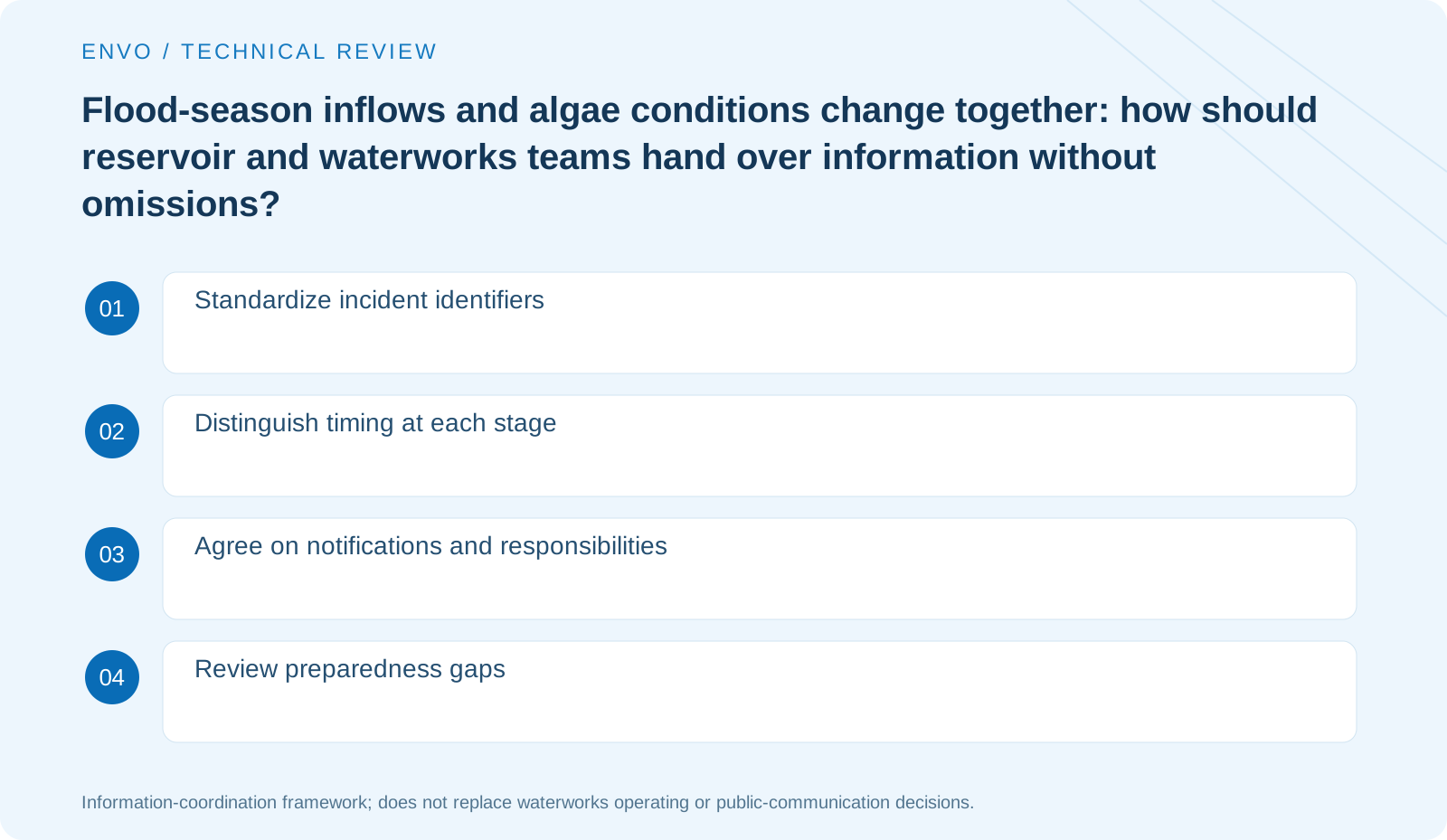
Assign a shared incident identifier
Record when an event was first observed, its location and the information source, linking photographs, incoming-water descriptions and treatment-plant inlet data under one identifier. Identical software is unnecessary; shared fields can be used initially. Preserve unverified information as an observation or pending verification so it does not become a confirmed test conclusion as it passes through reporting levels. The event identifier supports traceability and does not establish algal species, toxins or treatment risks.
Separate source-side and plant-side timing
Record reservoir observation time, water sampling time, laboratory report time and the time the plant receives information separately. Samples undergo transport and analysis; the report date is not the start date of a water-quality change. The plant should also record abstraction and process operating conditions at the time. A shared timeline helps parties distinguish comparable data from background information, reducing errors from using delayed results to explain current supply conditions.
Agree in advance on notification recipients and follow-up actions
EPA’s public-water-system cyanotoxin tools treat preparation, monitoring, treatment and communication as connected tasks. For this project, management can determine in advance what information triggers notification, which responsible people must be notified, who arranges follow-up checks and how responses are recorded. Notification is not an instruction for everyone to stop supply or change chemicals; authorized personnel make decisions under local procedures. Procurement teams need defined tasks and documentation gaps, not unverified risk rumors.
Use incident closure to inform future preparedness
After the incident, review information gaps, test-response times, consumable availability and contact validity. Retain useful fields as the next incident’s template and simplify repetitive reports that do not help decisions. When replenishing chemicals or test consumables, specify the actual treatment task and established technical conditions rather than making one product the permanent default because of a single incident. Clear handovers reduce decision delays but do not replace site testing or professional judgment.
Explore further
Can a notice describe a suspected bloom as confirmed toxin detection?
No. Express the evidence status of observation, identification and toxin testing separately.
Must the same data be copied repeatedly for different departments?
Use a shared event identifier to link original records, reducing transcription errors while making each party’s receipt and handling status clear.
References
This article draws on publicly available technical information. Third-party sources do not establish ENVO product approvals, field testing or project experience. Confirm each use against actual supply documents and site conditions.