

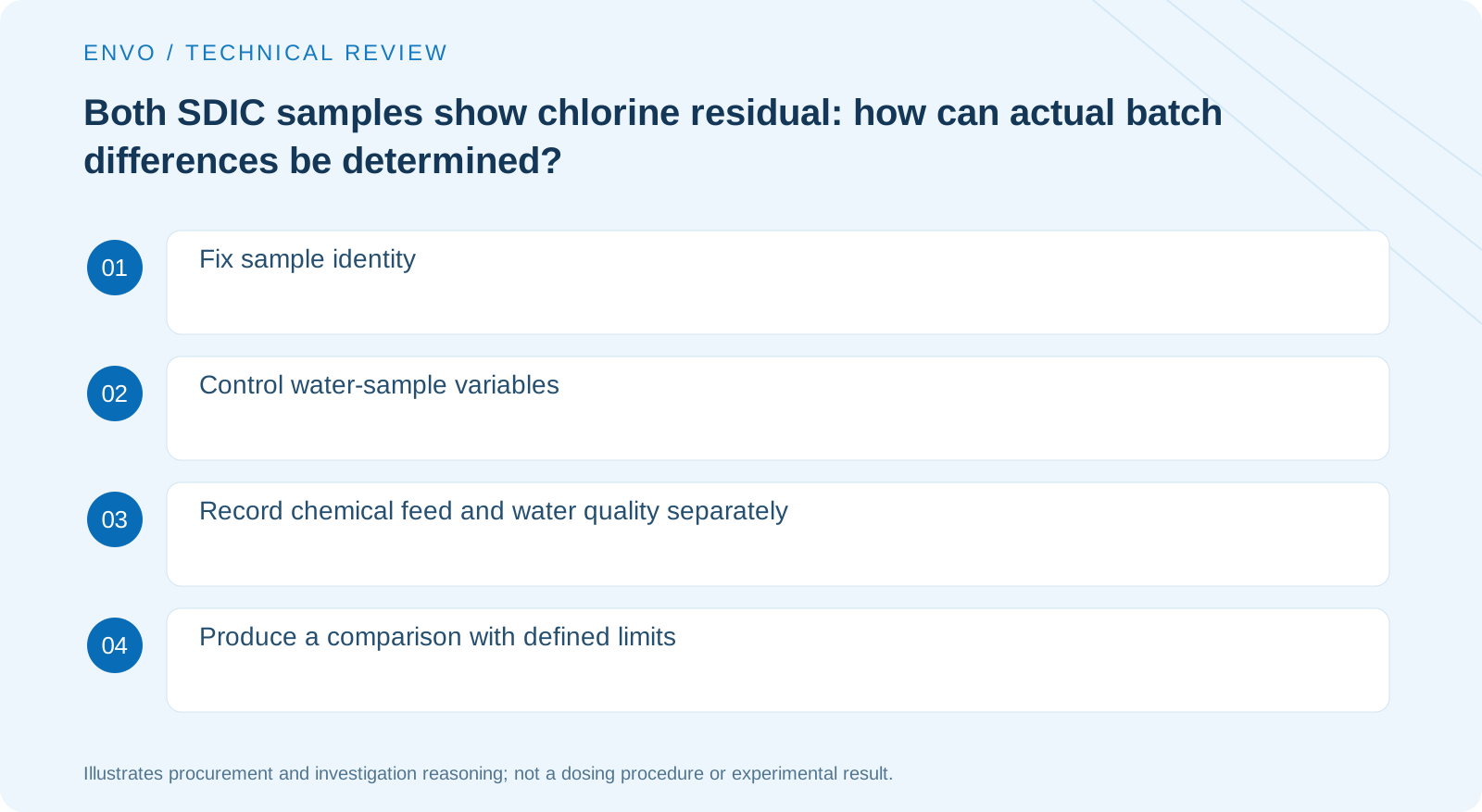
First ensure the comparison concerns the same items
Identify each sample’s hydration form, formulated-product model, dosage form and batch. Comparisons are meaningful only when intended uses align. Describe raw-material granules separately from tablets containing excipients; faster dissolution is not a complete quality conclusion. Where equipment is required, include permitted dosage forms in trial limits rather than changing the original task to accommodate a sample.
Separate water-sample variation from product differences
Compare water samples from the same source and sampling period, stored under the plan, recording temperature, pH, turbidity and treatment demand. Differences between tests on different dates or sources may reflect chlorine demand rather than material. Define observation times and analytical methods before comparison; do not change endpoints after seeing a favorable result.
Record dosing behavior separately from water quality results
Dissolution or feeder observations should record undissolved material, delivery stability and equipment condition; water-quality records should cover relevant residuals and target-microbe evidence. The two are related but not interchangeable. CDC pool guidance notes that disinfection also depends on water quality and target pathogens; detectable residual chlorine does not establish completion of every treatment objective.
Use a discrepancy list rather than a single winner-or-loser conclusion
Reports can list matches, differences, unresolved items and conditions for the next review. If material criteria match but equipment trials are insufficient, leave equipment conclusions pending; consistent differences in identical water warrant retests and batch evidence. Send these records with the intended use to support discussion of substitution, samples or further validation.
Use a results matrix to avoid selecting only the best result
Retain initial water quality, treatment conditions, relevant residuals and endpoint tests for each sample, distinguishing repeat tests from tests on different water samples. A sample that performs better only in clear water with a low treatment load should not be ranked best for every application. Group results by target operating conditions so buyers can see where advantages occur and which conditions remain unverified. Explain anomalous and invalid test data rather than deleting them and showing only the best curves. Assessing actual operating costs also requires information on site equipment, packaging, delivery and maintenance; a laboratory comparison of activity cannot establish economics on its own. Where chlorine residual results appear identical, first confirm that the measurement basis and timing match before discussing differences in performance. Otherwise, a seemingly fair comparison may actually compare entirely different conditions.
Explore further
Can a single beaker trial represent long-term operation with the entire batch?
No. It supports judgments only for the specified water samples and observation conditions; appropriate batch and field validation are still needed.
Do identical chlorine residuals prove that two dosage forms are equivalent?
No. Observation time, chemical feeding, target water quality, and the intended uses of the equipment and formulation must also be considered.
References
This article draws on publicly available technical information. Third-party sources do not establish ENVO product approvals, field testing or project experience. Confirm each use against actual supply documents and site conditions.