

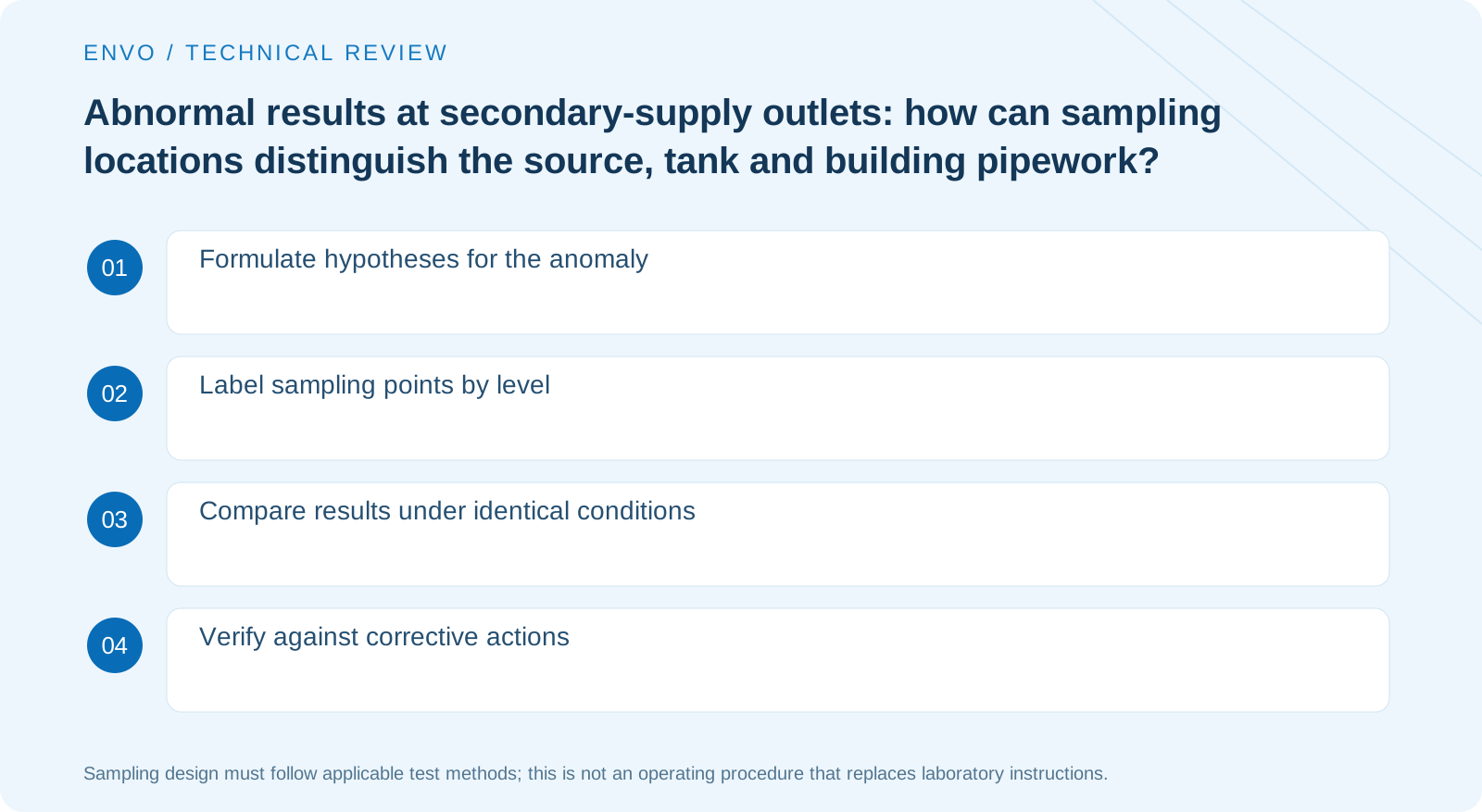
First define the hypothesis to be tested
Is the concern changed incoming water, uncontrolled storage or a stagnant branch? Identify locations needed to support or exclude each explanation. Do not collect arbitrary samples first and invent a narrative afterward. Qualified personnel should design sampling under applicable methods. The layered diagram suggested here communicates scope and cannot replace formal sampling procedures or laboratory requirements.
Retain sampling conditions to avoid invalid comparisons
Record outlet identity, use state, time, relevant water quality and sampling method. Outlet treatment or flushing before sampling affects what the sample represents and must follow and be recorded under the established method. Comparing samples with different purposes or preparation may misidentify sampling differences as tank or piping faults and lead to repairs in the wrong place.
Look for consistency across space and time
Arrange anomalous results upstream to downstream alongside tank maintenance, supply interruptions and low-use records. Simultaneous branch changes suggest checking shared upstream sections; localized changes suggest checking local use and components. These are investigative leads, not proof of pathogen origin. CDC building-water guidance emphasizes management of the entire circuit rather than isolated measures.
Use the same logic for corrective action and verification
Clarify whether corrective work concerns container hygiene, valve flow paths, terminal components or treatment control. Afterward, retain a sampling design capable of testing the original hypothesis and assess restoration under the management plan. Technical inquiries can include deidentified process and testing records rather than one abnormal value alone. Preserving location and conditions gives subsequent supply or maintenance recommendations a verifiable objective.
Link verification data to the items being corrected
If corrective action concerns a particular terminal component, the verification report should identify its corresponding sampling location and prior issue records. If it concerns a tank, identify who determines the downstream assessment scope. This mapping can be attached to the work order without creating a large separate system. Without location mapping, a normal report can easily be used to explain unrelated corrective work. Retaining a cross-reference between old locations and new identifiers during handover also reduces the risk of losing historical context when personnel change.
Explore further
Does inlet compliance establish compliance throughout the building?
This cannot be assumed automatically. Building storage and distribution and endpoint equipment each need their own management and validation.
Must every tap be tested?
The number and locations depend on risk, use and a professional sampling plan. The key is that samples answer a clearly defined question.
References
This article draws on publicly available technical information. Third-party sources do not establish ENVO product approvals, field testing or project experience. Confirm each use against actual supply documents and site conditions.