

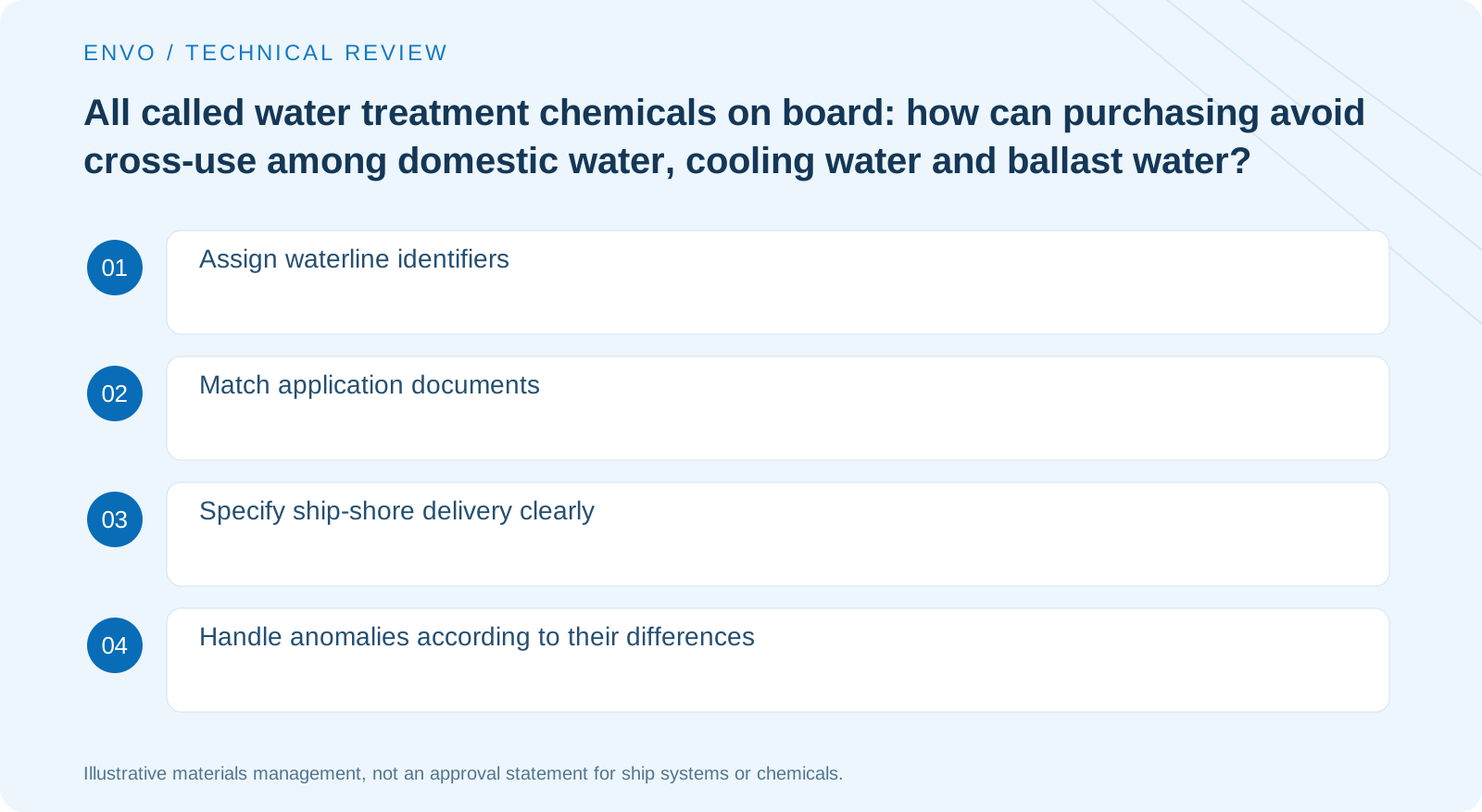
Use waterline identifiers instead of vague department names
Assign separate identifiers to domestic-water, seawater-cooling, ballast-water and wastewater needs, with the ship providing corresponding equipment or piping descriptions. Centralized procurement by the engineering department does not mean these uses can share one formulated product. Material codes may retain familiar commercial names, but notes should identify the intended water circuit. For temporary replenishment, especially record whether the substitution concerns an inventory code or a specific equipment-approved material so similar names do not imply interchangeability.
Update document requirements with changes in use
WHO’s Guide to Ship Sanitation addresses the complete domestic-water supply chain, whereas IMO ballast-water documents concern a different type of system management. Document review therefore needs a defined use context. For domestic water, request information relevant to drinking-water contact; for cooling-water fouling control, review equipment, materials and discharge limits; for ballast water, have the system provider confirm specific supporting requirements. No single certificate set is a universal authorization for every shipboard water circuit, and general supplier export experience is not approval for marine use.
Include ship-shore delivery information in the order
Alongside vessel name, port and delivery window, record package identifiers, intended storage location, receiving contact and the ship-approved material description. Use labels and lists that actual personnel can distinguish by application, reducing reliance on appearance after delivery. If English names or abbreviations resemble one another, show complete chemical identities or product models together and retain versions and confirmations. Do not relabel an old product for another use to resolve a material mismatch.
Investigate material discrepancies before deciding on acceptance
When a delivery differs from the order, separate discrepancies in name, specification, use documentation, packaging and equipment compatibility instead of asking only whether it can be used. Photograph unopened labels and compare them with the order and equipment manufacturer’s requirements; the responsible shipboard personnel should decide how to proceed. Suppliers must explain actual differences and outstanding checks rather than relying on visual similarity. This coding and handover approach also improves traceability at the next port and reduces confusion between purchasing histories for different water circuits.
Retain the link between old codes and new orders
When changing an internal material code, record the old code, reason and corresponding documents so agents do not repeat an incorrect purchase from a historical order. Code mapping supports traceability but does not establish that old and new formulated products have passed a technical-equivalence review.
Explore further
Can one supplier provide products for different shipboard water circuits?
They can be discussed separately, but each formulation and use still needs its own matching documentation and equipment requirements.
Does centralized purchasing imply one chemical for all uses?
No. Centralized management can use one form, but materials and approval boundaries must remain distinct for each water circuit.
References
This article draws on publicly available technical information. Third-party sources do not establish ENVO product approvals, field testing or project experience. Confirm each use against actual supply documents and site conditions.