

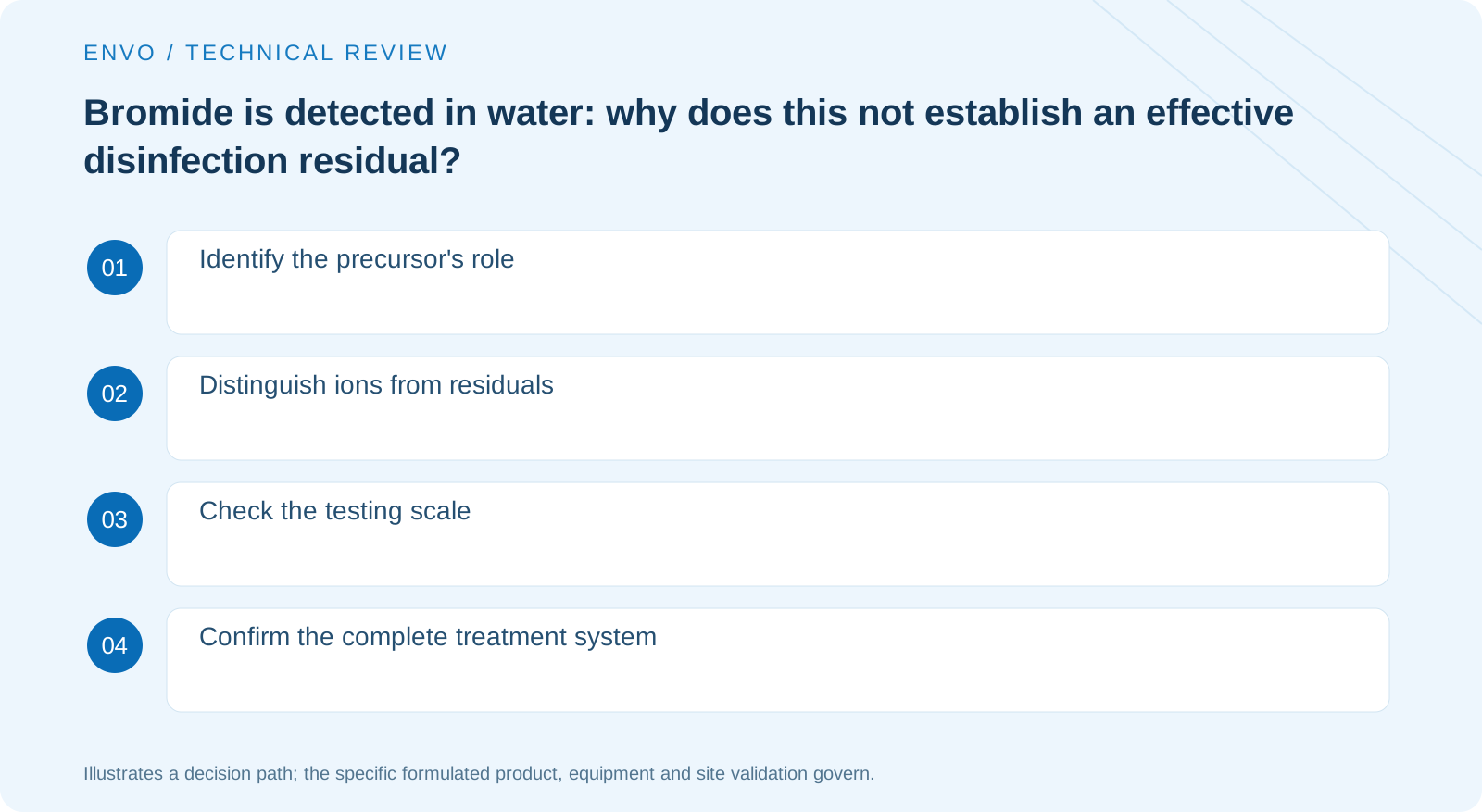
Start with the product’s role in the system
Procurement requirements should state the designed water-treatment system that sodium bromide will enter rather than treating the raw material name as a final formulated disinfectant. ICL’s historical label example shows explicit use boundaries as part of a specific product, but does not establish current authorization for any arbitrary supply batch.
Distinguish the two testing questions
Total bromide analysis measures the relevant ions in water, while operational residual testing should be selected according to the system’s instructions. These reports are not interchangeable. Entering a result in a residual-control table merely because it contains the word ‘bromine’ may falsely suggest to operators that treatment is complete.
Check the instrument scale and method
Some chlorine and bromine tests use similar color-development principles, but their scales and result expressions differ. Taylor’s official FAQ cautions that the two readings must be distinguished. Interpret results according to the instrument and formulated-product instructions; do not relabel one unit as another or decide product suitability from the instrument’s color alone.
Make completeness of the treatment system a prerequisite for selection
If equipment, supporting procedures and use documents are not clearly identified, complete the system information before buying precursors. This article provides no activation or on-site preparation guidance. Check pools, spas and industrial circuits separately; a historical label for one application cannot cover every water environment.
Information to bring to a troubleshooting review
Provide raw-material labels, current system name, instrument models, reagent codes, units and point photographs so specialists identify the measurand first. Split records combining ionic content and disinfectant residual into separate fields and review historical entries. Clear targets establish a reliable basis for trends and product changes.
Identify what each test measures on the process flow diagram
Label raw-material input, system operation and final water samples separately, stating the chemical species actually measured at each stage. Raw-material content, bromide-ion results and oxidizing residual answer different questions and cannot be placed in one column as a trend. Where a report uses only abbreviations, confirm the full names and result-expression basis with the testing party before interpreting it.
Demonstrating final water-environment control also requires corresponding microbial or use assessment; detecting elemental bromine alone is insufficient. Analytical conclusions should distinguish raw-material identity, operating data and evidence of actual suitability. This converts the vague statement ‘contains bromine’ into specific questions for system and testing personnel.
Explore further
Is sodium bromide itself a complete disinfection program ready for direct operation?
No. Check the complete treatment system and formulated-product use.
Can a chlorine-scale result be reported directly as bromine?
No. Interpret it using the corresponding test method and scale.
References
This article draws on publicly available technical information. Third-party sources do not establish ENVO product approvals, field testing or project experience. Confirm each use against actual supply documents and site conditions.