

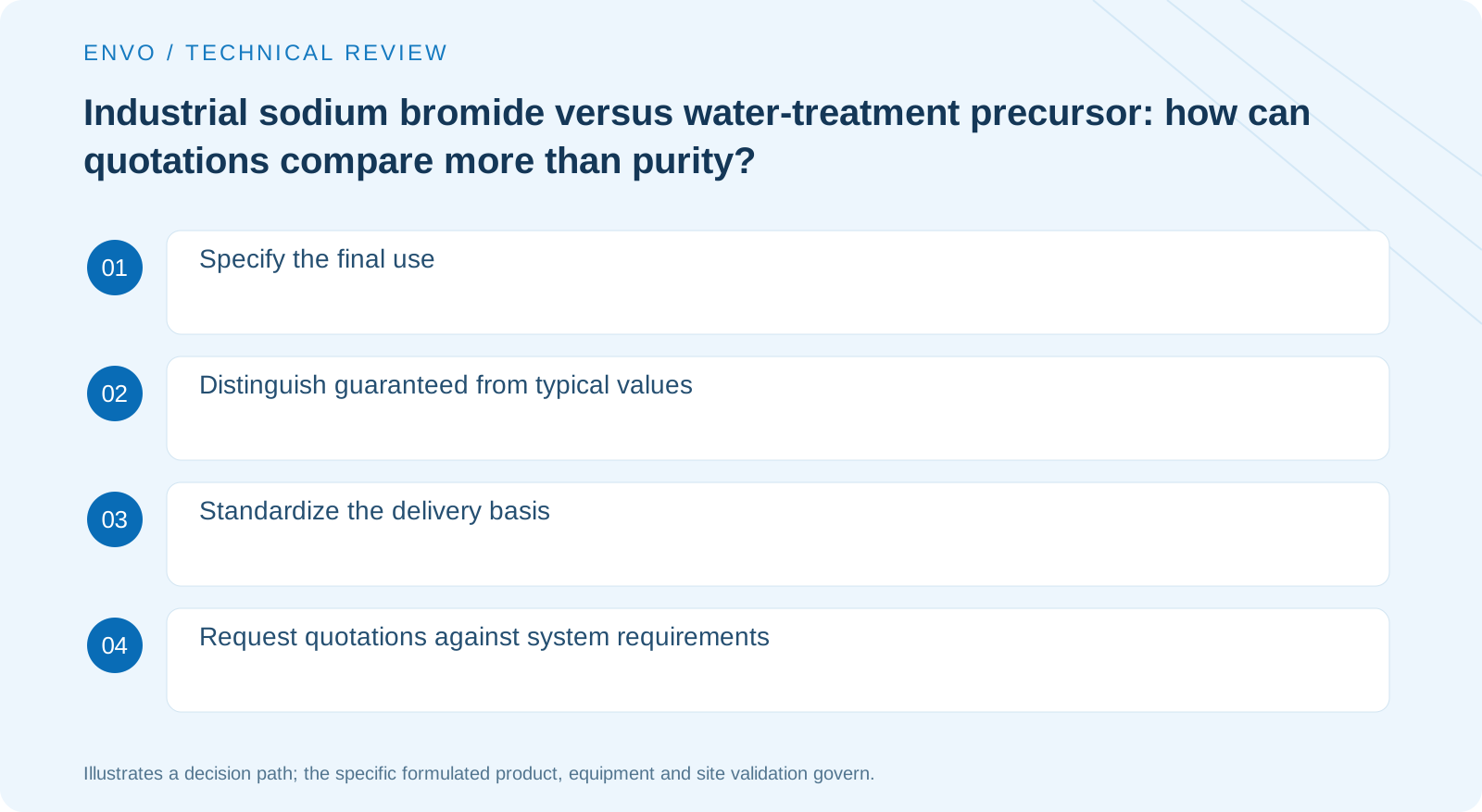
First specify the final aquatic environment
Distinguish industrial recirculating water, pools and other evidence-supported uses, explaining the supporting system into which the raw material enters. Documentation and impurity priorities may differ among applications. A supplier receiving only ‘high-purity NaBr’ may not know which documentation the project needs.
Separate guaranteed parameters from typical values
Mark main-component content, impurities, moisture and other quoted parameters as guaranteed values, test results or reference values. Typical values are not batch guarantees, and an unlisted parameter is not necessarily compliant with equipment requirements. The goal is verifiable specifications, not the most attractive percentages.
Confirm physical form and receiving arrangements
Solid and liquid forms differ in metering, packaging and site receiving, and concentration expressions must be consistent. Do not compare prices per unit mass and per unit volume directly while ignoring delivered concentration. Confirm net weight and packaging from actual supply information rather than online photographs.
Check the application and formulated-product identity
Public historical labels help identify items to check but do not replace current documents for the relevant product, region and use. Supply-chain raw-material identity and end-product approval are separate forms of evidence and should be recorded separately in purchasing tables.
A field sequence suitable for quotation requests
Arrange requirements as system/use, full name, supplied form, main-content basis, key impurities, batch methods, packaging and document scope. Ask suppliers to complete each field and identify unguaranteed items. Technical teams can assess suitability before commercial comparison, avoiding renegotiation after prices are agreed but documentation is missing.
Identify actual specification differences through quotations on the same basis
Alongside price, the quotation table should record delivery form, main-component assay basis, important impurities, package quantities, testing and use documentation. Mark unprovided items as gaps; do not insert common industry values as though they were product guarantees. Explain price differences caused by packaging or delivery separately from differences in chemical specifications.
Ask suppliers which information applies to proposed batches and which is typical product data. A candidate with only generic industrial evidence and another with system approval can be compared for evidence completeness rather than numerical purity alone. Actual system needs should determine final specifications, not the highest percentage in a table.
Explore further
Is analytical grade necessarily more suitable for water treatment?
A grade name cannot replace system-use and impurity requirements.
Can a historical label serve as current supply approval?
No. It must apply to the current formulated product and region of use.
References
This article draws on publicly available technical information. Third-party sources do not establish ENVO product approvals, field testing or project experience. Confirm each use against actual supply documents and site conditions.