

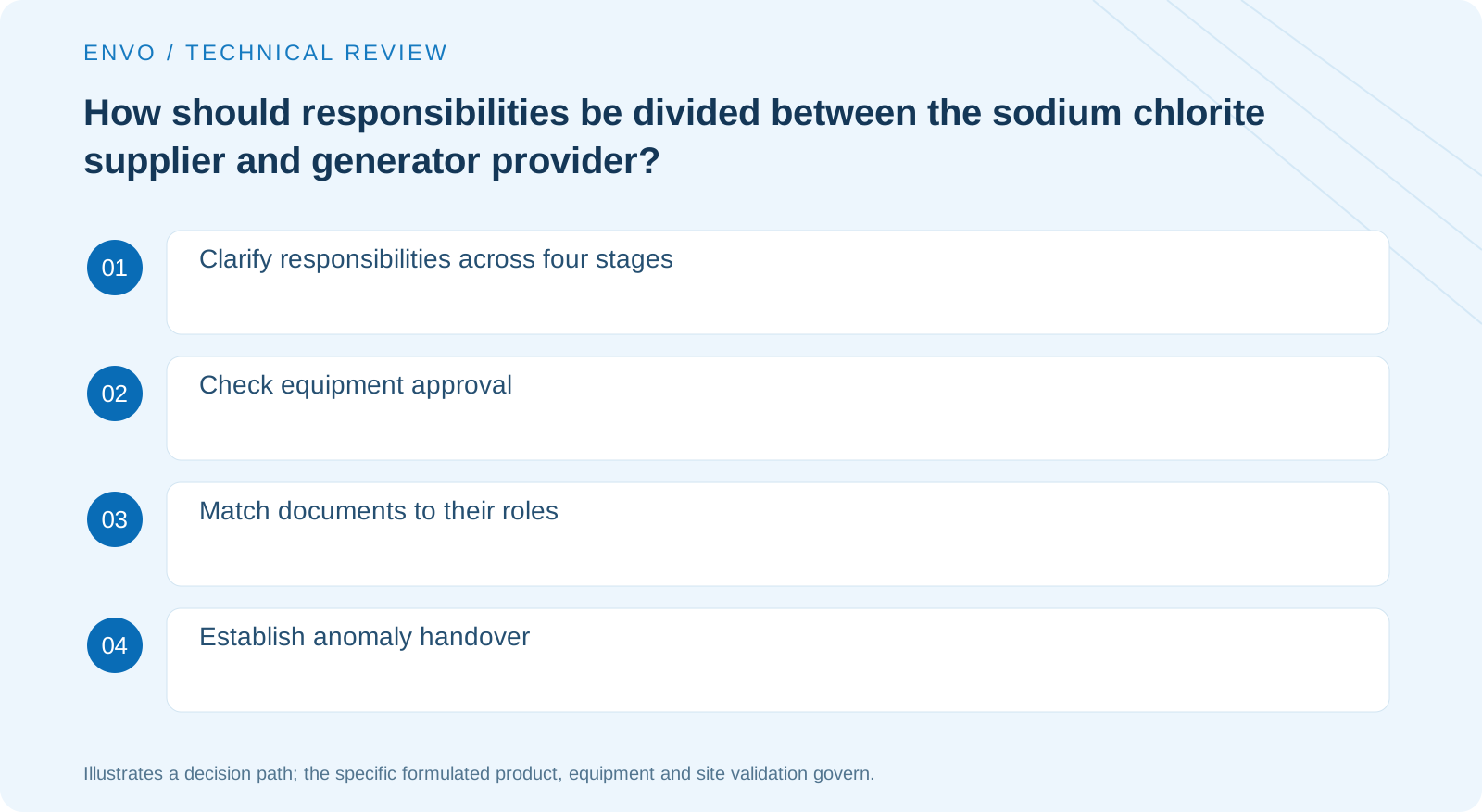
Divide the purchasing scope into four parts
List raw material delivery, equipment operation, generated-product quality and final water use separately. Raw material suppliers generally provide composition and safety documents; equipment suppliers define approved specifications and procedures; final water quality also requires operating and use-related validation. Contracts may allocate responsibility, but the documentation must not leave gaps between parties.
Obtain equipment approval before purchasing in bulk
Send the equipment model and raw material specifications to the supplier to confirm product coverage. Common chemical-market specifications cannot replace equipment specifications. Even good-quality raw material can create additional delivery problems if its form or packaging does not suit site receiving arrangements.
Distinguish what each document establishes
A COA addresses batch quality, an SDS addresses safety information, and an equipment manual defines compatibility and operating limits. None alone establishes effective disinfection of the final water. Third-party equipment or raw-material documentation must not be represented as ENVO project certification.
Define how anomalies are communicated
Agree on who receives reports of raw material nonconformity, equipment alarms and generated-product abnormalities, and what records and samples are required. First preserve evidence and follow site procedures rather than continuing to change raw materials and procedures before the problem is understood, making traceability difficult.
Practical issues the handover meeting should resolve
Confirm who retains raw-material samples, supplies equipment-permitted impurity lists, validates product analysis, authorizes final-water restoration and maintains current documents. Assign specific responsibilities and records rather than write manufacturer responsible. Resolve unassigned tasks before agreeing supply to reduce later disputes.
Use a question list to confirm supply boundaries
At the handover meeting, answer each question: Who approves the raw material specification? Who confirms equipment contact materials? Who tests the generated product? Who authorizes release of the final water for use? Who handles abnormal batches? Support every answer with a document or a clear assignment of responsibility; ‘the supplier handles the entire package’ should not obscure the technical scope. Even if one organization performs several roles, specify the acceptance evidence for each separately.
If a raw-material supplier provides only a COA and equipment provider only operating records, confirm whether batch and time link them. Without that link, the output quality from that material under those conditions cannot be established. Agree identifiers and recording methods before purchasing rather than reconstruct chat histories after disputes.
Explore further
Does purchasing compliant raw materials complete the disinfection solution?
No. Equipment, generated product and final use also require validation.
Who should provide permitted raw-material specifications?
Use specific equipment requirements as the basis and align each item with the supplier’s product.
References
This article draws on publicly available technical information. Third-party sources do not establish ENVO product approvals, field testing or project experience. Confirm each use against actual supply documents and site conditions.