

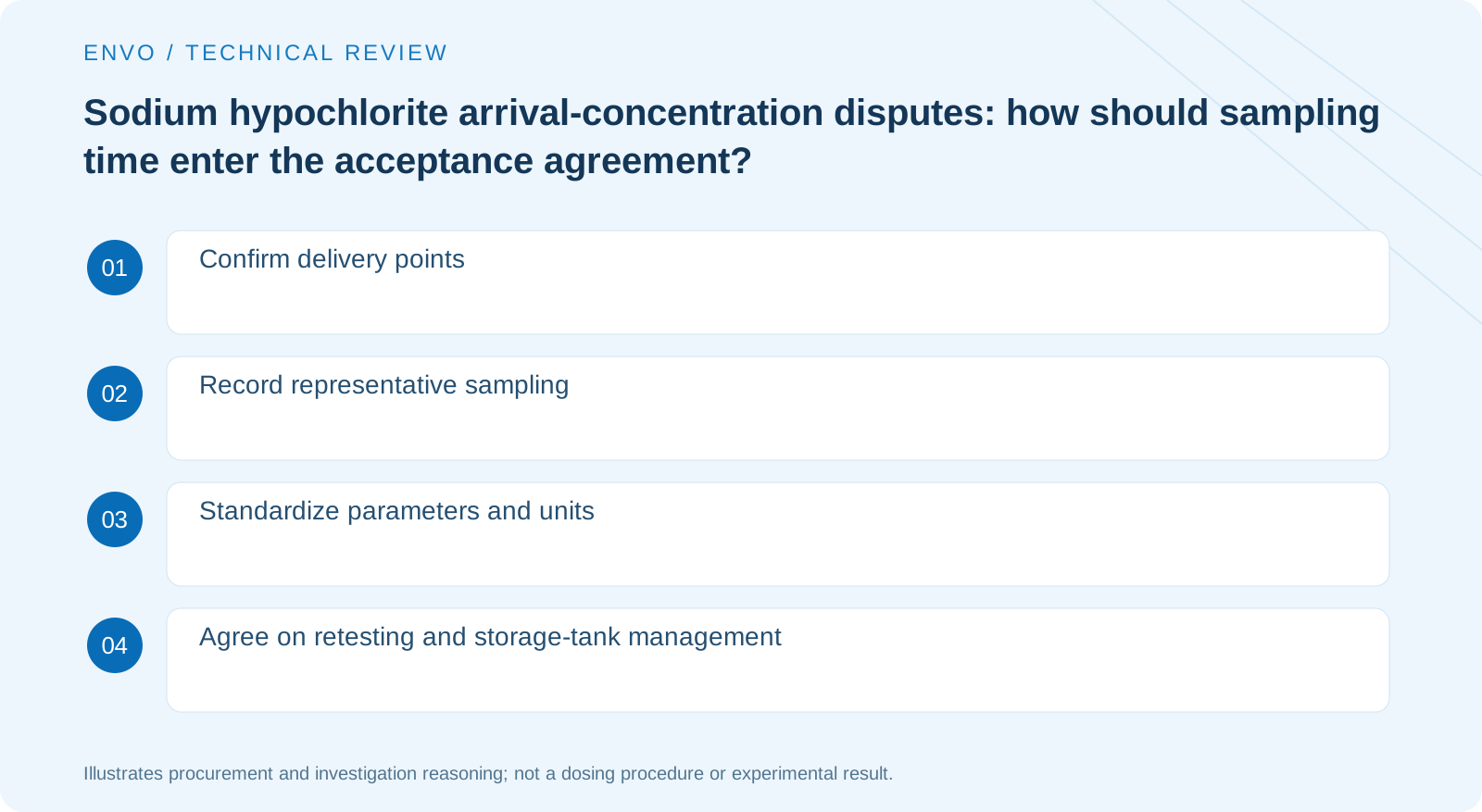
Distinguish responsibilities at the three time points
Factory tests describe production-release condition, receipt tests describe the delivery stage, and post-storage retests guide site management. Recording all three stages reduces misunderstandings caused by different report dates. Typical supplier parameters are not delivery guarantees, and contracts should not assume every day of service remains identical to the factory value.
Sampling records matter more than an isolated numerical result
Agree who samples, where, with which compatible container, and how samples are sealed, identified and submitted; the testing organization and safety requirements determine detailed procedures. Record vehicle or container number, batch, collection time and handover. Do not use a tank sample after blending to assess one truckload. If new material has mixed with old stock, disclose this rather than attributing every test difference to the new batch.
Standardize the content basis and method
Specify whether the report measures sodium hypochlorite or available chlorine, its mass or volume basis, and whether density and temperature enter conversions. Different units cannot be compared by number alone. ATSDR describes sodium hypochlorite as typically aqueous; color is not a concentration measurement, and darker appearance cannot replace valid analysis.
Define practical response steps for anomalies
Agree retesting organizations, retained-sample checks and anomalous-batch procedures, preserving transport and storage conditions. Monitor site tank turnover separately so changed material is not used under an obsolete concentration assumption. Inquiries should state transport distance, expected turnover and delivery acceptance, aligning quality-guarantee boundaries before price and batch-size discussions.
Give disputed samples a shared reference time
The contract can specify the delivery stage at which specifications apply and define sample identification, retention and verification procedures. A production report, a sample taken at receipt and a stock sample taken one week later are not inherently equivalent; retain dates and conditions separately. If buyer and seller results differ, first check sample and method equivalence before deciding whether a real change occurred. Do not compare only one figure on each report’s front page. Disclose gaps in transport, receipt and storage records honestly, rather than retrospectively estimating an exact degradation amount to correct results. For ongoing supply, agreed dispute-resolution timing and methods often reduce disagreements more effectively than repeatedly raising the initial specification on paper. Every verification conclusion must relate to the actual batch; a conforming replacement batch report cannot erase the original dispute.
Explore further
Is receipt inspection unnecessary if the delivery note states the concentration?
Determine acceptance procedures according to purchasing agreements and use requirements. A delivery note cannot replace agreed test evidence.
Can color be used to compare concentrations in two tanker loads?
Do not do this. Color is affected by multiple factors; measurement requires an applicable analytical method.
References
This article draws on publicly available technical information. Third-party sources do not establish ENVO product approvals, field testing or project experience. Confirm each use against actual supply documents and site conditions.