

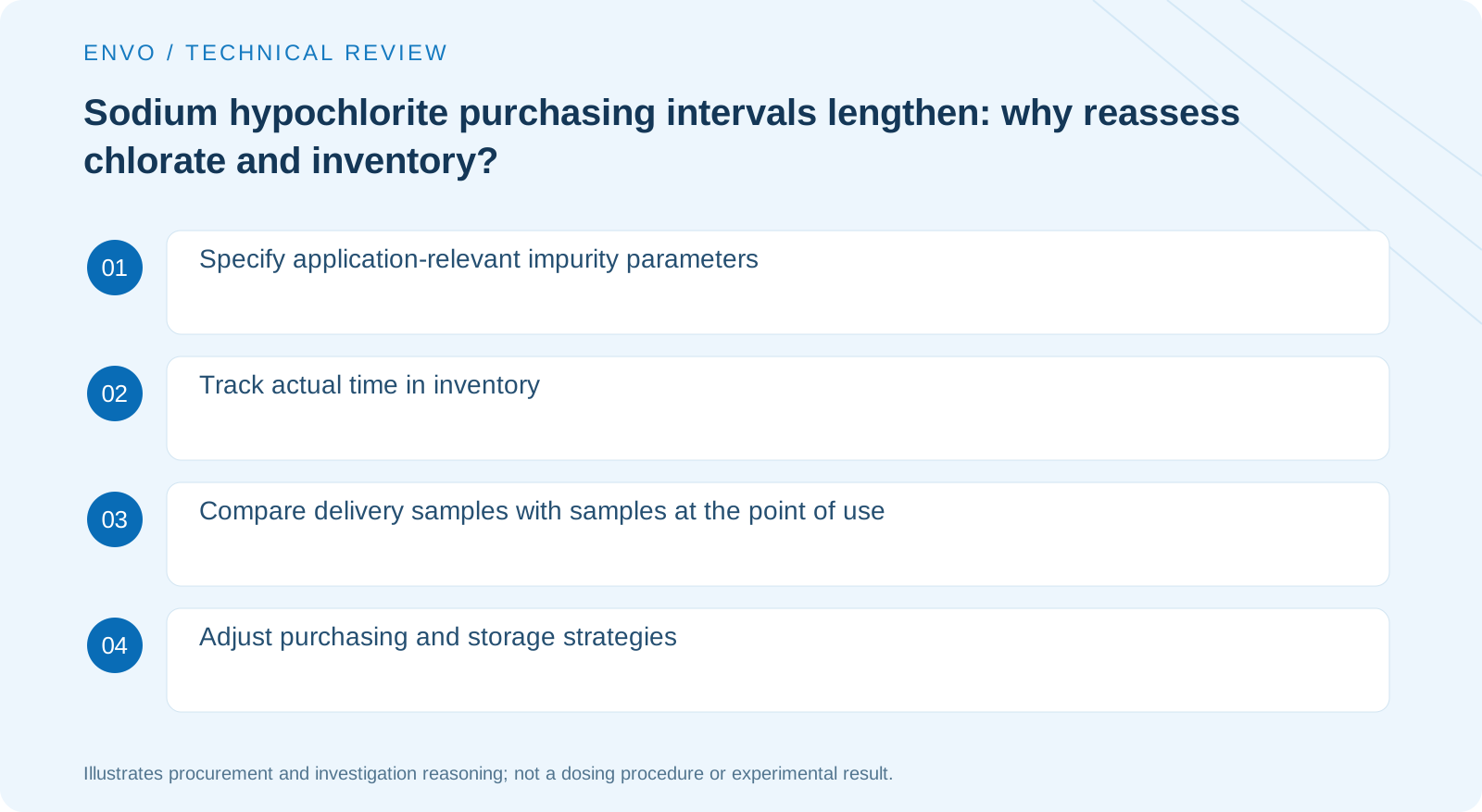
First establish final water-use requirements
Drinking-water, food-process and general industrial-water uses have different impurity-control requirements; define tests from the actual use. EPA’s chlorate technical-support document helps explain the technical background but does not replace current destination standards or specific product requirements. Buyers should obtain a process- or quality-approved checklist rather than copy another country’s limits into contracts independently.
Make inventory age a recorded data field
Record each batch’s receipt, tank entry and depletion dates, mixed-batch situations, storage temperature and light controls. Average turnover can conceal long-retained tank-bottom material; assess actual renewal against facilities and operation. Cleaning and modifications must follow relevant procedures. The aim here is to identify data gaps, not provide tank-operating instructions.
Schedule testing to match the purchasing cycle
Technical and testing personnel can compare samples at delivery and during the planned use period, recording active-ingredient content and impurities requiring control separately. Check whether the methods suit the concentration and water sample, and identify the sampling stage in the report. Even if active-ingredient content remains acceptable, a product cannot be accepted solely because it ‘still contains chlorine’ when an impurity fails the requirements for its intended use.
Address findings through inventory-turnover strategy
Review may support staged deliveries, changed batch sizes, improved storage or additional in-use validation, based on measurements and site conditions. Do not make unconditional claims that higher concentration is cheaper or lower concentration more stable. Specify delivery quality, expected use timing and application-related impurity requirements together to obtain a more complete quotation.
Use the distribution of inventory ages to plan purchasing
Total inventory alone does not describe how stock is managed. Record production, arrival, opening and expected use dates separately for each batch to establish a batch timeline. The quality manager should determine the reviews needed for stock held for a long time or under uncertain conditions. Discussions of chlorate should cite applicable technical and target-market requirements, rather than extracting a number from a historical technical document as a universal global standard. Comparisons between more frequent deliveries and bulk purchasing must include actual logistics and management conditions; smaller batches cannot simply be promised to eliminate every risk. Continue retaining quality and operating data after changing the purchasing schedule to verify whether the change resolves the original issue. Explain to customers that inventory management is one control condition and cannot independently replace a complete review of manufacture, transport, testing and the actual disinfection objective.
Explore further
Is chlorate caused only by storage?
Do not attribute it solely to one cause; investigate actual raw material, production, storage, transport and water-treatment information together.
Does compliant available chlorine mean suitability for every use?
No. Specific uses may also require impurity control and checks of formulated-product labels and application documents.
References
This article draws on publicly available technical information. Third-party sources do not establish ENVO product approvals, field testing or project experience. Confirm each use against actual supply documents and site conditions.