

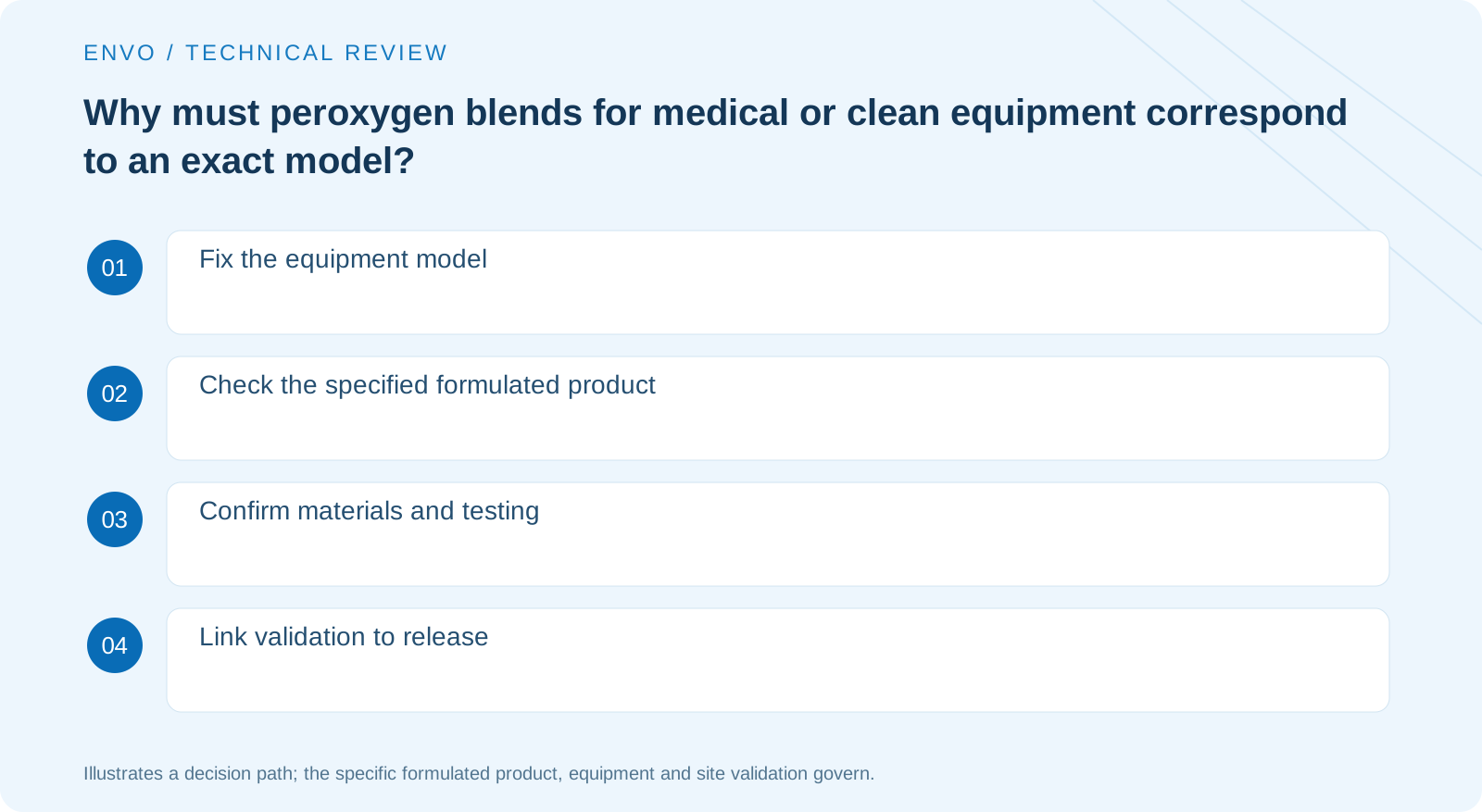
First define requirements from the equipment’s use
Identify the equipment manufacturer, model and treatment section, specifying whether the task is water-line maintenance, tank hygiene or another defined procedure. CDC dental and dialysis materials emphasize the respective systems’ water-quality and management requirements, showing that ‘medical water’ is not a single universal condition.
Distinguish an active ingredient from an approved formulated product
Equipment may permit a particular commercial formulation and procedure rather than any raw material with the same ingredient. Check the manual version corresponding to the product name, concentration expression and use scope. Without exact formulated-product evidence, do not infer equipment approval from an industrial-grade TDS.
Check materials and supporting testing arrangements
Beyond the main equipment, consider seals, piping and sensors, and whether residual-test reagents cover the formulation. Seemingly similar oxidation systems may contain different excipients and stabilizers, so substitution cannot be based solely on active-ingredient percentages.
Link purchasing and release through a complete verification process
Record the formulated-product batch number, equipment procedure documents, validation information and release responsibility. Qualified specialists must carry out actual use under equipment and quality requirements. If documentation is incomplete, obtain the missing model and procedure evidence rather than borrowing generic timing parameters from another application.
Match equipment approval documentation to the product being purchased
For each device, record model, materials or key components, software and procedure versions, consumables and disinfectant-document version. Unchanged hardware with upgraded procedures may make old instructions inadequate. If documents name only an active ingredient, clarify whether this means a specified complete product or a class of formulations requiring validation.
Mark supplier documents as directly covering, needing supplementation or not covering the use. A general waterline-cleaning trial does not cover dialysis, and dental-equipment compatibility does not approve pharmaceutical-water systems. Focus on contact targets, validation endpoints and return-to-use conditions rather than report length or prominent institutional names.
Put product codes in inquiries and orders before delivery and retain equipment-provider and user confirmations. Changes in auxiliaries, concentration or packaging require checks of procedures and metering. Procurement can coordinate closure, but verbal same-ingredient assurances cannot replace equipment approval or the end user’s validation responsibility.
Explore further
Can industrial peroxide raw material directly replace an equipment-specified formulation?
No. A judgment is possible only after equipment approval and validation conditions are clear.
Can dental and dialysis systems be assessed in the same way?
No. Follow equipment and respective water-use requirements separately.
References
This article draws on publicly available technical information. Third-party sources do not establish ENVO product approvals, field testing or project experience. Confirm each use against actual supply documents and site conditions.