

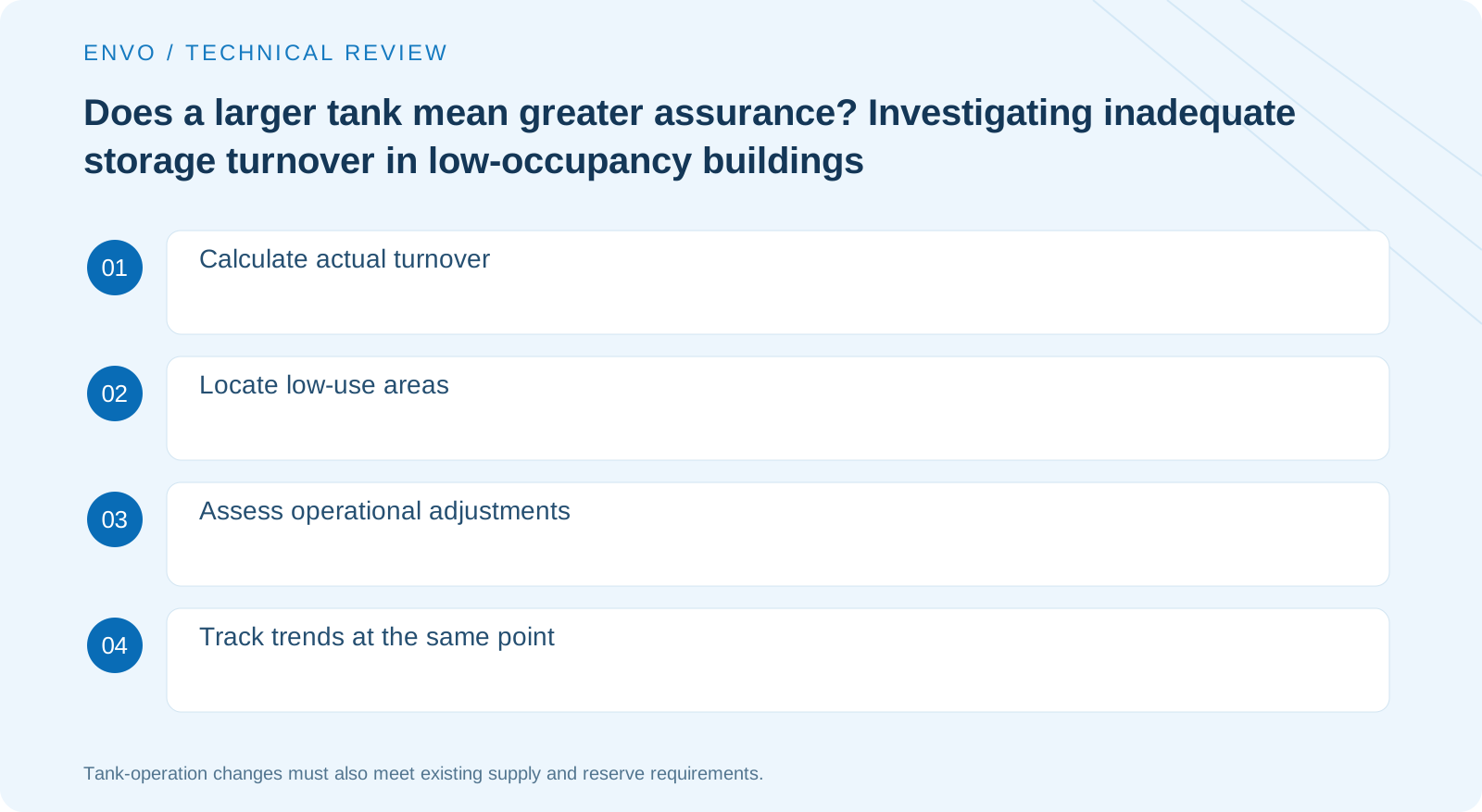
First establish the scope of actual turnover calculations
Compile effective storage volume, daily demand, replenishment method and tank-compartment operating status. Separately mark fire reserves or other storage that cannot be freely adjusted and domestic-water needs, with responsible personnel confirming constraints. Nominal total volume does not establish that all water turns over, and reserves should not be reduced independently. First identify water actually participating in daily exchange.
Look for evidence of localized stagnation
EPA water-age guidance links water age with residual consumption and other quality changes. Check low-use areas, tank compartments, standby lines and post-maintenance valve positions. Mapping temperature, residuals and usage to locations identifies problems better than averaging all readings. Refer compartments with persistently little turnover for joint design and operations assessment.
Treat operational changes as changes in operating conditions
Hotel low seasons, vacant offices and school holidays can make previously suitable arrangements inadequate. Identify planned closure areas, minimum-use periods and restart dates, clarifying continuing maintenance. One chemical replenishment cannot replace ongoing turnover management. Record approved changes in level, rotation, circulation or flushing while meeting supply and safety requirements.
Create a parameter table that supports ongoing verification
Record changes at fixed locations and comparable times, retaining before-and-after data rather than selecting the best moment. Inquiries should identify the affected storage unit, duration and actions already taken. Reframing procurement from ‘increase chemical strength’ to ‘support monitorable supply quality with the existing tanks’ gives proposal discussions clear boundaries.
Do not let building-wide averages conceal differences between zones
Retain identifiers for individual tank compartments or main zones in summary reports rather than reporting only average residual or water temperature. Averages may conceal differences between a frequently used zone and one kept on standby for a long time. The operations team can first select locations representative of known problems, maintain concise ongoing records, and then decide whether to expand the investigation. Procurement reviews should preserve these location differences to avoid treating a local management problem as a need to upgrade every chemical specification.
Explore further
Should the water tank simply be made smaller?
First check reserve requirements, design constraints and actual operation; the concept of water age alone does not justify direct modifications.
Will adding a circulation pump solve the problem?
Actual flow paths and operating performance must be confirmed. An equipment name alone does not establish renewal of water in every area.
References
This article draws on publicly available technical information. Third-party sources do not establish ENVO product approvals, field testing or project experience. Confirm each use against actual supply documents and site conditions.