

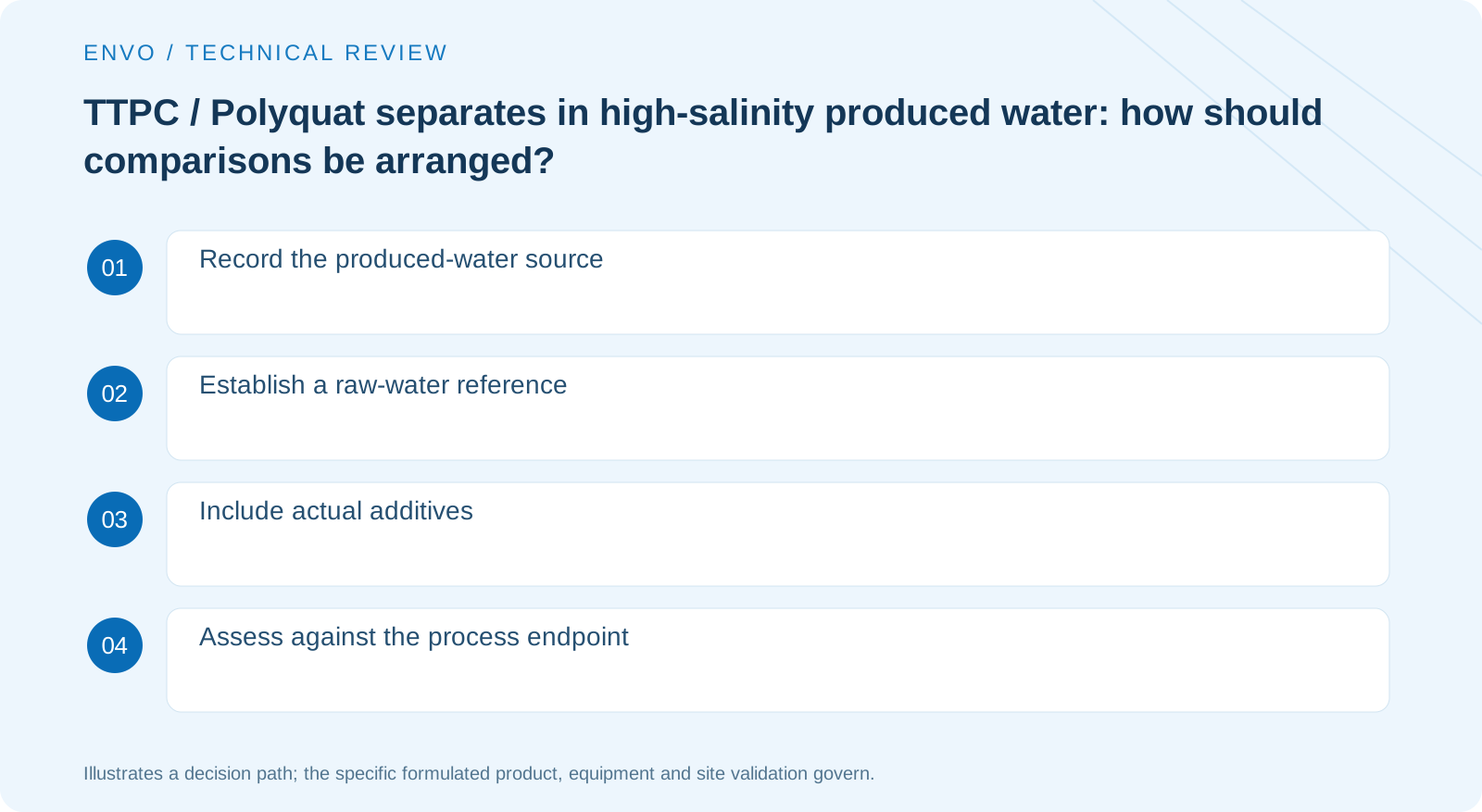
Confirm whether the sample represents the water requiring treatment
Record the producing well group, sampling date, oil content condition, salinity and treatment stage, stating whether filtration or water mixing occurred. Undisclosed pretreatment may change the subject of comparison. Samples from different well groups are not equivalent merely because their conductivity is the same.
Separate pre-existing stratification from new observations
First retain observations of untreated water at rest and under the existing procedure, then compare the complete candidate formulation. If the source water already emulsifies or stratifies, the test must explain additional changes caused by the new product. Do not show only a final clear bottle while omitting intermediate stages and deposits.
Include anionic additives in the discussion
TTPC/polymeric quaternary ammonium blends are candidates requiring verification of compatibility with cationic systems. Provide actual scale-inhibitor, friction-reducer and related additive information so the testing organization can design suitable conditions. A manufacturer’s claim of compatibility with common oilfield chemicals is not the same guarantee for every additive and brine.
Assess the significance of phase separation using process endpoints
Beyond appearance, assess the importance of abnormalities in relation to filtration, reinjection or fracturing-fluid function. Record microbiological results separately so improved phase stability does not conceal inadequate microbial control. Limit conclusions to the validated product, water sample and additive combination, stating what still requires checking before scale-up.
Which original conditions must high-salinity-water validation records retain?
Sample records can include source or well group, date, pretreatment, key quality, oil condition, existing additives and storage time. Identify filtration or settling before submission, which may make samples unrepresentative of the full site water. For mixed well groups, record actual sampling context rather than treating one day’s bottle as permanently stable water quality.
When interpreting phase separation, first ask whether the raw-water control also changed, then compare the full additive-system control with the candidate, and finally assess whether the change affects critical project functions. Without a raw-water control, changes introduced by the formulation are difficult to distinguish. Appearance alone, without process results, cannot establish whether a change is acceptable.
Trial conclusions should identify the applicable water samples and additive combinations and list conditions that may be exceeded on site. Reuse the same checklist when the well group or additives change instead of simply carrying forward the phrase ‘high-salinity compatible.’ For unexplained changes, first retain original samples and records rather than introducing new variables merely to obtain a clear appearance.
Explore further
Can the same trial conclusion be used whenever conductivity is identical?
No. Ionic composition, oil content and additives may differ.
Can validation be omitted if the manufacturer advertises compatibility?
No. The actual combination of fluids still requires confirmation.
References
This article draws on publicly available technical information. Third-party sources do not establish ENVO product approvals, field testing or project experience. Confirm each use against actual supply documents and site conditions.