

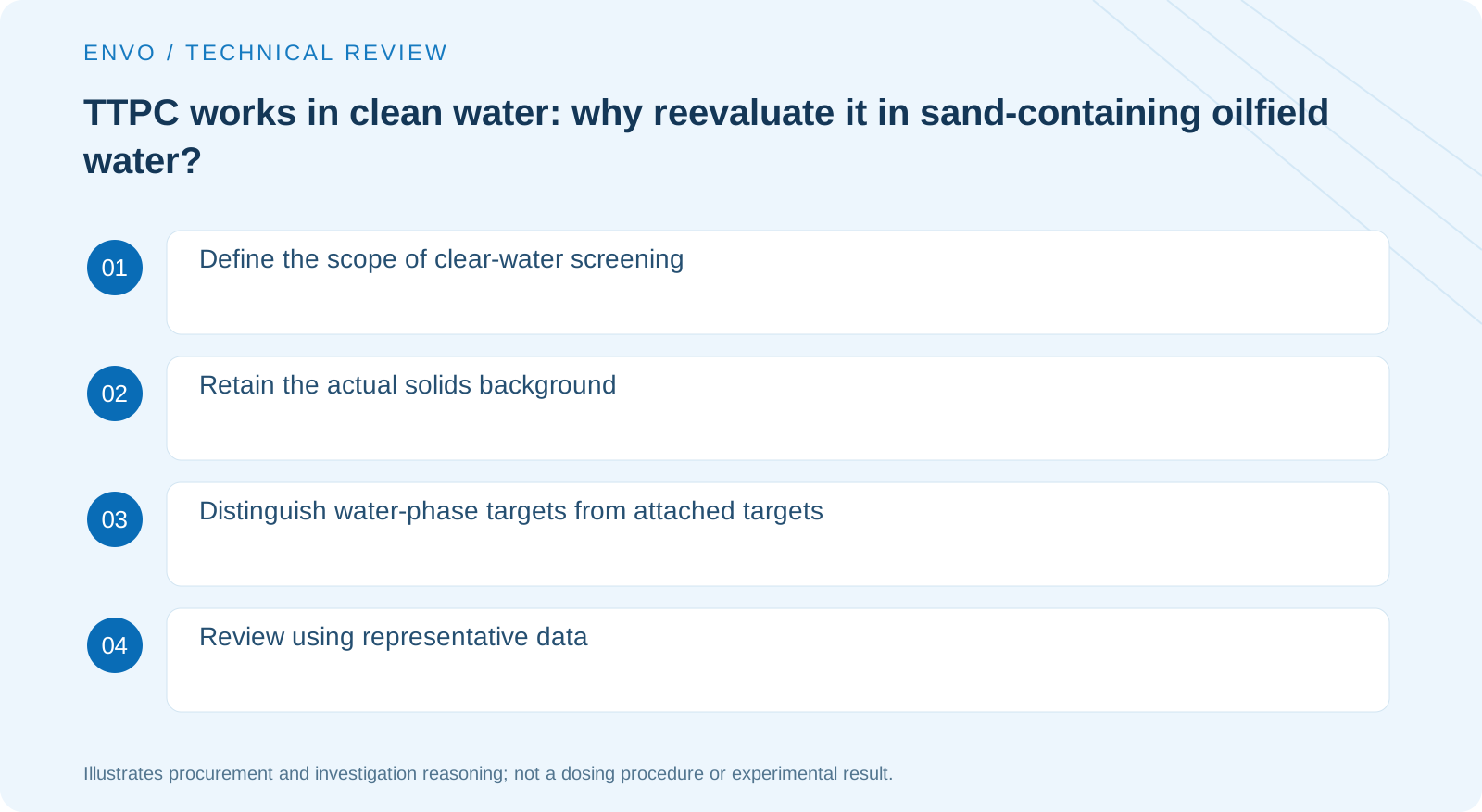
Confirm the questions addressed by clear-water screening
Clean-water trials support preliminary comparison but omit site salinity, suspended solids, oil and process additives. LANXESS energy-water-treatment information notes that surface-active biocides, including TTPC, may be affected by adsorption to solid surfaces. This supports validation in the actual matrix, not a fixed assumed loss percentage, and does not establish that every TTPC product is ineffective in sand-containing systems.
Include actual solids in the sample description
Record the sampled process, tests concerning solids properties and content, and sampling and storage conditions. Do not send only filtered clear liquid while requesting evaluation of the whole system. Test leaders should decide whether to retain the original sample, include controls or use staged testing according to the objective. Proppants or deposits from different sources are not interchangeable because they look alike; a sand photograph cannot establish surface properties or chemical effects.
Observe water-phase and attached contamination together
If site objectives include microbial control on pipe walls or solid surfaces, falling water-phase counts alone miss part of the problem. Select validation methods matching the objective and specify whether they measure suspended, attached or overall changes. Trials should also address interference from continued chemical action during sampling. Counts continuing to fall after collection cannot all be attributed to effects already achieved on site; sample-handling methods require corresponding validation.
Avoid concealing gaps in the explanation by increasing the dose
When clear-water and actual-water results differ, review samples, methods, formulations and operating conditions before simply raising the dose to obtain a desired result. Incomplete chemical identity, active-content basis or additive records may make further testing add cost without interpretable information. Candidate programs must follow specific labels and approved site procedures. This page provides no universal dose, contact time or mixing instructions.
Support purchasing decisions with representative data
Inquiries should provide process location, actual water background, principal solids, existing formulations and the specific problem to control. Require reports to distinguish experimental conditions, observations and extrapolation limits; one laboratory advantage cannot become a year-round site guarantee. For combinations needing further site confirmation, define the plan and responsibilities. These steps provide a basis for comparing supply reliability and technical support against project needs.
Test-sampling records should also state whether bottom or wall deposits are included. An analysis limited to the water phase would overstate its scope if titled ‘whole-system control.’ Results for different targets can be presented side by side without forcing them into one overall percentage, allowing project personnel to see where evidence exists and where field verification remains necessary.
Explore further
Does filtering the water until clear before a trial improve accuracy?
If site water contains solids, filtration may alter representativeness. Decide according to the test objective.
Can an unsatisfactory clean-water test rule out TTPC?
It explains only the corresponding conditions; assess it against target operating conditions and methods.
References
This article draws on publicly available technical information. Third-party sources do not establish ENVO product approvals, field testing or project experience. Confirm each use against actual supply documents and site conditions.