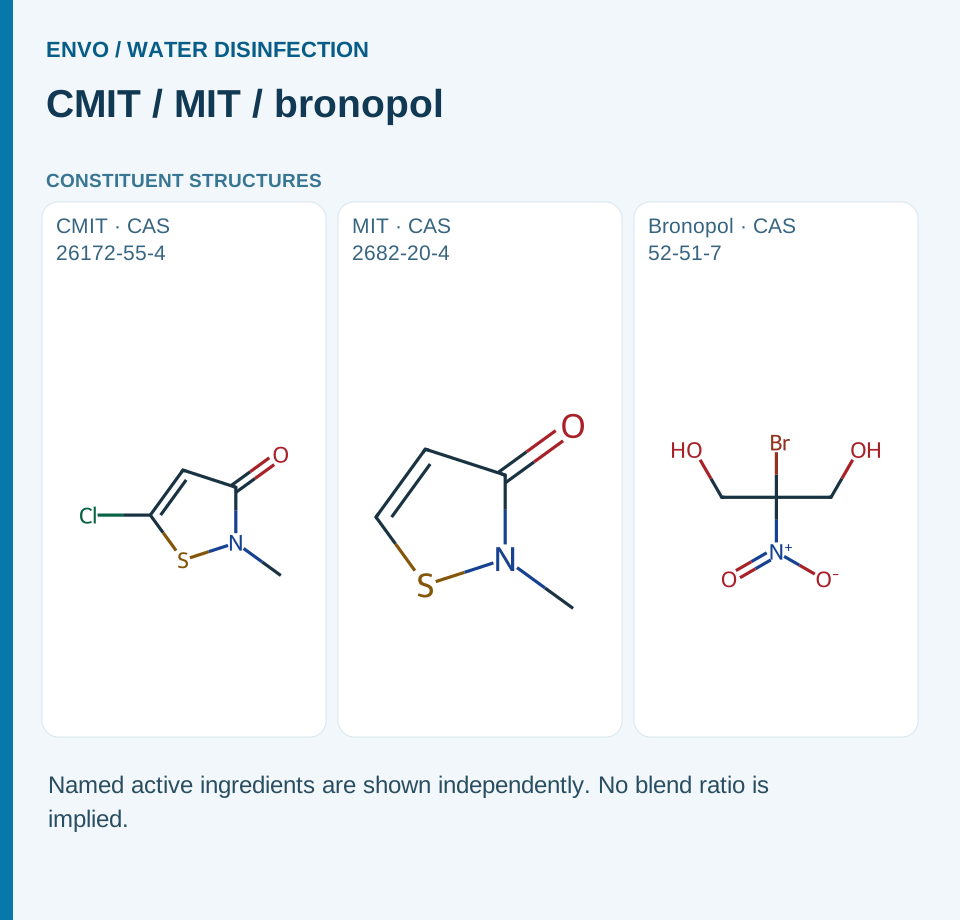
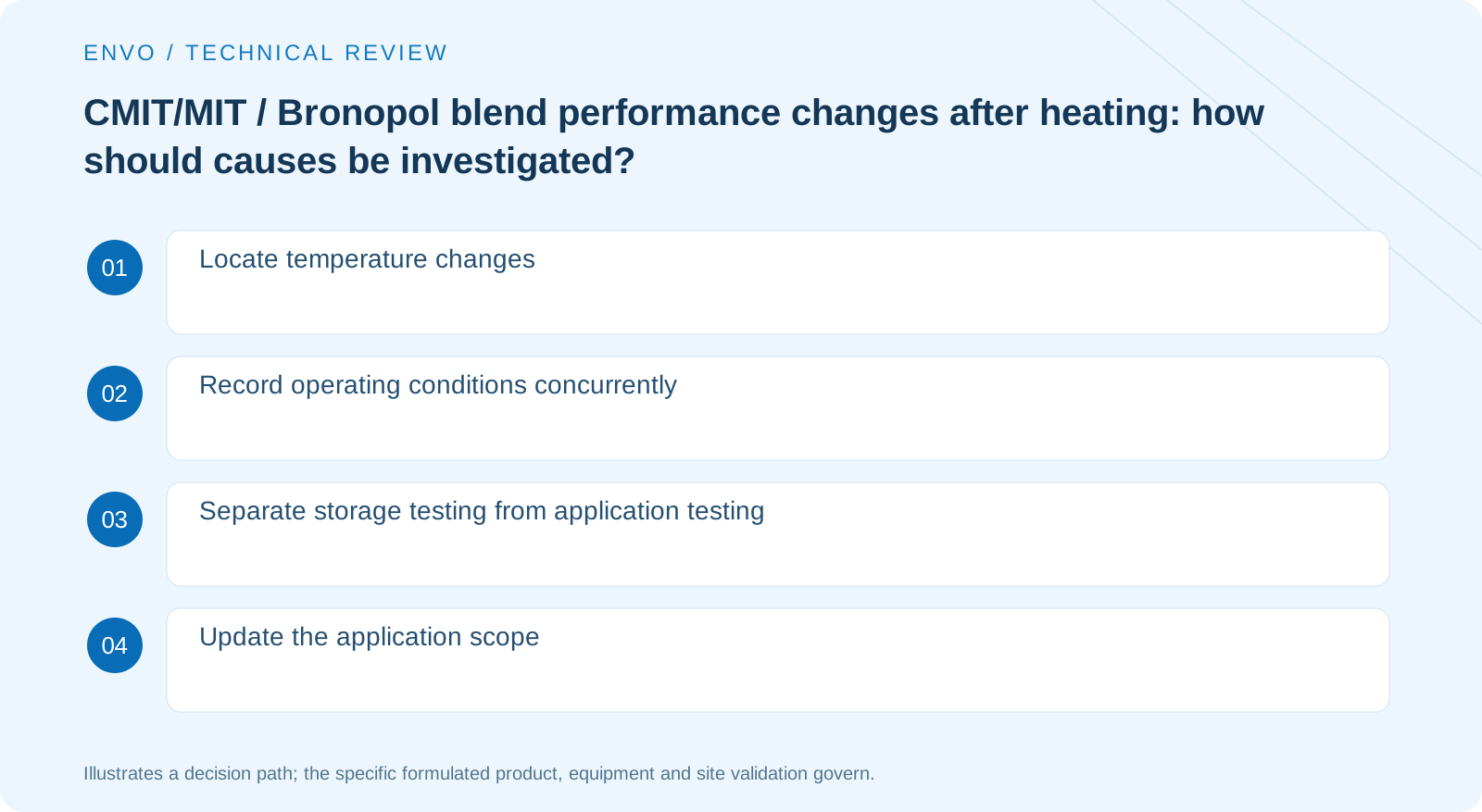
Specify where the temperature change occurs
Record whether the change involves heat exposure in storage, warmer makeup water or a hotter recirculation circuit, and align it with the onset of the problem. These changes involve different processes. LANXESS cooling-water product information describes stabilized systems in certain blends, showing that formulation design needs checking; a blend should not be viewed merely as two raw-material names.
Check shared variables before and after the change
Record pH, blowdown, makeup water, load, retention and current chemicals together. Higher temperatures may coincide with seasonal or production-load changes, and these variables cannot be ignored. Establishing a shared timeline before selecting representative samples reduces the risk of describing correlation as causation.
Design the trial to answer the two questions separately
One set of evidence establishes whether the formulated product retains quality under agreed storage conditions; another concerns application performance in actual water samples. Storage stability does not establish effectiveness under operating conditions, and changed performance does not automatically establish nonconformity of the stock solution. Tests should identify the product batch and conditions and retain necessary reference samples.
Update purchasing requirements using the application scope
If new operating conditions fall outside existing evidence, require revalidation or select a more suitable candidate. Orders can include actual seasonal temperature ranges and pH conditions rather than simply 'for circulating water.' Do not increase dosage without testing to conceal stability or coverage problems.
Use before-and-after comparisons to rule out incorrect attribution
Organize data into storage, formulation quality and site operation. Storage covers transport temperatures and time; quality covers same-batch tests and retained samples; operation covers water temperature, pH, makeup, loads and methods. Complete data may not exist at every level, but gaps should be explicit; absence of data does not establish absence of change.
Normal concentrate results with changed water performance suggest checking conditions and representativeness. Differences between receipt and supplier-retained samples require quality and logistics review. Changed methods require comparability assessment first. Each conclusion needs evidence; chronology alone does not establish causation.
A technical inquiry can include available records from these three levels and identify the main issue to confirm, such as the storage window or a new operating-temperature range. This lets the supplier provide targeted evidence instead of repeatedly sending a generic TDS without site conditions.
Explore further
Does a rise in microbial counts after heating necessarily mean the biocide has decomposed?
No direct conclusion is possible. Check water quality, load and testing conditions together.
Does a stabilized formulation need no temperature limits?
Specific formulated-product documents and validation scope still govern.
References
This article draws on publicly available technical information. Third-party sources do not establish ENVO product approvals, field testing or project experience. Confirm each use against actual supply documents and site conditions.