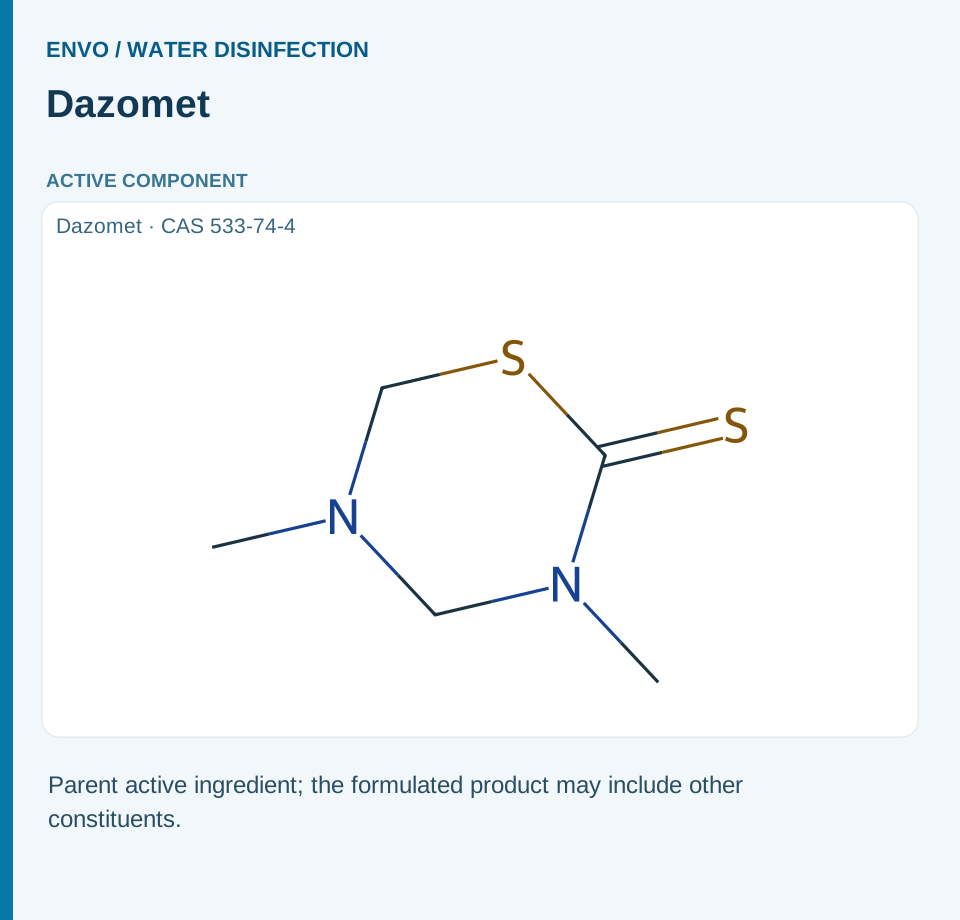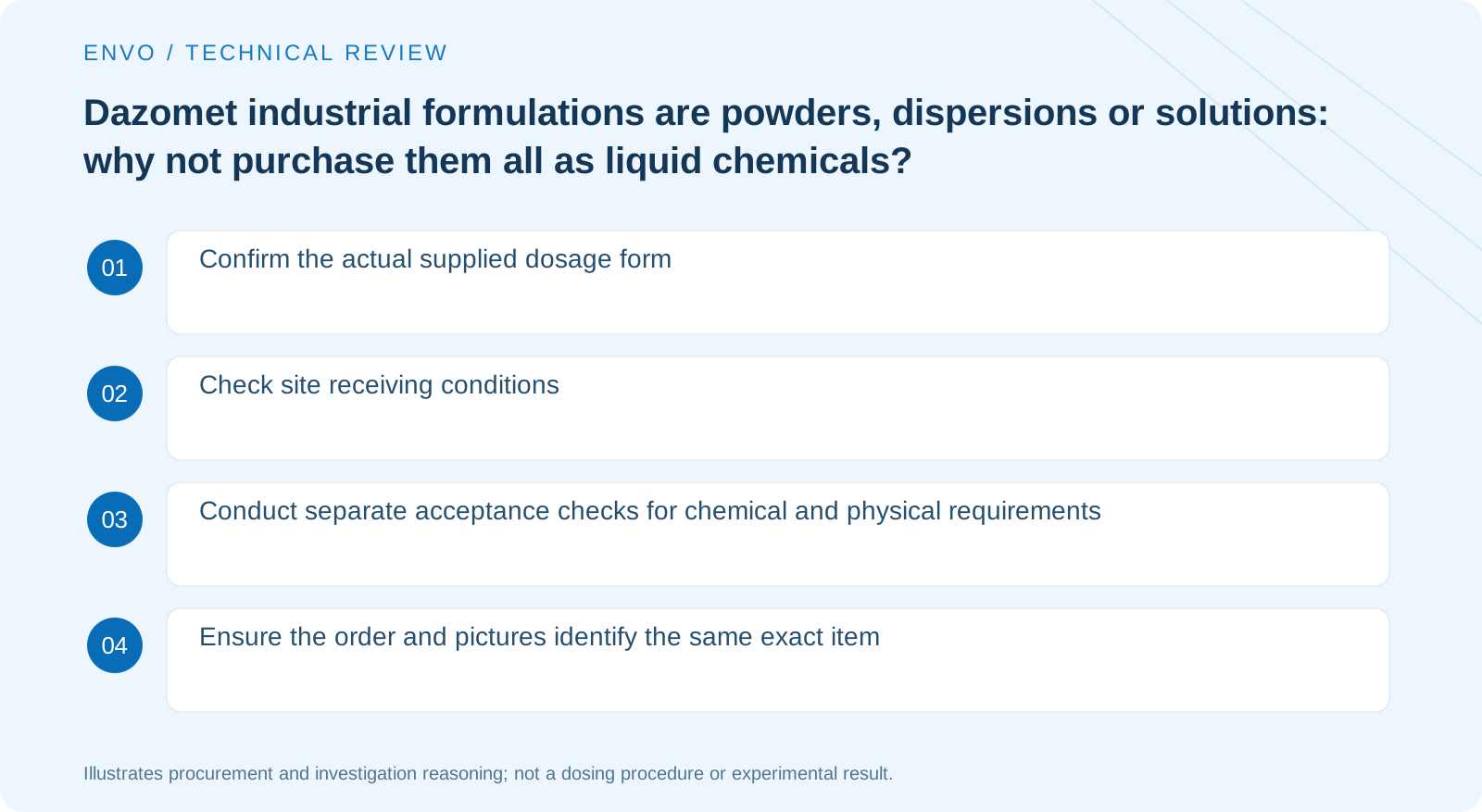
First confirm the dosage form from actual documentation
LANXESS's industrial-preservative directory shows commercial Dazomet powder, water-dispersible and solution products, whose specific formulations and uses still require verification. Directory concentrations cannot become ENVO's stock specifications, and the shared active ingredient does not justify combining three dosage forms into one generic parameter table. Procurement documents should state the actual model and retain its complete declared physical form.
Use site receiving capabilities as a selection criterion
Site personnel must confirm that the customer has equipment, storage and management conditions for a dosage form; price per tonne alone is insufficient. Receipt requirements for powders or dispersions may differ from those for homogeneous solutions and should come from actual product and equipment instructions. The webpage provides no improvised formulation route or recommendation to turn raw materials into finished products to save money; that change creates new technical and responsibility boundaries.
A single test result cannot establish physical compatibility
Conforming active content does not establish stable delivery through existing equipment, and acceptable physical condition does not establish complete chemical specifications or use documentation. Create separate acceptance items for identity, active-content basis, relevant physical properties, packaging and uses. Quality personnel should determine representative sampling and testing for dispersions. Do not reject them against an inappropriate clarity criterion or explain every anomaly as a dosage-form characteristic.
Retain differences in supporting provisions when comparing quotations
Different dosage-form quotations may include different packaging, delivery and site-work requirements; calling everything liquid chemical hides these distinctions. Ask suppliers to specify each delivery item and customer prerequisite and confirm suitable equipment availability. Do not promise that one form is necessarily more stable or cheaper. Evaluate actual product data and project conditions rather than replacing review with marketing generalizations.
Create a description suitable for repeat purchasing
Orders should cite the exact model, dosage form, specification version, packaging and required documents. A later change of form should undergo change review. Website images should match this description; powder photographs and liquid labels must not sit under one default product. Letting customers provide current-product photographs and equipment details in inquiries helps identify the required delivery and reduces purchases of material that cannot be used directly.
If the liquid-chemical entry in a legacy-system purchasing list actually refers to a dispersion product, retain its full name and formulation type in the new version so an English translation does not further misidentify it as a homogeneous solution. Keeping product images, technical explanations and order fields consistent prevents recurring errors more effectively than polishing one page alone.
Explore further
Can an aqueous dispersion and a solution be treated as the same formulation type?
No. Check the specific product definition and physical requirements.
Can we independently convert powder into a liquid supply for convenience?
Do not treat an improvised modification as a validated formulated product; it requires review within a technically qualified framework.
References
This article draws on publicly available technical information. Third-party sources do not establish ENVO product approvals, field testing or project experience. Confirm each use against actual supply documents and site conditions.