Identify the test medium and objective in the documentation
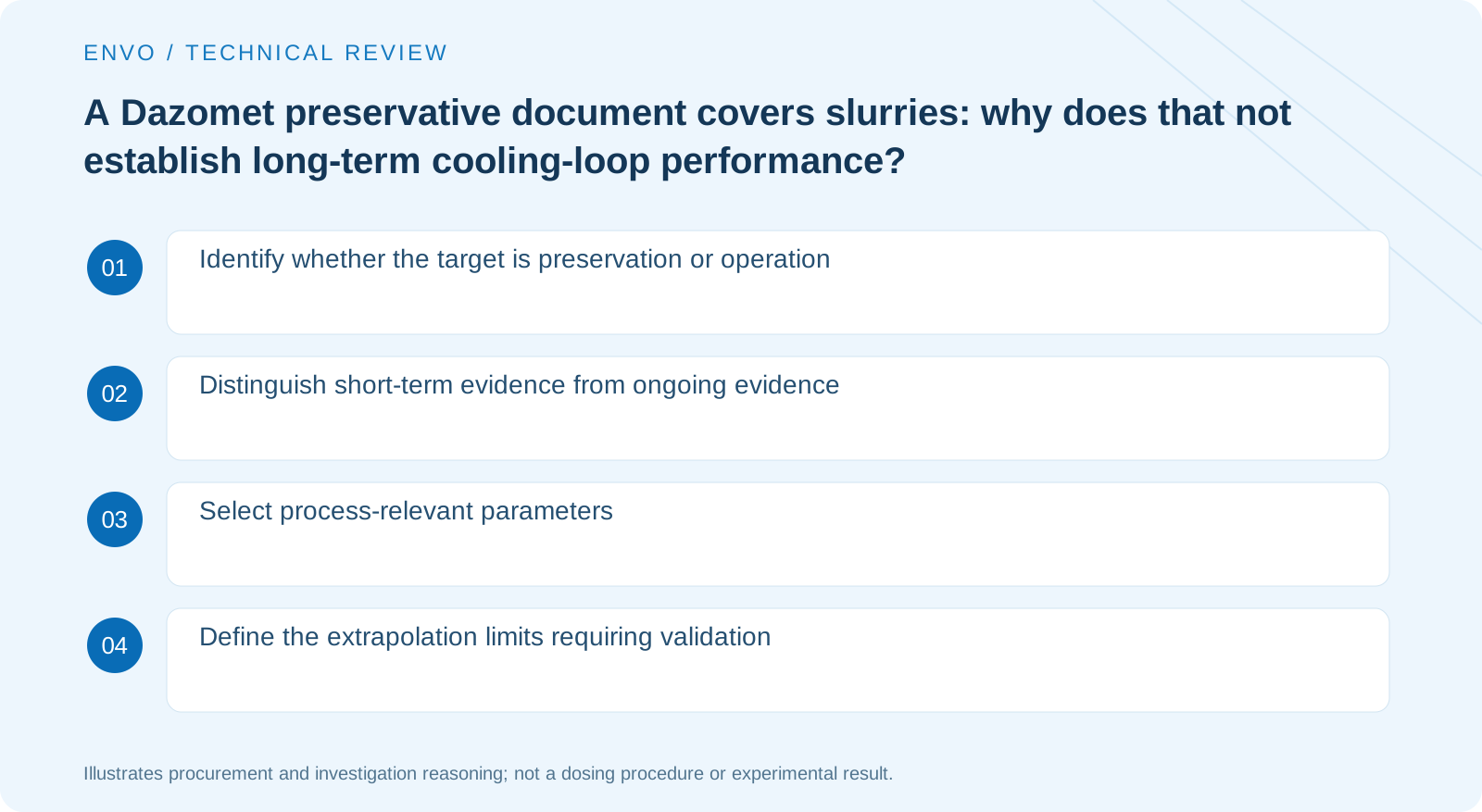
Industrial-preservation catalogs may concern adhesives, mineral slurries or other finished products, whereas cooling-water literature concerns operating systems. LANXESS provides different Dazomet product and application references, illustrating that a category cannot replace a specific treatment target. First identify the sample, the quality problem being prevented and how results were assessed. Terms such as slime control do not establish that one conclusion applies across all industrial media.
Consider differences between open and closed systems
Stored samples and operating circuits with continuous makeup, discharge and process inputs experience different changes. Tests should therefore be redesigned for the objective rather than mechanically converting preservation time into a water-system dosing interval. Site personnel describe actual recirculation conditions, and suppliers propose verifiable plans within product uses. The webpage gives no cross-use dose or time conversions, helping prevent valid data from being applied in the wrong context.
Separate short-term screening from ongoing observation
Initial trials can identify obvious incompatibility or rank candidates, but long-term operation still requires confirmation across load changes, maintenance and process stability. Label conclusions by stage; short screening is not continuous-operation validation. Where no real site data exist, define what needs collecting without inventing operating duration, cost savings or improvement percentages for product pages.
Check non-microbiological parameters at the same time
Slurry preservation also requires attention to slurry quality criteria, while recirculating-water treatment requires equipment and operating requirements. One microbial result may not address every customer problem. Select tests for the actual process instead of imposing every generic chemical-list parameter on every medium. Concise, targeted trials assess product value more effectively than large amounts of irrelevant data.
Present existing evidence separately from items awaiting validation
Articles can give public background on product uses, while product pages identify the actual supply and available documentation. Inquiries should include the medium, operating or storage state, existing problem and target market so suppliers can provide relevant evidence. Explicit limits for uncovered scenarios allow further assessment without suggesting that catalog coverage equals site validation under every condition.
If a customer wants one product for both storage preservation and an operating circuit, establish two assessment tasks and determine whether both are covered by the same formulated-product documentation. Even if the same supply model is ultimately selected, retain the evidence separately; a pass in one application cannot substitute for a pass in the other.
Explore further
Can preservation-period data directly become a cooling-water maintenance interval?
No. The two system types have different conditions and assessment objectives.
Does the absence of long-term case studies prevent further technical assessment?
Yes, provided current evidence and the parts requiring validation are clearly identified.
References
This article draws on publicly available technical information. Third-party sources do not establish ENVO product approvals, field testing or project experience. Confirm each use against actual supply documents and site conditions.