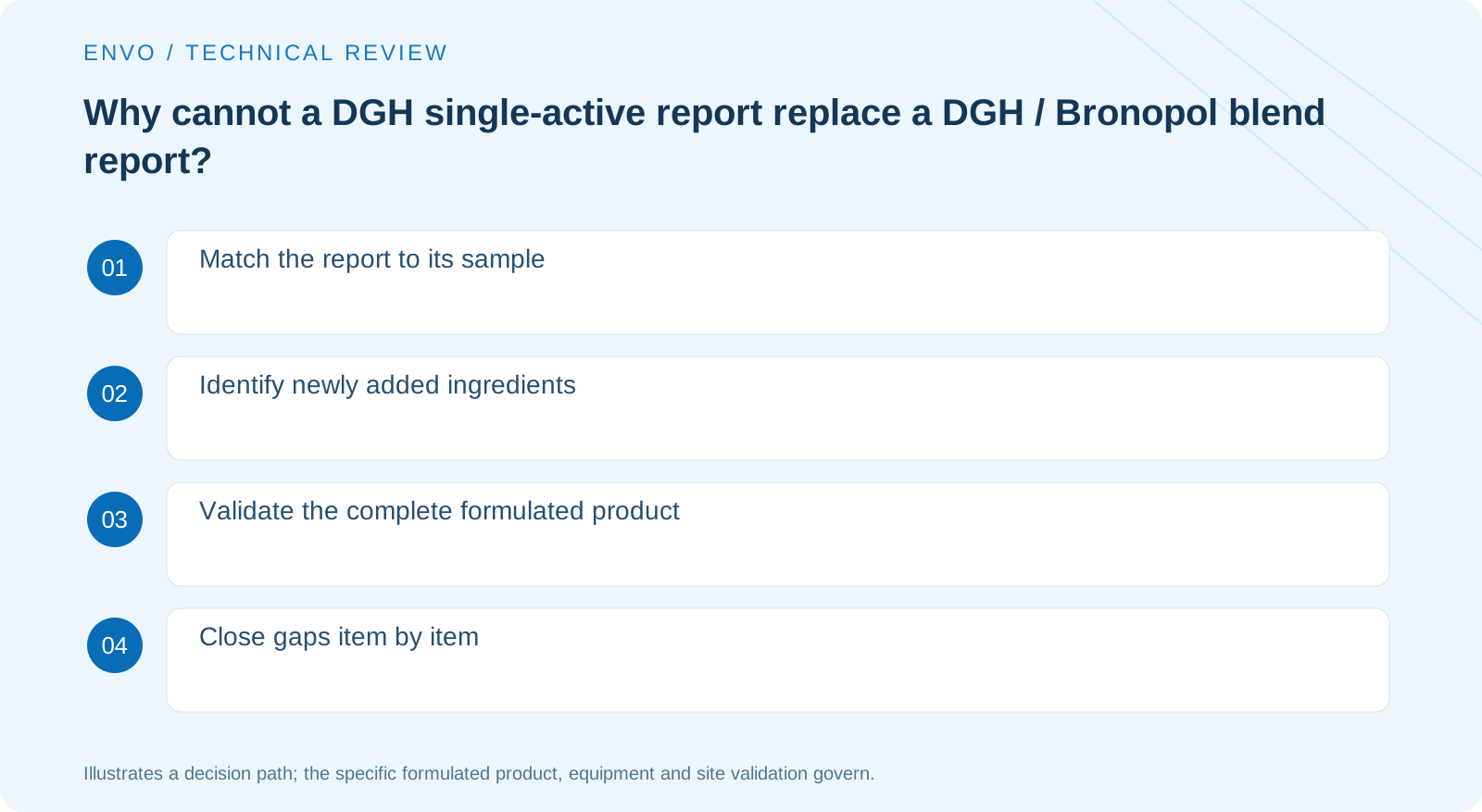
Clarify how the report relates to the model being purchased
Check the report's sample name, model and batch number against the quotation item by item. A DGH-only report is background information for one component; adding the blend's name to its cover cannot turn it into validation of the complete product.
Include a verification field for newly added ingredients
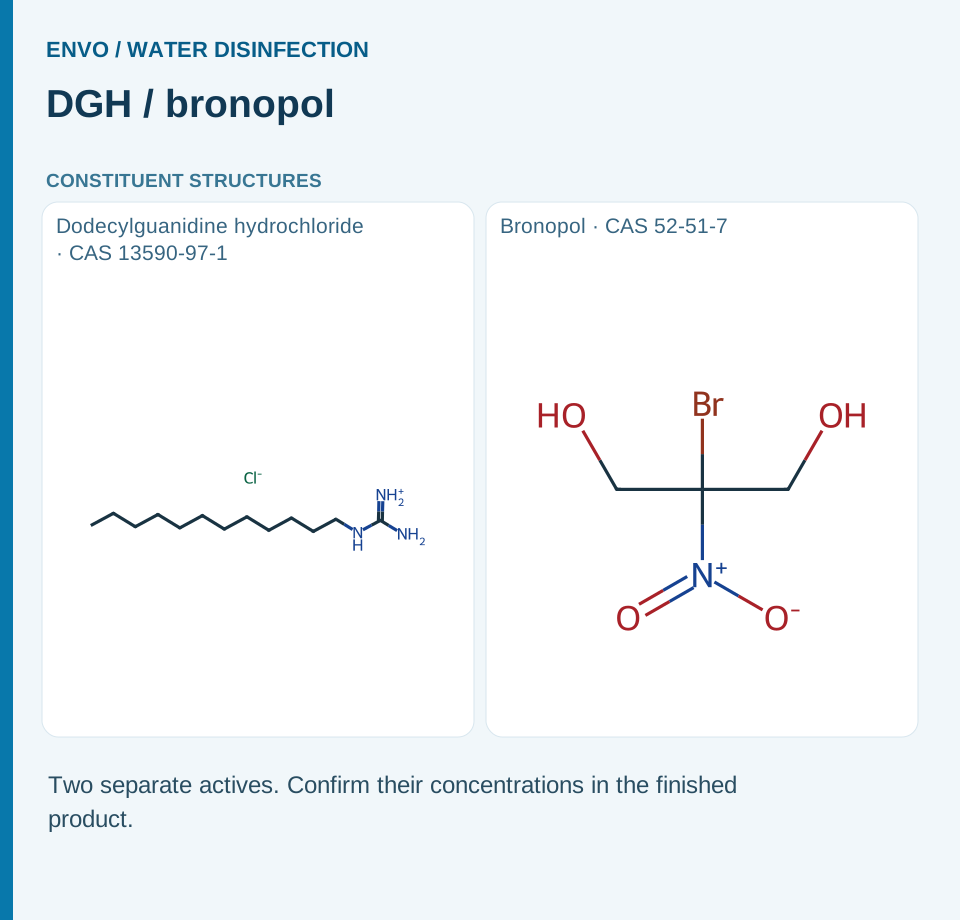
Ask about Bronopol's identity and acceptance method in the formulated product, and record relevant information about solvents and the stabilization system. Preliminary procurement screening does not require confidential formulation ratios, but it does require knowing which key parameters are guaranteed and which need specific documents or testing.
Validate formulated-product efficacy and compatibility together
Test water should include existing additives and specify temperature, pH and target microorganisms. An effective single active does not establish identical blend performance in that environment. Likewise, a photograph showing physical stability cannot replace blend-efficacy information. These evidence types serve separate purposes and should not substitute for one another.
Assign a specific action to each documentation gap
Turn uncovered items into answerable questions, such as missing blend-stability evidence, testing in the actual additive system or individual-component analysis. The supplier can then fill each gap rather than repeatedly sending the same single-active introduction. Purchasing conclusions must match available evidence; a catalog listing for this type of blend does not establish comprehensive validation.
Distinguish evidence for components, the formulated product and the site
Organize information into three levels: chemical and mechanistic background for DGH or Bronopol; quality and stability of the complete blend; and application assessment in actual water and additives. Place each report only at the level it supports and cross-reference connections. This prevents one single-agent report from being copied into multiple sections, creating apparent volume while evidence for the formulated product remains absent.
If second-level documentation is complete but third-level evidence is insufficient, the next step should focus on validation under the customer's operating conditions. If the blend's identity is unclear, resolve formulated-product documentation first. If field and laboratory results differ, investigate differences in conditions rather than automatically dismissing either. This layered approach identifies exactly which evidence is missing.
An inquiry can directly list the model, stability range, test medium and analytes requiring confirmation. Appropriate access arrangements can be agreed for confidential supplier information, but information that cannot be checked must not be advertised as verified. The purchasing objective is sufficiently reliable decision evidence, not the largest possible collection of attachments.
Explore further
Does information for a single-active product have no value at all?
It provides component-level reference information but is not application evidence for the complete formulation.
Must commercial formulation ratios be disclosed for comparison?
Full confidential disclosure is unnecessary, but critical guaranteed specifications and validation boundaries must be clear.
References
This article draws on publicly available technical information. Third-party sources do not establish ENVO product approvals, field testing or project experience. Confirm each use against actual supply documents and site conditions.