
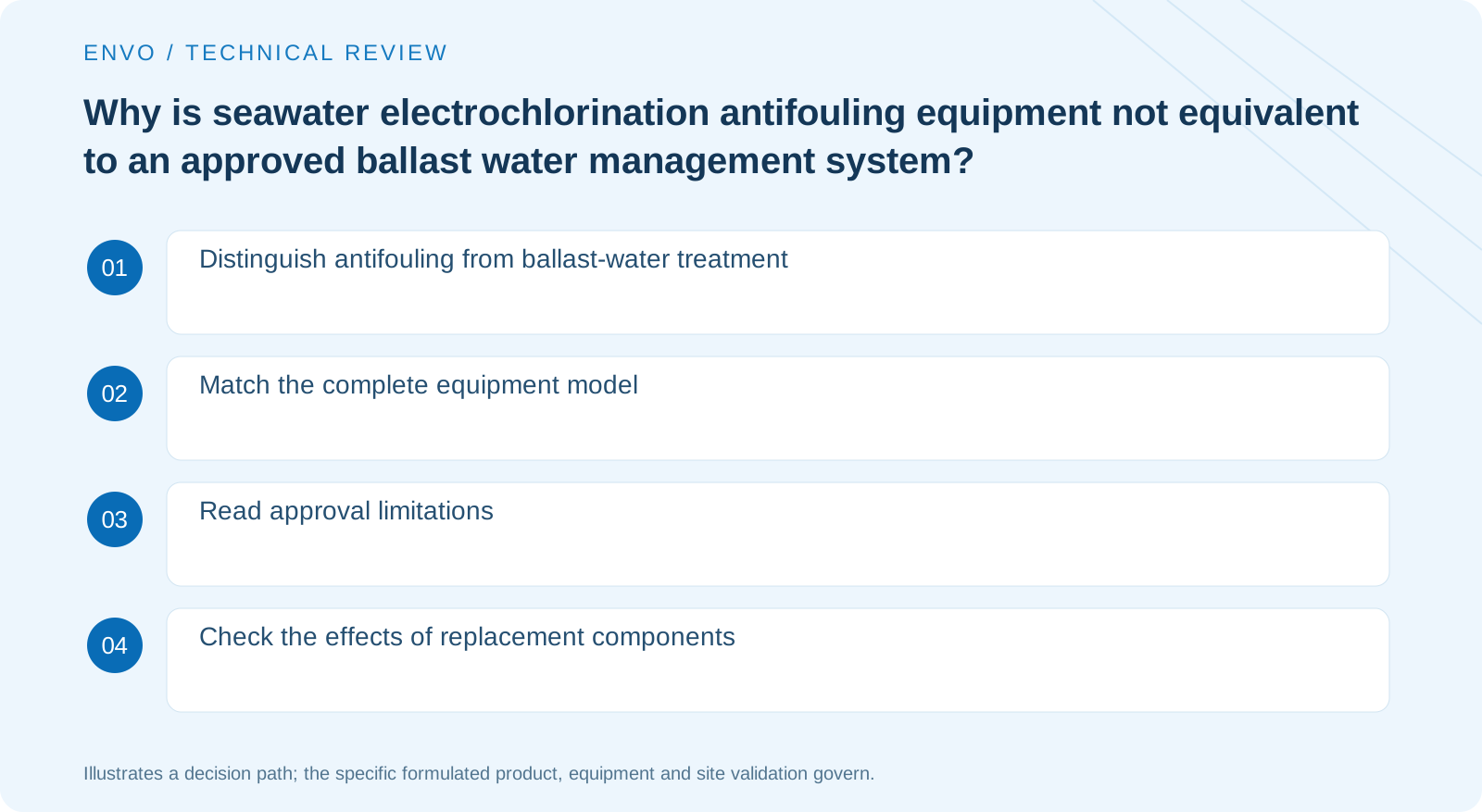
First distinguish the treatment target from the required standard
Seawater cooling systems primarily address biofouling of the relevant facilities, whereas ballast-water management has its own system requirements and validation framework. De Nora seawater-electrolysis product materials describe antifouling uses; they do not establish that every similar installation is an approved ballast-water system.
Check the exact system model
Confirm the manufacturer, system model, composition and version from certificates and associated documents rather than checking only the electrolytic module's brand. The relevant IMO framework addresses the complete BWMS; sensors, controls and other treatment stages may all be part of the approved configuration.
Read the approval scope and limitations
Record applicable conditions, equipment configuration and documented operating limits; a certificate cover alone does not establish coverage for every vessel. A competent professional team should check vessel type, operating conditions and authority requirements. This page does not provide a compliance-release determination.
Treat replacement components as a change-control item
Before substituting another brand's module, raw material or control approach, check the effect on system approval and operating documents. Shared chemical principles do not automatically establish equivalence. Keeping the technical supply scope consistent with the approved system scope reduces later installation and acceptance disputes.
First establish whether the task is antifouling or ballast water treatment
Shipboard requirements should state the serviced area, purpose and applicable standards. Seawater-cooling fouling control and ballast-water management may use related technology but involve different approvals. De Nora seawater-electrolysis information explains fouling-control background; it cannot establish that any electrolyzer meets ballast-water system requirements.
For ballast-water projects, verify the approval's exact system model, composition, scope and current project requirements with relevant professionals. Component certificates or one generator test do not equal complete-system approval. Seawater-cooling fouling control likewise requires review for its own use without borrowing unrelated certificates to enhance credibility.
Itemize generation, ancillary equipment, monitoring and project acceptance in the quotation, specifying who provides documents and how they correspond to delivered equipment. This helps customers distinguish existing technical experience from qualifications needed for this project, avoiding discovery after installation that the purchased equipment's intended use differs from the scope of the required whole-system certification.
Explore further
Does certification of an electrolysis module equal BWMS approval?
No. Check the complete system and its configuration scope.
Can a successful cooling-water case replace ballast-water testing?
No. The two applications have different objectives and evidence requirements.
References
This article draws on publicly available technical information. Third-party sources do not establish ENVO product approvals, field testing or project experience. Confirm each use against actual supply documents and site conditions.