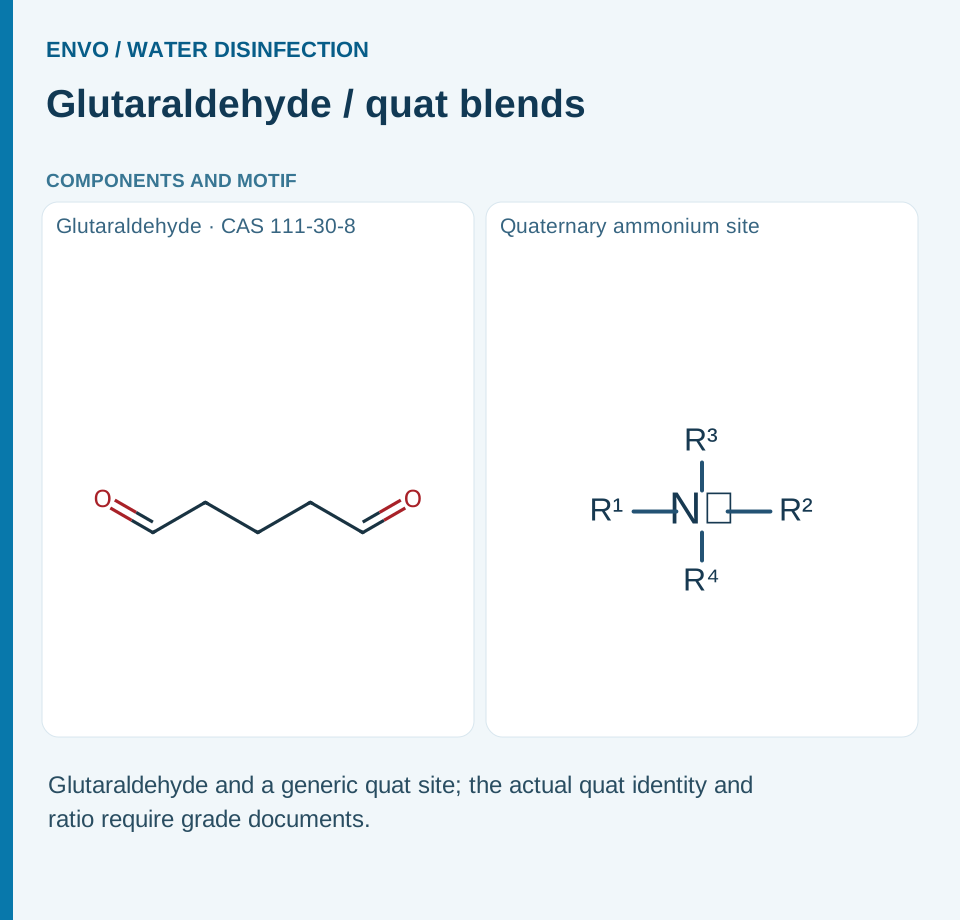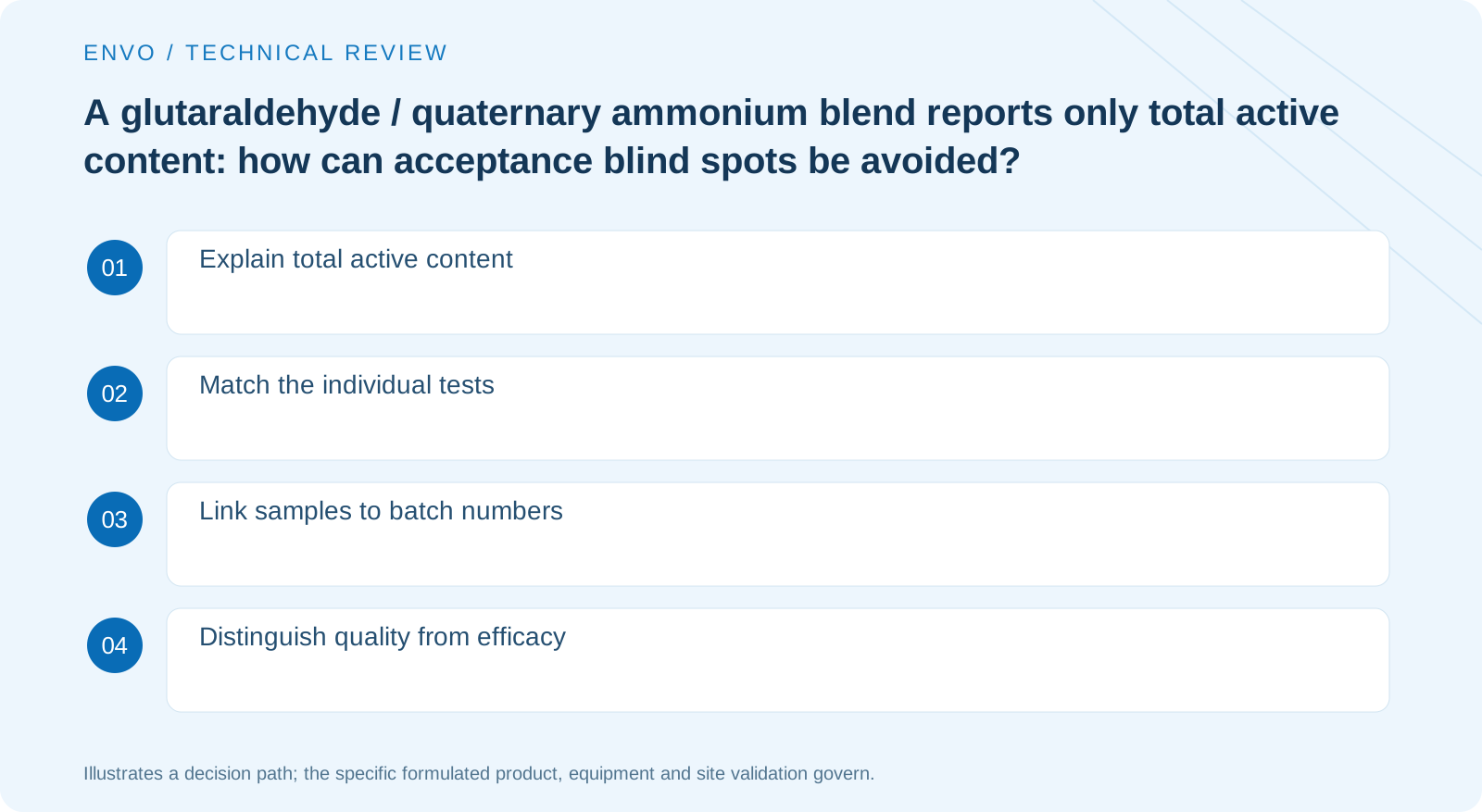
First ask what total active content includes
Require clear names and calculation methods for each active ingredient. If a quaternary ammonium component is described only generically, ask for its chemical type and identifying information. Total active content may contribute to a commercial comparison, but cannot independently establish that every component meets the agreement. Figures without individual-component explanations should not be the sole acceptance basis.
Match test methods to the components
Ask whether the report distinguishes glutaraldehyde from the quaternary ammonium compound used and whether other formulation components interfere. Purchasing personnel need not design the experiment themselves, but should obtain the method name, applicable scope and result basis. Inferring every component's content from one nonspecific parameter may conceal actual formulation differences.
Establish a consistency chain linking samples and batches
Link the approved sample code, quoted model, production batch number and report date. Color or density can help reveal abnormalities, but cannot replace critical active-ingredient testing. Supplier changes to the formulation or raw-material system should trigger reassessment, rather than merely an updated appearance photograph.
Separate quality assurance from site performance
Batch composition conformity establishes that delivery meets the agreement, not effectiveness in every oilfield fluid. Keep use documentation, composition acceptance and application testing as three linked bodies of evidence. In a dispute, this helps distinguish inconsistent delivery, storage or transport changes, and operating-condition changes instead of attributing everything to 'poor chemicals.'
Key fields in a blended-product batch checklist
A batch table can include product code, batch number, glutaraldehyde result, quaternary ammonium identity and result, methods, appearance and stability parameters. Confidential constituents require traceable product identification and quality commitments; customers should not have to judge from advertised ratios. Keep sample and batch-document terminology consistent instead of using unmatchable abbreviations for one component.
If total active content matches but individual-component results differ, first check calculation bases, methods and formulation versions. If methods match and results genuinely fall outside guaranteed ranges, follow the quality procedure. If changes appear only after arrival, also investigate storage and transport. These branches require original reports and retained samples; appearance or a single on-site microbial count cannot substitute for them.
When establishing repeat-purchase files, separately record all approved changes, including when a new formulation entered use and its validation. Subsequent performance feedback can then be traced to the actual product rather than several different formulations sharing one commercial name over time.
Explore further
Can individual checks be skipped when total active content is compliant?
Confirm the key ingredients of the blend individually as agreed.
Can a COA prove oilfield performance?
Batch analysis cannot replace validation of efficacy under operating conditions and fluid compatibility.
References
This article draws on publicly available technical information. Third-party sources do not establish ENVO product approvals, field testing or project experience. Confirm each use against actual supply documents and site conditions.