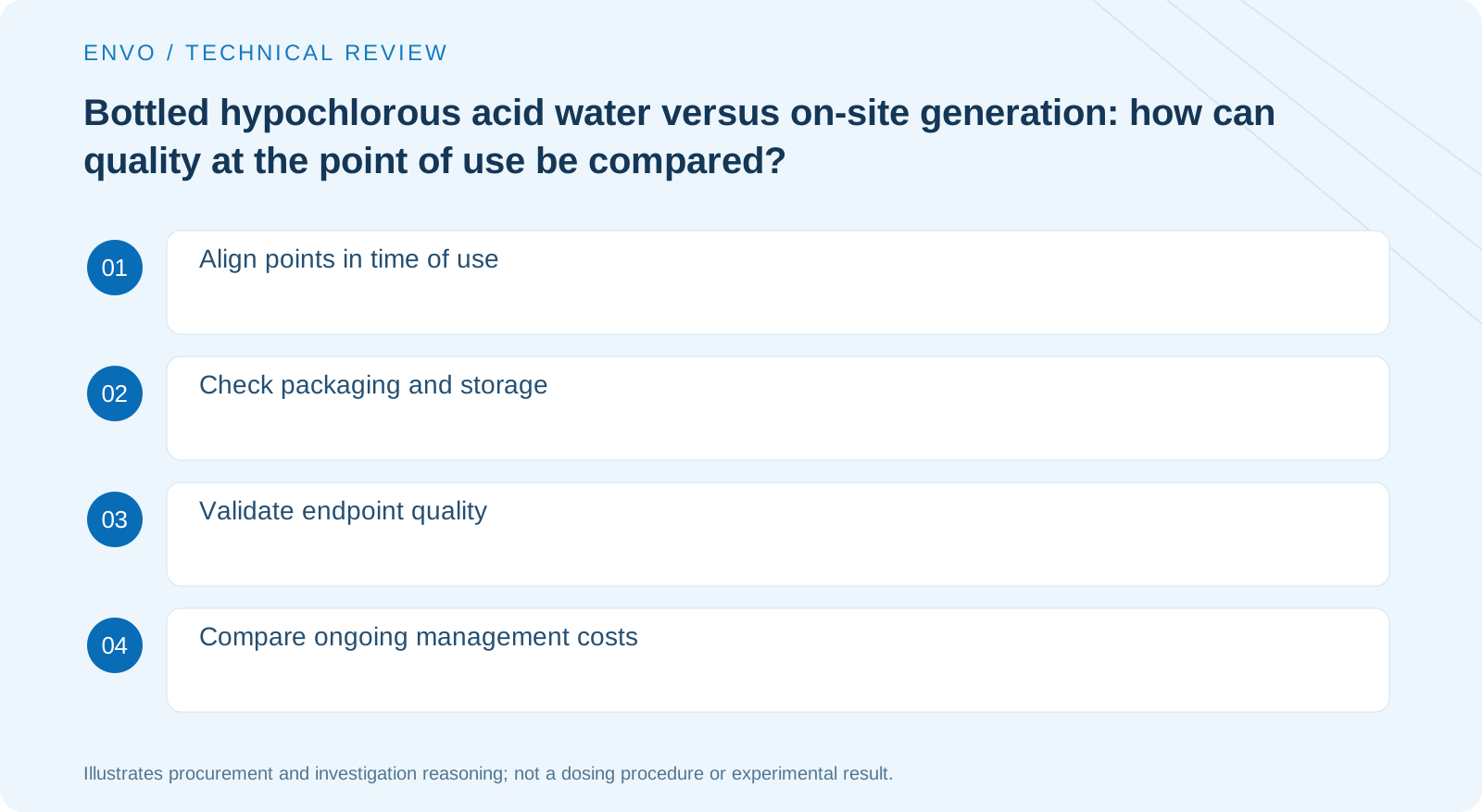
Align the time points used for quality comparison
For bottled products, distinguish production, factory release, arrival, opening and final use. For on-site systems, distinguish generation, temporary storage and delivery to the point of use. Samples taken at different use stages cannot be directly ranked even with identical test methods. Shelf life is a declaration for a specific product and packaging conditions requiring corresponding evidence; another brand's period or an online test table cannot establish the current product's storage life.
Consider actual packaging and delivery routes
Record container material, seal condition, transport and storage conditions, and opened-container management, checking alignment with supplier statements. Packaging color or a light-protective bottle claim alone does not establish stability; review validation for the actual packaging and specification. For small-volume customers with irregular use, package size matching consumption patterns may matter more to management than nominal initial concentration.
On-site generation also requires ongoing confirmation
A generator's advertised parameters do not establish product condition under every operating scenario. Ask how raw materials, incoming water, equipment maintenance and quality monitoring affect output, and confirm responsibility for identifying and managing anomalies. An establishment number for the equipment site cannot replace product performance or quality assessment. Where holding tanks and long transfer lines exist, sampling must represent the actual point of use rather than only a favorable fresh-outlet sample.
Do not respond to degradation by arbitrarily adjusting the blend
When quality differs, first review sampling, methods, timing and storage records, then contact qualified supply and technical personnel. Do not mix additional chemicals to restore one reading or infer disinfection capability from odor strength. Reformulation or departures from labels for human-contact, food or drinking-water uses require separate review; an ordinary webpage cannot supply universal adjustment instructions.
Structure the inquiry around delivery reliability
Provide daily usage ranges, intervals, delivery cycles and current storage conditions, requesting separate explanations of specifications, packaging and validation. Compare bottled supply and on-site generation for quality assurance, maintenance, staffing and documentation burdens without assuming either is always cheaper. Acceptance forms should record sampling stage, packaging state and method version to provide a shared traceable basis for disputes.
When comparing delivery and point-of-use samples, retain opening and sampling records rather than treating an unopened retained sample as representative of repeated bottle opening during use. If a customer cannot consume large packs continuously, first discuss sizes matching the use pattern instead of later extending use through storage methods unsupported by the formulated-product documentation.
Explore further
Is freshly generated water necessarily more suitable than bottled water?
Not necessarily. Both must meet specific use and actual point-of-use quality requirements.
Can another brand's shelf life be copied directly?
No. The formulation, packaging and conditions must match.
References
This article draws on publicly available technical information. Third-party sources do not establish ENVO product approvals, field testing or project experience. Confirm each use against actual supply documents and site conditions.