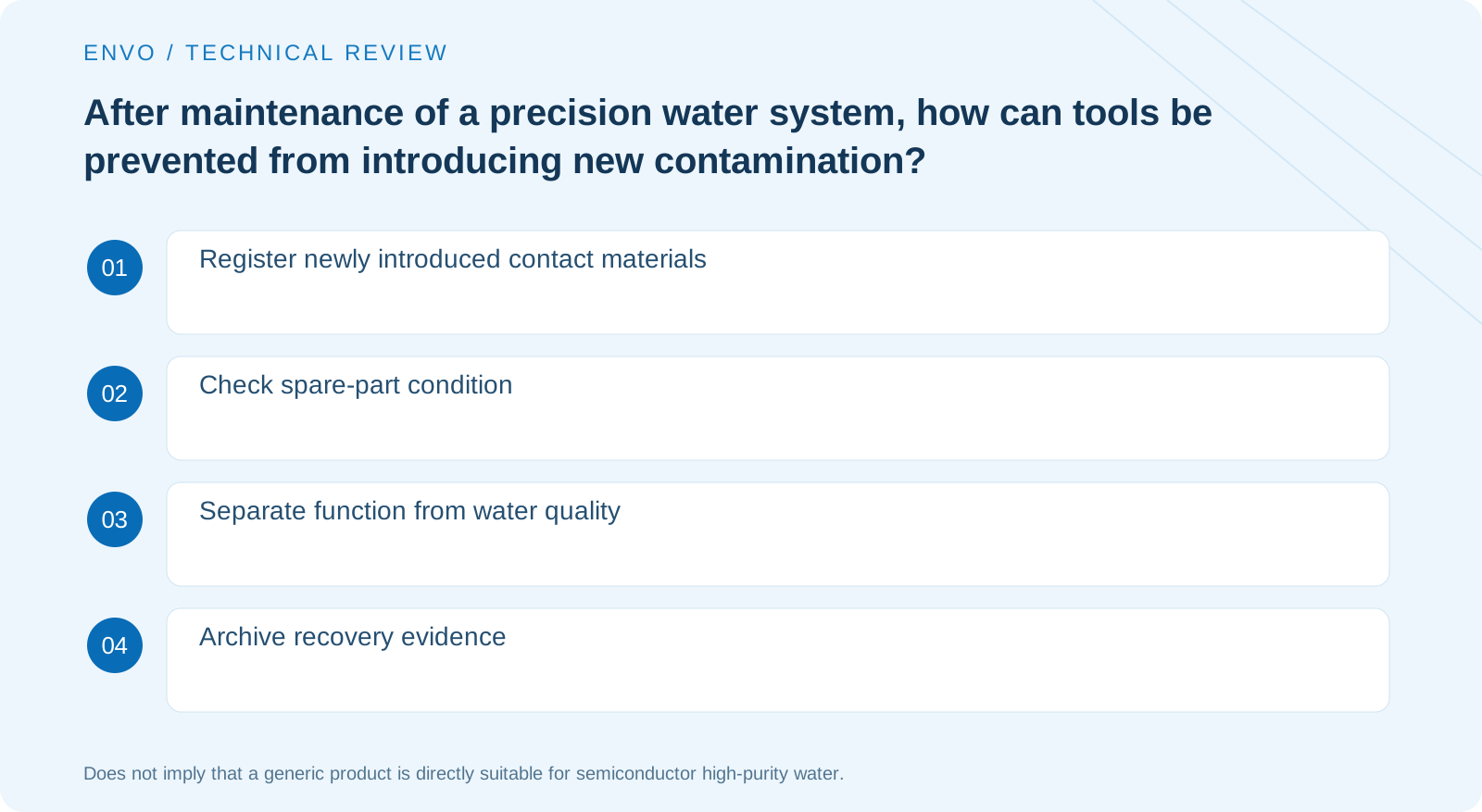
List new contact materials introduced during maintenance
Record tools, temporary hoses, seals, lubricants or cleaning supplies, and their contact locations. Clearly distinguish items that touch only external equipment surfaces from those that may enter the water circuit. This article recommends retaining a simple checklist with the work order rather than relying on memory later. Materials or supplies whose suitability is unconfirmed should not enter water circuits with stringent requirements merely for convenience.
Check spare-part identification and storage condition
Identically shaped spare parts may differ in material and delivered cleanliness. Confirm models, documents, packaging and preinstallation management against equipment requirements rather than substituting ordinary warehouse labels for technical information. Samsung's ultrapure-water information notes that minute impurities may affect precision processes, but project documents must define acceptable conditions; promotional purity concepts cannot establish them.
Maintenance records should also state whether temporary hoses, tools or packaging entered the contact area and where removed components went. After a temporary bypass is restored, recheck drawings, valve positions and monitoring points. This allows problems with spare parts themselves to be distinguished from changes introduced during installation, rather than identifying the contamination source solely from a component name.
Sign off maintenance completion separately from water-supply restoration
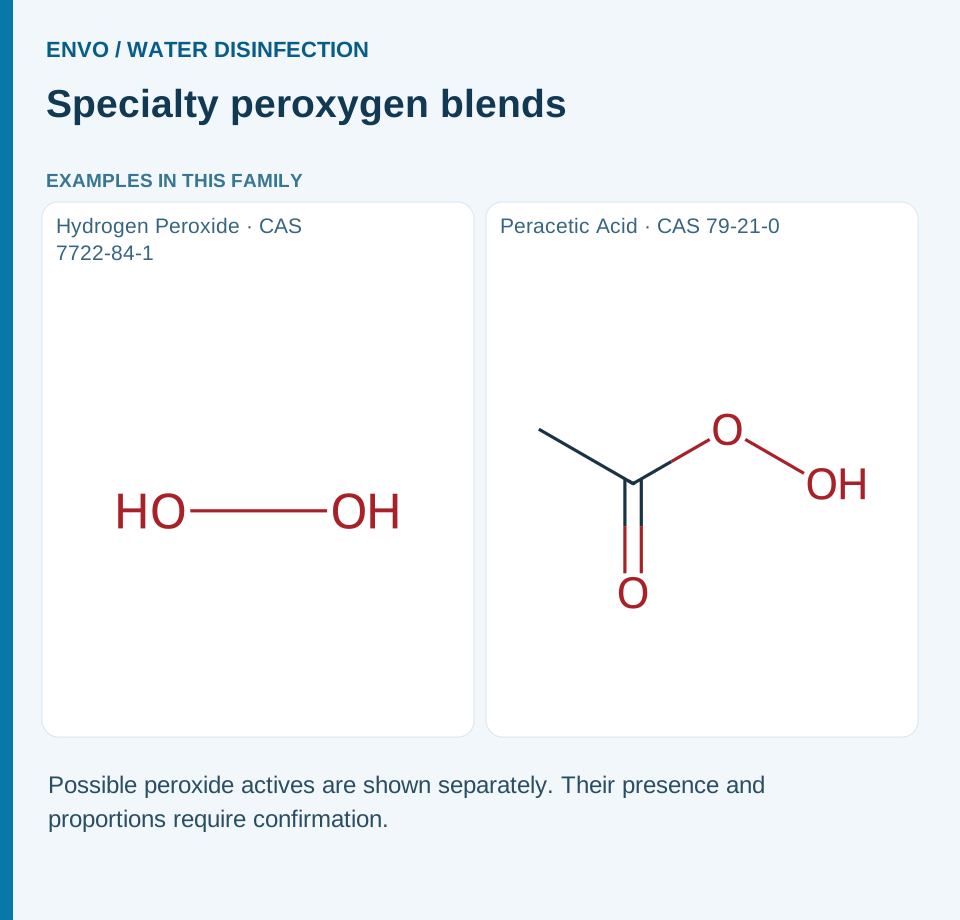
Restoration of equipment function and water quality suitable for use are separate outcomes. Identify who is responsible for cleaning or treatment, flushing, necessary testing and the return-to-service decision. Evaluation of disinfectant formulations must also consider components they may introduce and verification of their removal. Normal microbiological results do not establish that all process parameters have recovered.
Cover conditions before and after maintenance in anomaly investigations
Retain premaintenance baselines, implementation records and post-restoration data to assess whether changes correspond to particular contacts or actions. Acknowledge attribution limits when several materials change simultaneously. Suitable personnel should collect comparison samples and test under approved methods, not judge equipment from improvised sampling in uncontrolled containers. Continue investigating when evidence is insufficient rather than issuing a definitive conclusion.
Make the next purchasing specification more precise
Spare-part and treatment-supply procurement should define models, delivery states, documents and substitution approval. Include contact conditions and process parameters to restore in technical inquiries. Completion records should answer what was installed, what it contacted and how restoration was confirmed, offering more traceability than one repair photograph.
Explore further
Can water supply resume after a normal trial run following component replacement?
Water-quality recovery for the final use must also be confirmed under project procedures.
Can ordinary cleaning tools be shared?
Manage this according to the maintenance area and process requirements; do not assume every tool suits a controlled water circuit.
References
This article draws on publicly available technical information. Third-party sources do not establish ENVO product approvals, field testing or project experience. Confirm each use against actual supply documents and site conditions.