Start with the waterline rather than the control display
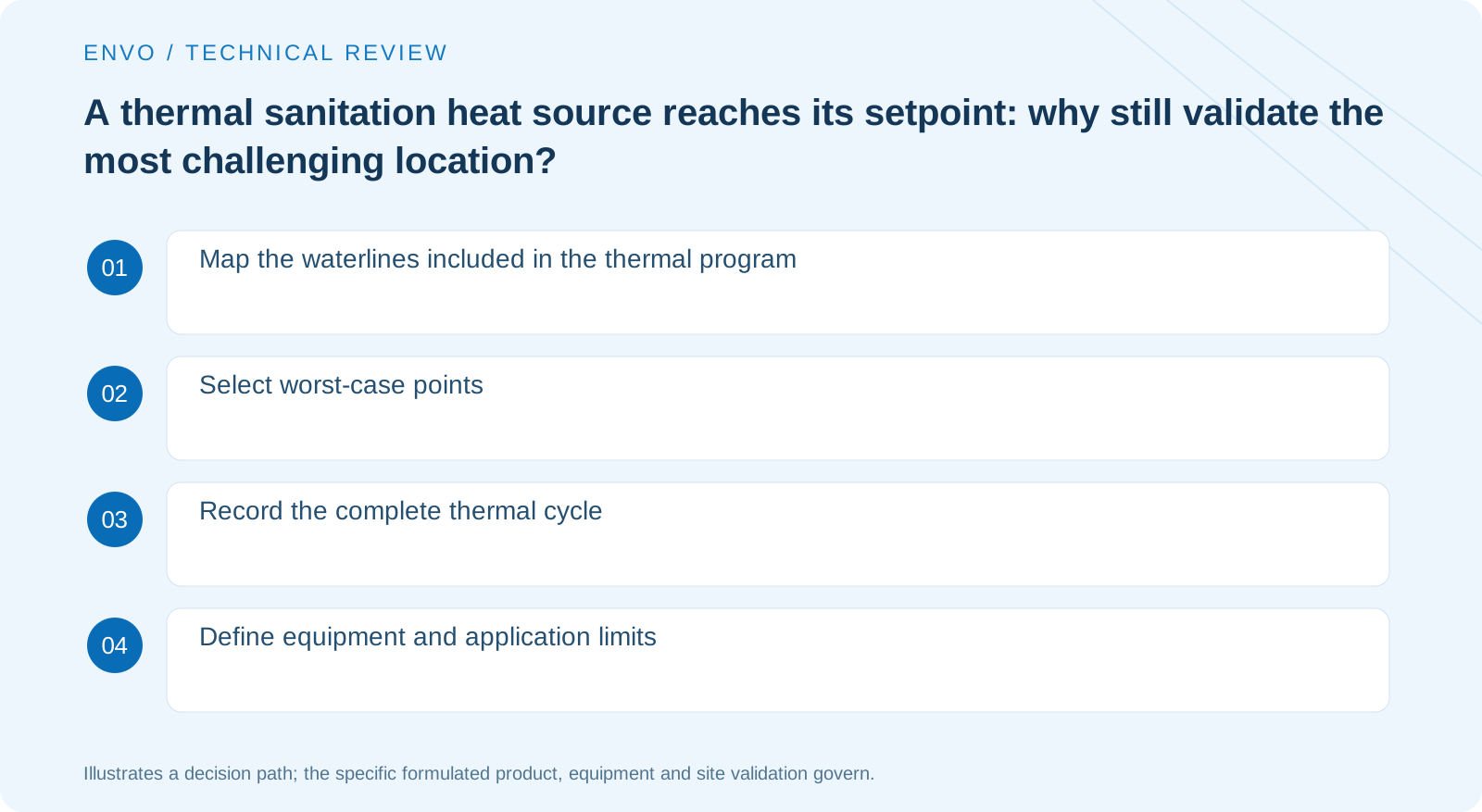
Map the main circuit, branches, valves, tanks and possible stagnant locations, confirming which parts actually participate in the thermal procedure. A displayed setpoint achievement applies only to the corresponding measuring point; it does not automatically establish identical conditions at every endpoint.
Select representative points with a clear rationale
Professional validation personnel should identify worst-case locations from system structure and actual operation and record their selection basis. WHO pharmaceutical-water guidance emphasizes system design and validation, showing why validation should not merely select a few convenient sensor locations.
Record time and temperature together
Thermal-process assessment must address the complete cycle and equipment specifications rather than one instant at the highest temperature. This article provides no universal temperature-and-time prescription because equipment and objectives differ. Sensor verification, record completeness and abnormalities also belong in validation documentation.
Distinguish thermal sanitation from other uses
Thermal programs for pharmaceutical purified water or dedicated equipment are not equivalent to emergency heat treatment in ordinary buildings. CDC has specific recommendations for thermal treatment of drinking-water systems, so an equipment-specific program must not be generalized to an entire building. Purchasing should identify actual objectives and boundaries, avoiding the oversimplification that high temperature solves everything.
Use temperature-distribution evidence to confirm program coverage
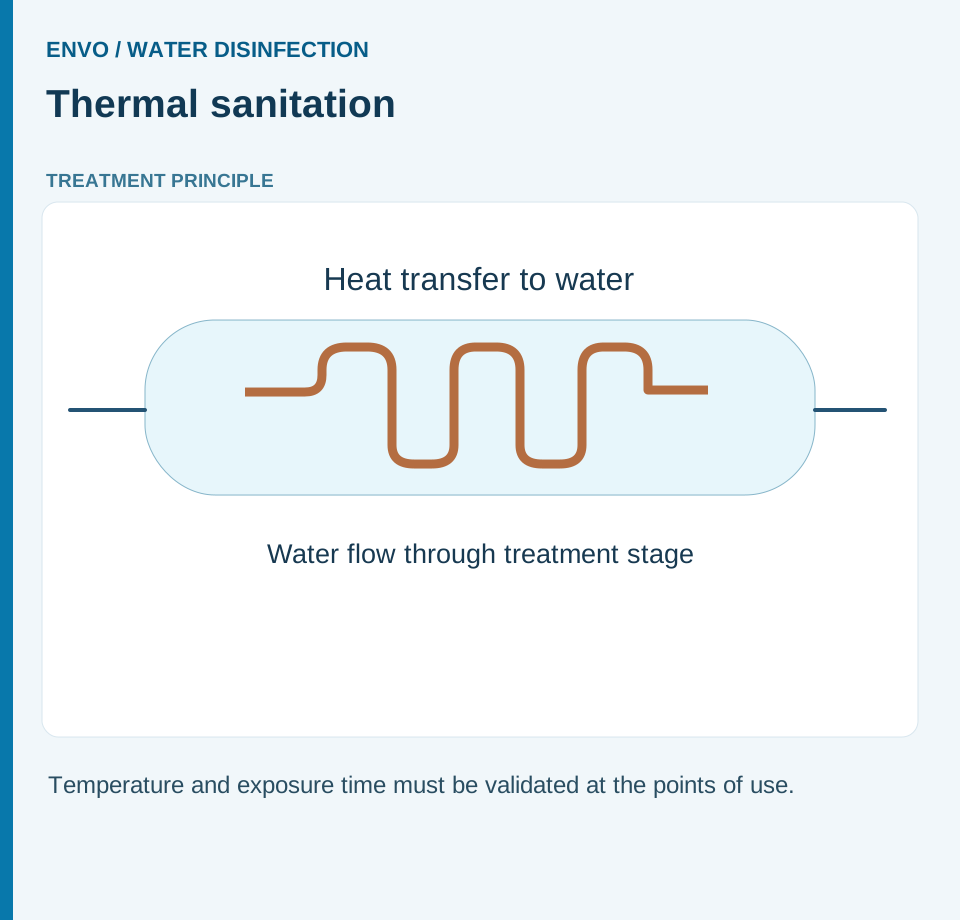
Map temperature points, circulation and components actually requiring treatment, identifying measured locations and gaps. Tank or main-unit temperature alone may not establish remote or complex-component conditions. Equipment and quality teams should define points and validation procedures; this article gives no executable temperature-time combination.
Associate each measurement point's process with equipment state rather than summarize maximum temperature alone. Retain limitations for uncovered branches or unrepresentative points. Failure to meet approved conditions at one point cannot be offset by averaging higher temperatures elsewhere. Specialists should assess procedure and design suitability.
WHO pharmaceutical-water guidance supports principles of system validation and ongoing monitoring, not universal thermal-treatment instructions for building water. Equipment thermal disinfection must not be extended directly to thermal shock in supply facilities while people use them. Clear targets and validation limits help customers identify whether equipment procedures, temperature verification or another treatment route is needed.
Explore further
Does a compliant main-loop temperature represent all branches?
No. Evidence-based validation of coverage and worst-case locations is required.
Can one temperature and duration be specified for all equipment?
No. Follow the specific equipment requirements and validation objectives.
References
This article draws on publicly available technical information. Third-party sources do not establish ENVO product approvals, field testing or project experience. Confirm each use against actual supply documents and site conditions.