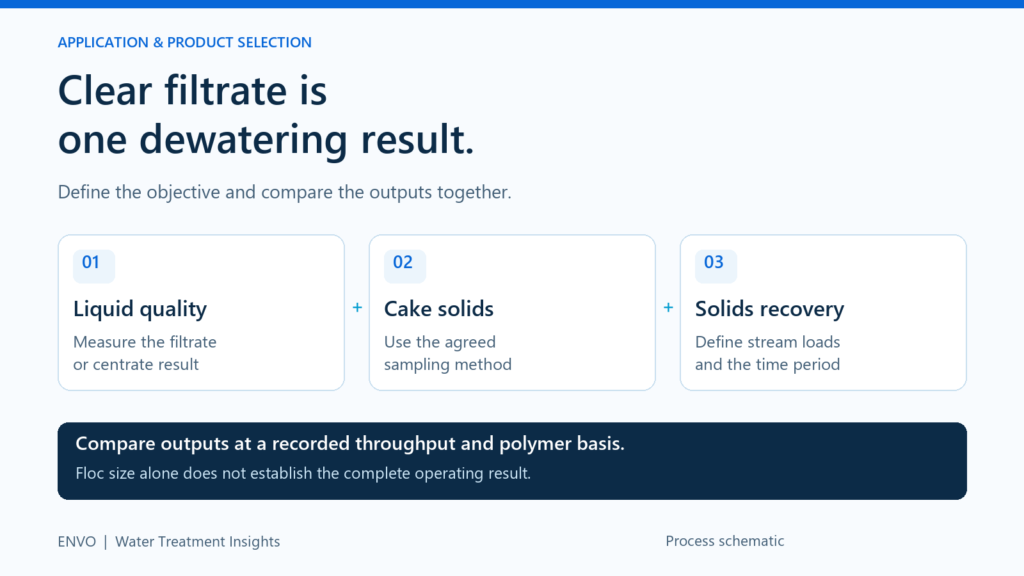
Before comparing two PAM trial results, identify whether each dose means delivered product, active polymer or prepared solution. Convert them to a stated common basis, and keep the original product-basis numbers alongside the conversion. For sludge dewatering, also identify the dry-solids load used as the denominator.
This guide addresses one question: are the dose figures in your comparison actually comparable? For ionic type, viscosity and grade-matching questions, use our separate PAM replacement information checklist.
Separate three different quantities
| Quantity | What it describes | What must be recorded |
|---|---|---|
| Delivered-product dose | Mass of the purchased product applied to a defined water volume or dry-solids mass. | Product identity, dose unit and whether the figure refers to the undiluted product. |
| Active-polymer dose | Polymer mass on the explicitly agreed active-content basis. | Active fraction, its definition and the technical document supporting it. |
| Prepared-solution feed | Volume or mass of the made-up solution delivered by the dosing system. | Preparation recipe, concentration basis and measured feed rate. |
Kemira’s chemical flocculants guidance describes polymer dosage in relation to both active polymer and sludge dry solids. That makes a bare number such as “5 kg per tonne” incomplete unless its numerator and denominator are identified.
Convert a volume-based trial to active-polymer dose
When the supplier has confirmed an active-polymer mass fraction:
Active-polymer dose (mg/L) = delivered-product dose (mg/L) × active mass fraction
A stated 35% active fraction is entered as 0.35. Do not substitute a total-solids figure unless the supplier confirms that it is the correct basis for this calculation.
| Trial product | Delivered-product dose | Assumed, explicitly stated active fraction | Calculated active-polymer dose |
|---|---|---|---|
| A | 4.0 mg/L | 0.90 | 3.6 mg/L |
| B | 10.0 mg/L | 0.35 | 3.5 mg/L |
The delivered-product doses differ by a factor of 2.5, while the calculated active doses are close. The comparison should retain both columns. Similar active doses establish a common reporting basis; grade suitability and treatment performance still require separate evaluation.
For dewatering, calculate against dry-solids load
Use measurements taken over the same operating interval. If sludge flow is measured in m³/h and its dry-solids concentration in kg/m³:
Dry-solids load (kg/h) = sludge flow (m³/h) × dry-solids concentration (kg/m³)
For a measured feed of undiluted product, with product-specific density and active fraction:
Active-polymer feed (kg/h) = product feed (L/h) × density (kg/L) × active mass fraction
Dose (kg active polymer/t dry solids) = active-polymer feed (kg/h) ÷ dry-solids load (kg/h) × 1,000
If the pump delivers a diluted working solution, use that solution’s confirmed active concentration instead of the undiluted product’s density and active fraction. A solids result expressed as a mass percentage also needs the appropriate sludge mass-flow conversion; it is not automatically the same as kg/m³.
Fukasawa and colleagues’ 2024 study of polymer dosing in a sludge dewatering plant explicitly relates polymer flow to sludge flow, sludge dry solids and polymer concentration. The equations above are a unit-explicit mass-balance presentation, not a reproduction of that plant’s operating setpoint.
Check the preparation record before changing the grade
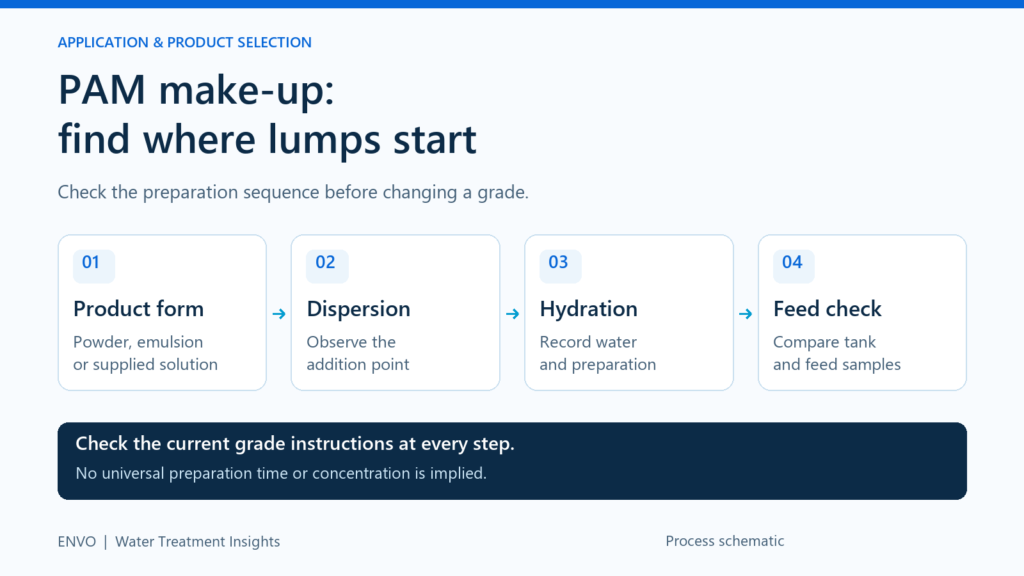
Ask what “0.1% solution” means: mass of delivered product per mass of solution, mass per volume, or active polymer concentration. Record the preparation water, mixing sequence, maturation conditions and solution age. Follow the current product manufacturer’s preparation instructions.
The U.S. EPA’s Dewatering Municipal Wastewater Sludges, Chapter 5 distinguishes polymer make-up arrangements and emphasizes preparation and feed-system control. Its 1987 equipment examples provide historical process context, rather than specifications for a current ENVO product.
Build a trial sheet that another person can reproduce
- Product basis: grade, batch, physical form, active-content definition and document version.
- Preparation basis: product mass, final solution quantity, concentration units and preparation conditions.
- Process basis: representative sample or sludge stream, flow, dry-solids result and sampling time.
- Dosing basis: measured feed, pump calibration conditions, delivered-product dose and calculated active dose.
- Result: the actual treatment objective and test method, such as clarification, solids capture, drainage or cake solids.
Keep unconfirmed inputs marked as unconfirmed. An agreed active-content definition and a calibrated feed measurement are more useful than adding extra decimal places to uncertain inputs.
Share the records needed for a useful comparison
Send the current technical sheet, preparation recipe, dosing records, relevant sample or sludge data, equipment type and the outcome you want to improve. ENVO can use this information to discuss the comparison basis and the product requirements to verify.
Explore polyacrylamide products and sludge thickening and dewatering applications, or contact ENVO about your trial records.
References and calculation method
- Kemira, Chemical flocculants, “Sludge dewatering polymer dosage.” Manufacturer reference for dosage terminology; accessed 27 October 2026.
- Fukasawa, A., Yamato, T. and Watanabe, S. (2024), Automatic Control of Polymer Dosage Using Floc Images in Sludge Dewatering Plant, Environmental Processes 11, article 29. See Section 2.2 and Equation 1. DOI: 10.1007/s40710-024-00707-5.
- U.S. Environmental Protection Agency (1987), Design Manual: Dewatering Municipal Wastewater Sludges, EPA/625/1-87/014, Chapter 5.
The conversion table is ENVO’s illustrative arithmetic using stated hypothetical inputs. The references explain the technical basis; they do not verify an ENVO grade, certificate or site result.