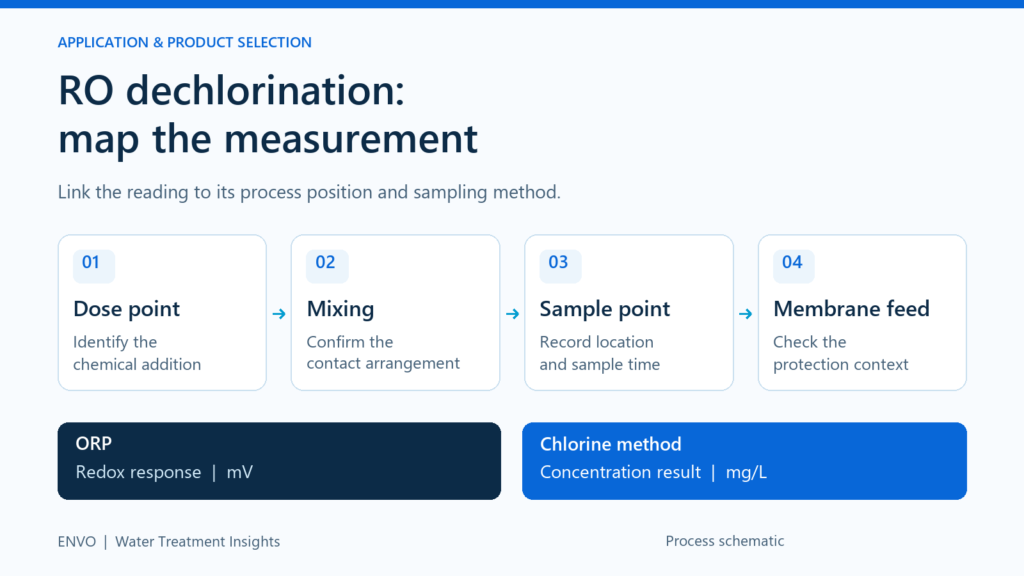
Map the measurement before changing the dose. When an RO dechlorination result is uncertain, identify the chemical addition point, mixing section, monitoring location and membrane feed. Then compare measurements taken at defined locations and times. An ORP number and a chlorine concentration describe different measurements; neither should be interpreted without its sampling and instrument context.
Understand what an ORP reading represents
ORP is reported in millivolts and responds to the redox conditions of the sample. It is not a direct free-chlorine concentration in mg/L. Hach’s dechlorination measurement discussion explains that pH, temperature and other oxidants or reductants can affect the relationship between ORP and chlorine. A falling ORP trend therefore needs interpretation, rather than an automatic conversion into a residual-chlorine result.
Keep the plant’s approved membrane-protection interlocks in service during investigation. Use the membrane supplier’s operating limits and the instrument method specified for the application.
Draw a simple process and sampling map
- Incoming water: where is the relevant chlorine demand measured?
- Chemical addition: where does the dechlorinating solution enter?
- Mixing: what section provides contact and mixing before the monitored stream reaches the membranes?
- Monitoring: where are the ORP probe and any chlorine sample connection?
- Membrane feed: does the monitoring arrangement represent the water entering the RO system?
DuPont’s February 2026 FilmTec chlorination/dechlorination excerpt discusses mixing, chemical injection and downstream ORP monitoring. Its recommendations are membrane-system guidance, not an ENVO chemical specification. Review the arrangement for the installed system instead of copying a setpoint from another plant.
Compare results that refer to the same water
| Comparison | Information to record | Question it helps answer |
|---|---|---|
| Online ORP and a chlorine-method result | Exact locations, collection times, units and method | Are the two results actually describing the same operating period and stream? |
| Before and after chemical addition | Flow, addition status and sampling positions | Where is the measured change occurring? |
| Stable operation and a reported alarm | Time-stamped readings and the corresponding feed-system record | Did the event coincide with a process, chemical-feed or monitoring change? |
| Current and earlier instrument checks | Probe maintenance, standard checks and sample-system condition | Is an apparent process change also associated with a measurement change? |
Use the specified analytical procedure and its checks. In particular, write down whether a chlorine result is free or total chlorine, together with its reporting limit and any stated interferences. A result described only as “zero chlorine” leaves important information missing.
Avoid turning a measurement problem into an uncontrolled dosing change
Do not assume that every high ORP reading is caused by the same chlorine load. Hach also discusses how misinterpretation can encourage excess reducing-agent feed. DuPont’s guidance identifies operating conditions in which sulfite control requires particular attention. Together, these references support checking both the measurement and the actual chemical-feed conditions before proposing a process adjustment.
Prepare a record with the supplied chemical identity, solution preparation, measured feed delivery, water flow and simultaneous analytical results. Any dose change should follow the site’s approved operating procedure and the applicable product and equipment documentation.
Questions buyers often ask
Can one ORP setpoint be used for every RO system?
A setting must be reviewed for the installed system, probe arrangement and actual water conditions. A published example is not a transferable approval for every membrane, chemical or sample stream.
Are sodium metabisulfite and a supplied bisulfite solution interchangeable by volume?
Confirm composition, concentration basis, density where relevant and the preparation method. Comparing only pump volume omits the product basis. Request the current grade documents before calculating a substitution.
What to send with a dechlorination enquiry
Send the membrane model, a marked process sketch, current chemical and technical sheet, feed records, water flow and time-matched ORP and chlorine results. Explore sodium metabisulfite, sodium bisulfite and RO pretreatment applications, or discuss the records with ENVO.
Sources and scope
- DuPont, FilmTec Chlorination/Dechlorination Technical Manual Excerpt, revision 11, February 2026: membrane protection, mixing and monitoring context.
- Hach, Is ORP Really Your Best Option for Dechlorination Measurement?, updated 28 July 2026: ORP interpretation and measurement limitations.
Sources checked on 27 October 2026. The sampling map and comparison table are ENVO’s editorial tools. This article does not prescribe a universal ORP value, chemical dose or membrane operating limit.