
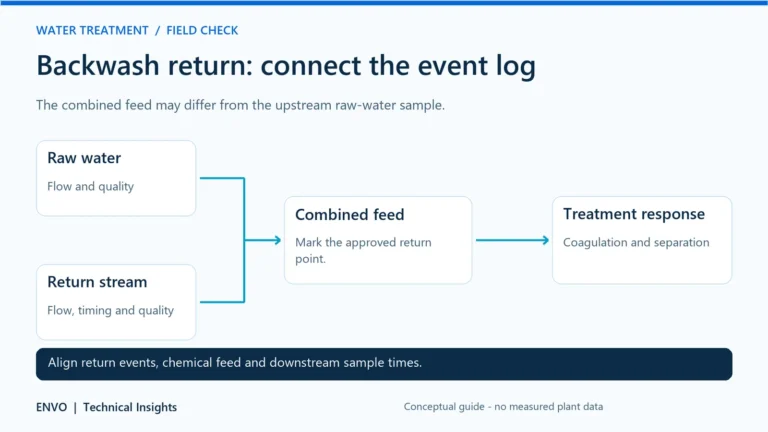
When alum clarification becomes unstable around a backwash-return event, put the recycle flow on the same timeline as the treatment results. The incoming raw-water record may not describe the full water and solids load reaching coagulation. Investigate the combined feed before assuming that the alum shipment changed.
Draw the actual return route
Identify which streams return: spent filter backwash, clarification residuals supernatant or another process liquid. Mark any holding, treatment and controlled-release steps. Record the approved return point. Different recycle streams should not be combined under one unqualified name in a test report.
US EPA's Filter Backwash Recycling Rule resources explain why recycle practices need review for treatment performance and microbial control. The technical guidance discusses flow and water-quality variation during recycle. Its regulatory provisions concern covered US systems; they are not a universal return-flow limit for every ENVO customer.
Use one event-based operating record
Align the backwash start, return-pump operation, raw-water flow, chemical-feed record and downstream samples. Account for travel and retention time. A downstream change that appears later may still relate to an earlier return event. A same-clock-time comparison without that context can point to the wrong cause.
| Time-series record | What to compare | Question for the review |
|---|---|---|
| Return flow and duration | Raw flow and combined process loading | Was there a short hydraulic event or a sustained return? |
| Return-stream quality | Start, later and representative-period samples | Was one sample representative of the event? |
| Alum delivery | Product identity and the flow used for feed pacing | Did the feed record reflect the combined treatment condition? |
| Clarifier and filter observations | Expected arrival of the return event | Where did the treatment response first change? |
Represent the return water in a treatability comparison
If recycle is part of normal operation, a raw-water-only jar test may omit an important condition. Design the comparison with the responsible process team using representative streams and an approved sampling plan. Record how the mixture relates to measured flow. An arbitrary laboratory blend should not be described as the actual plant condition.
Keep the return-water comparison separate from an alum-grade comparison initially. Establish a baseline with the current product and defined combined water. Then test the proposed variable. Changing recycle conditions, grade and dose together makes it difficult to identify a cause or evaluate the supplier fairly.
Separate hydraulic and chemical explanations
A return event may change several conditions simultaneously. Review treatment-unit loading and operating state as well as chemistry. Ontario's treatment guidance treats downstream processes and chemical application as linked considerations. A clearer jar cannot by itself show that an operating clarifier will handle a different hydraulic event.
Options such as equalization, treatment of a return stream or a revised return arrangement need a design and operating review. Do not adopt a percentage from a historical example as a permission to change the plant. Retain microbial-control safeguards and the locally applicable requirements throughout the investigation.
Questions about alum and recycle
Does stable raw-water turbidity rule out a recycle-related upset?
No. The raw-water sample may be upstream of the return connection. Establish the combined treatment boundary and the quality of the returned stream before drawing that conclusion.
Can a larger alum feed replace equalization?
These measures address different questions. A chemical change does not demonstrate adequate hydraulic or solids-handling capacity. The proposed response needs evidence from the actual system and approval through the plant’s engineering and operating process.
Prepare an event-based enquiry
Provide the return-flow sketch, a synchronized event log, chemical documents and matched separation results. Explore aluminium sulfate and raw-water clarification, or send ENVO a product and process brief. Identify the suspected event rather than describing the entire problem simply as “poor floc.”
Related technical guides
- Residual Aluminum After Alum: Dissolved or Floc Carryover?
- Alum for Phosphorus Removal: Orthophosphate Is Not Total P
Sources and scope
- US EPA, Filter Backwash Recycling Rule documents and technical manual
- Ontario, Design Guidelines: Treatment and Chemical Application
Sources checked on 30 October 2026. The comparison framework and illustration are original ENVO editorial material. They are not a plant case study, a product performance guarantee or a substitute for the applicable product label, operating procedure and local requirements.
