
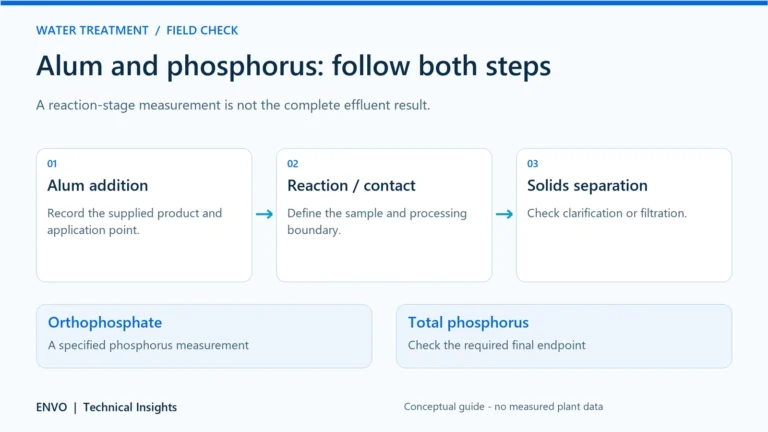
A low orthophosphate result does not, by itself, demonstrate that a total-phosphorus target has been met. An alum trial should define the phosphorus measurement, the sample boundary and the solids-separation step before a chemical-dose conclusion is drawn. Otherwise, two apparently conflicting results may be answering different questions.
Start with the phosphorus result required
US EPA Method 365.1 distinguishes phosphorus forms through sample preparation and analytical treatment. Ask the laboratory whether a result represents orthophosphate, dissolved phosphorus or total phosphorus, and retain the reporting basis. An abbreviated spreadsheet label such as “P” can hide an important difference.
Confirm the applicable effluent requirement with the responsible process and compliance team. Keep the laboratory method, sample type, reporting limit and units on the trial sheet. Do not compare a filtered grab sample with an unfiltered composite result as if only the chemical dose had changed.
Follow precipitation through to solids separation
The US EPA Nutrient Control Design Manual describes metal-salt phosphorus removal as a combination of chemical reaction and removal of the resulting solids. Alum addition is therefore only part of the treatment boundary. A favorable reaction-stage result still needs the downstream clarification or filtration performance to be evaluated.
Mark the chemical application point, contact and mixing steps, separation unit and final sample. Identify whether the trial sample was allowed to settle, filtered in the laboratory or collected from an operating unit. Those steps affect what reaches the analysis. Preserve that information when reporting a result to a supplier.
| Result or observation | Useful question | Additional evidence |
|---|---|---|
| Orthophosphate decreases | Was the targeted reactive fraction reduced? | Defined method, sample processing and total-P result |
| Total P stays above the required outcome | Which fractions or particles remain? | Matched filtered/unfiltered assessment where appropriate |
| Performance changes after clarification | Is solids separation part of the limitation? | Suspended-solids or particle-quality records |
| One grab sample looks unusually favorable | Does it represent the operating load? | Flow and sampling records over a relevant period |
Keep the comparison interpretable
Record influent conditions, flow, alum identity and actual delivery. Keep the sample-processing procedure consistent between conditions. If the laboratory changes dilution, filtration or digestion, document that change before combining the results in a comparison. Use a sampling plan that can distinguish an operating trend from an isolated observation.
A useful trial question is whether the proposed change improves the specified final outcome at a defined treatment boundary. It is less useful to ask which beaker becomes clearest without considering the analytical result. Likewise, chemical consumption should be compared over a consistent load and product basis, not simply by pump position.
Review the effects outside the phosphorus number
Include the resulting solids load, pH-condition records and downstream operation in the review. The EPA design manual discusses application-point and operational considerations; a generic reaction ratio is not a complete plant dose recommendation. The installed process and actual water determine what must be demonstrated.
Summarize the test as a short decision record: the required endpoint, the conditions compared, the evidence obtained and the unresolved limitation. Keep unsuccessful runs and changes in feed characteristics in the record. They help explain whether a proposed supply change was tested fairly.
Questions about alum phosphorus trials
Can a total-P limit be checked using an orthophosphate-only test?
Not as a direct replacement. Confirm the required parameter and the approved analytical method. A process-control test can be useful without being equivalent to the compliance measurement.
Will adding more alum solve a high total-P result?
That depends on the limitation. Establish the measured phosphorus forms and the effectiveness of solids removal first. More chemical is not evidence that the relevant fraction or separation problem has been addressed.
Prepare a phosphorus-removal enquiry
Send the target parameter, laboratory methods, matched influent and effluent data, process sketch and current chemical documents. Review aluminium sulfate and activated-sludge process support, or share the treatment and supply requirements with ENVO.
Related technical guides
- Residual Aluminum After Alum: Dissolved or Floc Carryover?
- Alum Treatment Upsets During Backwash Recycle: Track the Return
Sources and scope
- US EPA, Nutrient Control Design Manual (August 2010), Chapters 3 and 9
- US EPA, Method 365.1, Revision 2.0 (August 1993)
Sources checked on 30 October 2026. The comparison framework and illustration are original ENVO editorial material. They are not a plant case study, a product performance guarantee or a substitute for the applicable product label, operating procedure and local requirements.
