
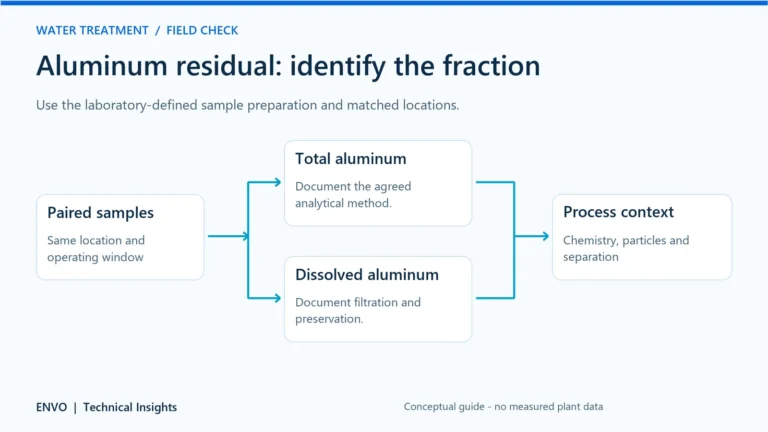
A high total-aluminum result after alum treatment does not identify the cause by itself. Determine whether the investigation concerns dissolved aluminum, aluminum associated with particles, or a sample-handling problem. Pair the analytical result with the exact treatment location before changing the coagulant.
Ask what the laboratory actually measured
“Aluminum” on a spreadsheet is incomplete without a method and sample description. Health Canada's aluminum technical document distinguishes dissolved and particulate fractions and explains why sample preparation matters. Filtration and preservation must follow the agreed laboratory procedure; filtering an already preserved sample later is not automatically equivalent.
Ask the laboratory which measurement is reported, the reporting limit, the filtration arrangement where applicable and the preservation requirements. Identify whether the required compliance result is total aluminum or another specified measurement. A process-diagnostic result and a compliance sample can serve different purposes.
Use a matched sample set
Compare samples from defined points, such as source water, clarification effluent and individual filter effluent, using a time window that accounts for process travel. Record the relevant pH, temperature, turbidity and filter operating state. Include whether the sample followed a backwash or another disturbance.
| Pattern to investigate | Evidence to check | Interpretation limit |
|---|---|---|
| Total aluminum rises with a particle-quality change | Paired dissolved result and separation-stage records | Association does not establish the exact failure point |
| Dissolved aluminum changes while turbidity stays similar | Sampling method and coagulation chemistry records | Low turbidity does not exclude dissolved aluminum |
| Only one filter stream changes | That filter’s operation and paired upstream sample | A plant-wide chemical change may not address a local issue |
| Results change with sample handling | Bottle, preservation, filtration and timing documentation | Unmatched sample processing prevents a reliable comparison |
Keep the chemistry and separation questions distinct
A clarified-water result and a filter-effluent result represent different treatment boundaries. Mark where the apparent increase occurs. A particulate issue may require investigation of capture or release, while a dissolved result directs attention to a different set of questions. Several mechanisms can operate together.
Do not treat the difference between two unmatched laboratory results as a precise particulate concentration. Confirm that methods, timing and sample processing support the comparison, and consider analytical uncertainty. This is especially important near reporting limits or when one result is reported only as below a detection limit.
Review the whole treatment objective
Ontario's treatment design guidance discusses the interaction of aluminum coagulants, process conditions and downstream treatment. Use the residual investigation alongside the required particle and other water-quality controls. Reducing the chemical feed without a process review can create a different treatment problem.
A practical investigation record states which explanation the evidence supports, which evidence is missing and what controlled comparison is proposed. It should distinguish a suspected chemical-condition change from a filter event. Keep adjustments within the plant’s approved procedures and the requirements of the responsible drinking-water authority.
Questions about aluminum residuals
Can clear water still contain dissolved aluminum?
Yes. A visual observation or turbidity reading does not measure every dissolved constituent. Use the appropriate analytical method and sampling plan rather than interpreting appearance as a dissolved-aluminum test.
Should alum be replaced as soon as total aluminum increases?
First locate the increase and identify the measured fraction. A sampling discrepancy or a separation-stage disturbance needs a different response from a demonstrated coagulant-condition problem. An alternative-grade trial should begin with that distinction.
What to send with an alum enquiry
Provide the current alum documents, sample locations, laboratory methods, paired results and a filter-event timeline. State the applicable treatment requirement. Review aluminium sulfate and clarification applications, or discuss the documented product and process requirements with ENVO. The objective is a traceable comparison, not a residual claim based on a single sample.
Related technical guides
- Alum for Phosphorus Removal: Orthophosphate Is Not Total P
- Alum Treatment Upsets During Backwash Recycle: Track the Return
Sources and scope
- Health Canada, Aluminum Guideline Technical Document (March 2021)
- Ontario, Design Guidelines: Treatment and Chemical Application
Sources checked on 30 October 2026. The comparison framework and illustration are original ENVO editorial material. They are not a plant case study, a product performance guarantee or a substitute for the applicable product label, operating procedure and local requirements.
