
Map the movement of contaminants
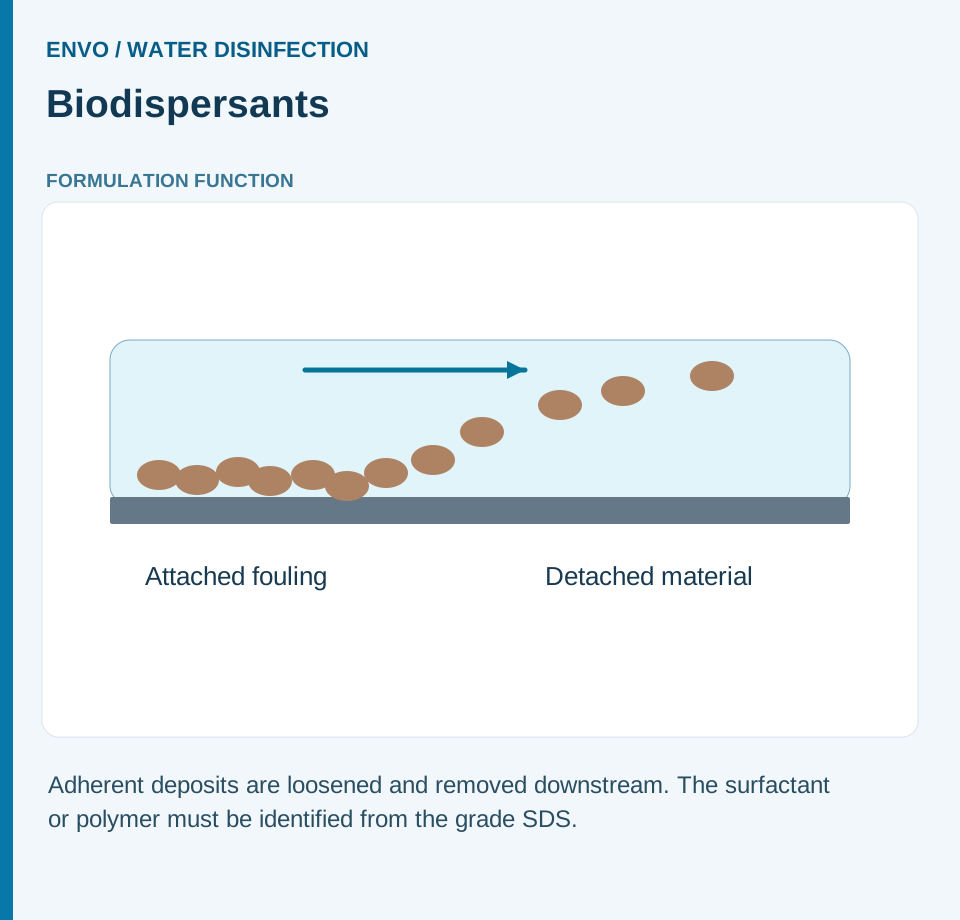
First map heat exchangers, collection basins, filters and blowdown outlets onto the actual process, recording pretreatment differential pressure, flow and turbidity at each. Observing only a transparent sample bottle can lead to mistaking transferred deposits for complete removal. Manufacturer literature describes biodispersant functions involving wetting and fouling dispersion, but the actual formulation still matters. A dispersion-performance statement does not establish sufficient downstream solid-liquid separation capacity.
Use timing relationships to distinguish different changes
A short-term rise in suspended solids and changed filter-retained material after treatment may be consistent with removal of existing deposits. However, sustained differential-pressure increases with falling flow may indicate that the filtration system cannot discharge the incoming load quickly enough. Compare data at the same operating flow and place backwashing, makeup water and other cleaning activities on one timeline. Increased differential pressure alone proves neither efficacy nor failure, and blockage is not a normal consequence that must simply be tolerated.
Check whether the problem is merely being shifted downstream
Check protection for critical small openings, nozzles, side-stream filters and heat-exchange passages, and inspect them under equipment procedures. Material removed during cleaning may redeposit if it reenters circulation, despite temporary surface improvement. Site trials should include destinations for captured material, cleaning arrangements and waste-handling responsibilities rather than postponing these until the trial ends. Systems with biological contamination must also follow existing risk-management procedures; ordinary dispersion observations cannot replace hygiene assessment.
Design staged reviews with stopping options
The site manager should set inspection points and stop criteria within permitted equipment conditions, recording visible deposits, filtration load and key operating parameters in stages. Stop thresholds must come from equipment requirements and approved site procedures, not generic online values. If stable flow cannot be maintained, blockage locations cannot be identified or no discharge route exists, establish those conditions before testing. This helps identify genuine operating improvements rather than using one pronounced water-phase change to rank product quality.
Express the purchasing objective as a complete outcome
Provide a system diagram, principal deposit locations, current filtration and expected cleaning window with the inquiry, asking candidate formulators to explain suitability limits and assessment methods. Acceptance records should cover changes in attached deposits alongside filtration, blowdown and restart results; evaluation need not promise a fixed removal rate. Engineering personnel should assess whether severely blocked equipment requires mechanical or specialized cleaning. A generic dispersant cannot be expected to replace all maintenance.
Explore further
Does increased differential pressure prove that a dispersant is working?
It is only a potentially related operating observation and should be assessed alongside retained material, flow and timing records.
Can a dispersant replace filter backwashing?
No. Detached material still requires appropriate capture and removal.
References
This article draws on publicly available technical information. Third-party sources do not establish ENVO product approvals, field testing or project experience. Confirm each use against actual supply documents and site conditions.