
Temporary turbidity or differential-pressure rise after treatment
Plan filtration and blowdown in advance and monitor deposit loading.
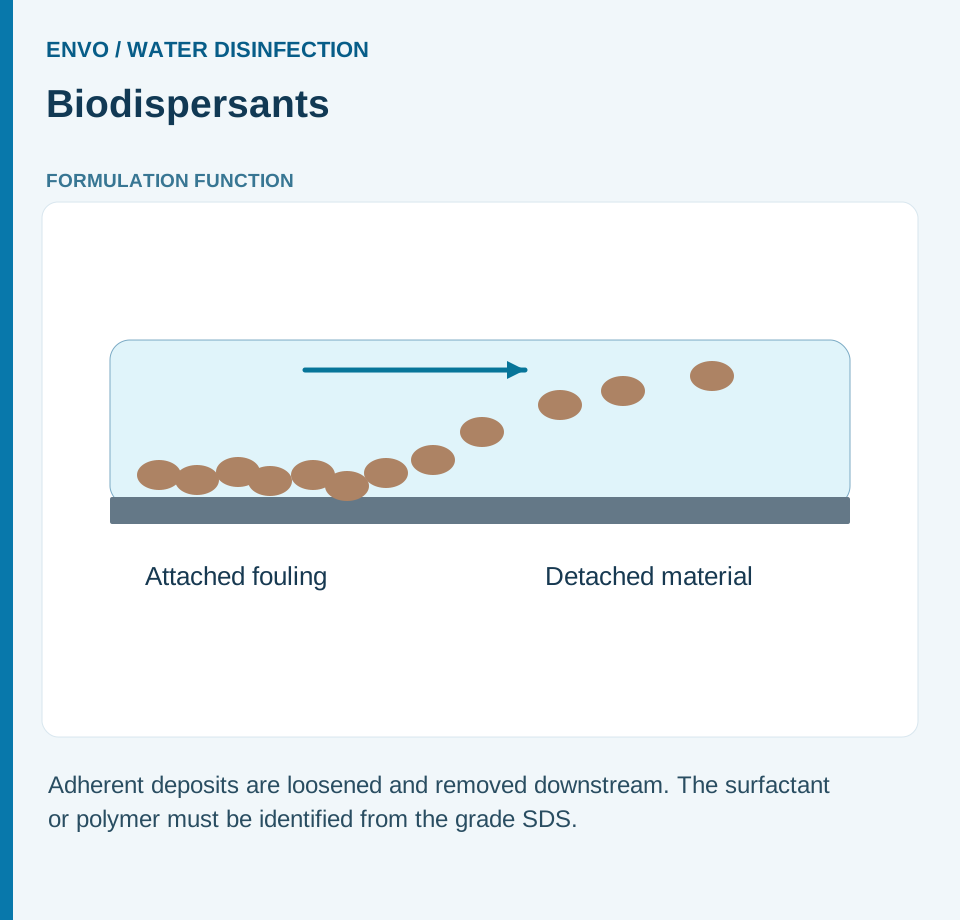
Precursors and supporting products / Auxiliary product
Biodispersants · Supporting products
An auxiliary product for cleaning programs targeting adherent fouling and biofilms. Compatibility with the primary chemical, the fate of detached deposits and process quality are key; dispersal is not equivalent to microbial killing.
An auxiliary component of biocide, cleaning, filtration and blowdown programs.
Bring an existing model or purchasing specification directly into the discussion.
Identity and physical form identify the product; specific concentration, grade, packaging and uses are governed by mutually confirmed formulated-product documents.
01 / Product and applications
A functional formulation that may contain surfactant or dispersing components; no universal formula or CAS is assigned.
The specific formulation's liquid or other form, color and foaming behavior must match actual supply documents.
02 / Specification selection
| Items to confirm | Relevance to purchasing and use |
|---|---|
| Functional evidence and component types | Clarify actual dispersing, wetting or other functions. |
| Compatibility with the primary chemical and existing additives | Avoid reducing biocidal or process performance. |
| Foam and product quality | Cooling towers, paper machines and oilfields each have constraints. |
| Filtration and blowdown capacity | Detached deposits need a manageable removal path. |
Include parameters, test methods and acceptance checkpoints in purchasing requirements to compare specifications.
03 / Applications and limits
These are starting points for conditional verification. Specific product suitability still requires joint confirmation through product documents, operating conditions and destination requirements.
04 / Common challenges
Plan filtration and blowdown in advance and monitor deposit loading.
Validate microbial control and deposit removal separately.
Conduct process-compatibility trials using the complete formulation.
05 / Documents and evidence
These documents support technical categories and use limits, not ENVO certifications or customer cases. Verification date: 2026-10-26.
06 / Frequently asked questions
No. Auxiliary dispersion and microbial killing require separate evidence.
This depends on the specific formulation, system load and treatment procedure.
Consider deposits, differential pressure, turbidity, microbiology and process quality together, not just clearer water.
Related selection options
Related products are not necessarily direct substitutes; verify each intended use.
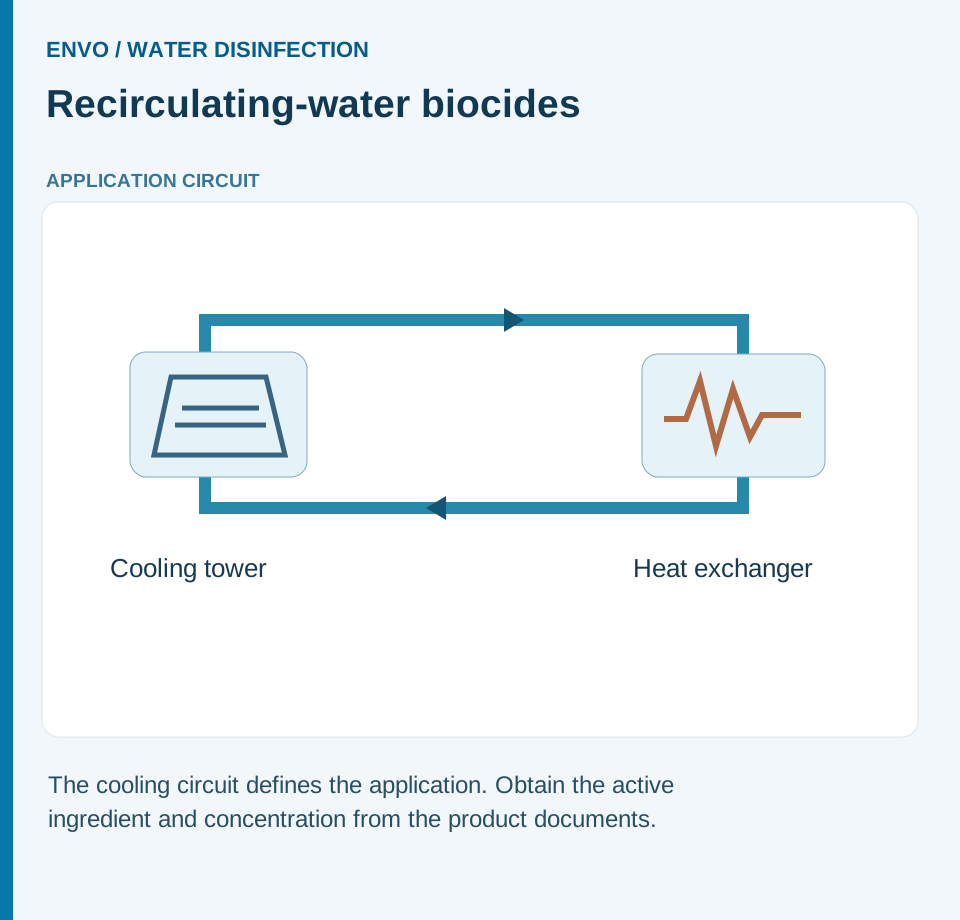 Technical schematic
Recirculating water formulations
A purchasing starting point that considers system water quality, microbial diagnosis and corrosion/scale inhibition programs together. Compare oxidizing, non-oxidizing and validated blended approaches, then select a specific formulated product and operating objectives.
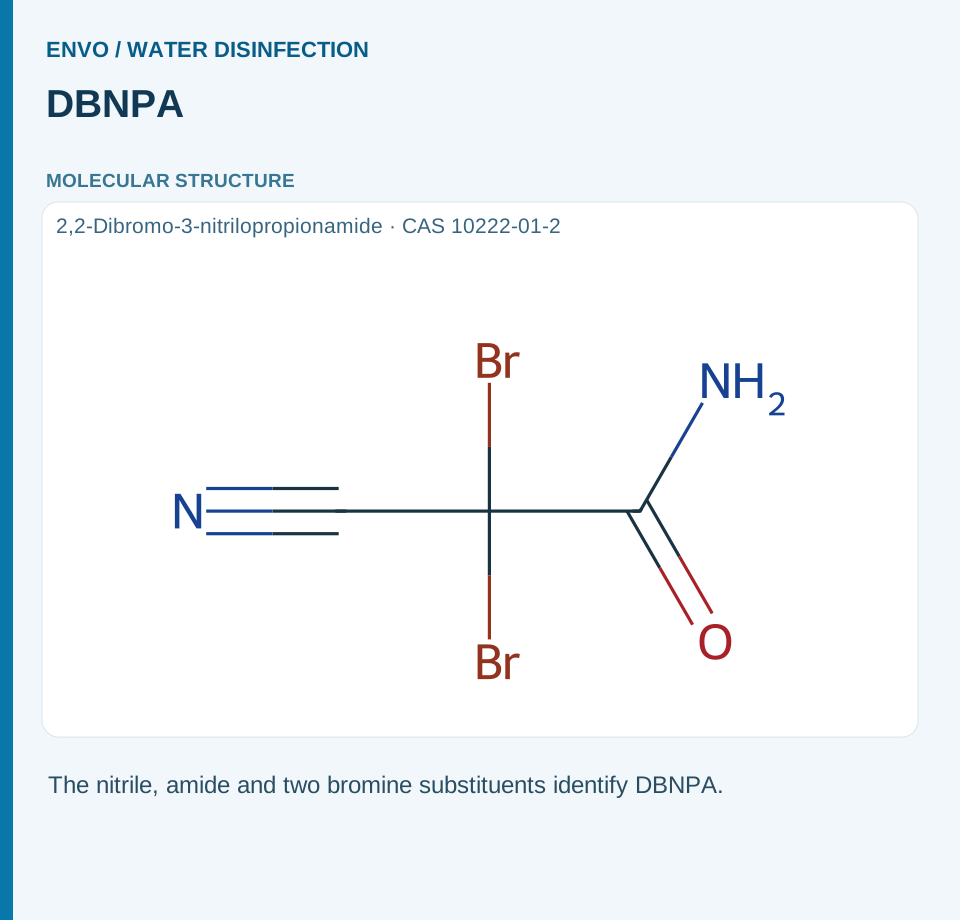 Molecular structure
DBNPA
For microbial control in membrane systems and industrial water where the corresponding use is supported. Select formulated products according to membrane material, treatment stage and water quality; do not replace existing products solely on the basis of an active ingredient name.
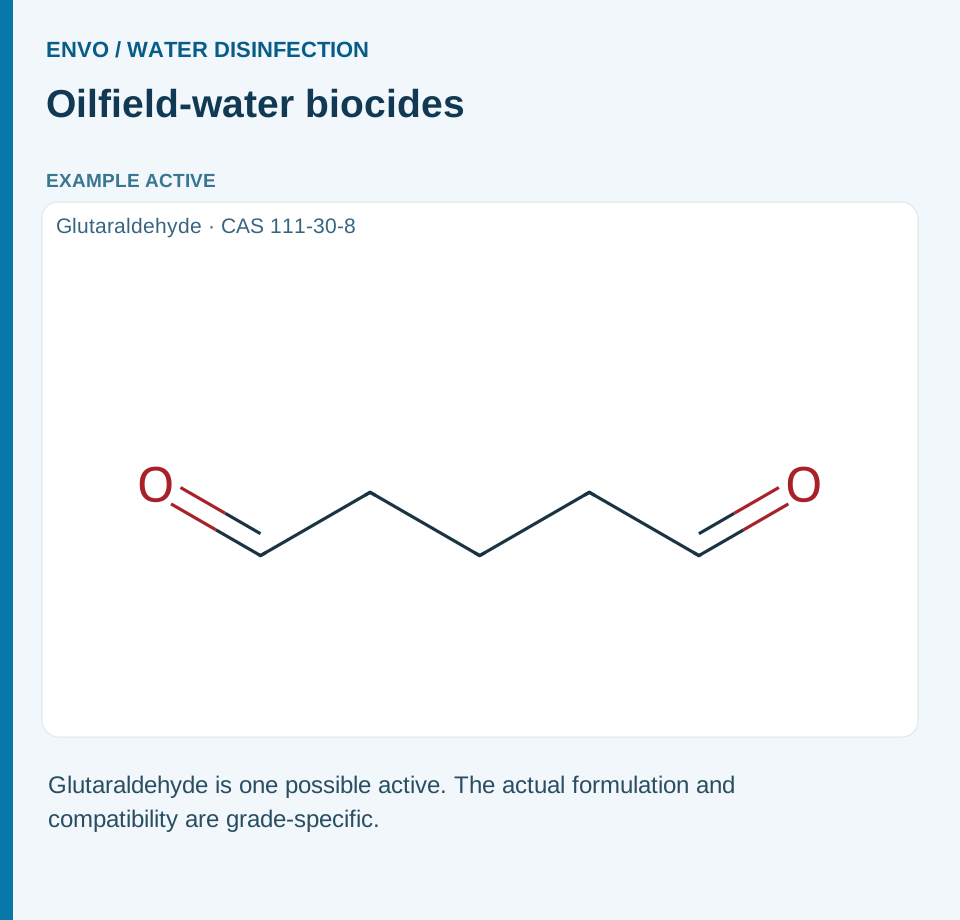 Example active
Oilfield formulations
Select for a specific treatment stage: produced water, reinjection, fracturing or surface water storage. Efficacy, corrosion and fluid compatibility require validation under the same actual operating conditions; one test cannot represent an entire oilfield.

Once dispersion transfers deposits into the water phase, downstream filtration and blowdown capacity become critical. Biodispersant evaluation must go beyond cleaner surfaces to confirm where detached material ends up and whether equipment receives extra loading.
Read and verify →
Low foam describes performance under specific conditions. A still beaker with no foam does not represent aeration, falling return water or high shear in recirculating water. Purchasing trials should observe foam formation, collapse and process effects.
Read and verify →
Biological fouling control in white-water systems must be evaluated with paper-machine wet-end operation. Purchasing should consider not only loosened deposits, but also changes involving dispersed material, existing additives and sheet quality.
Read and verify →ENVO · Purchasing and application support
Start with a product name, current model, water-quality report or destination documentation requirements.