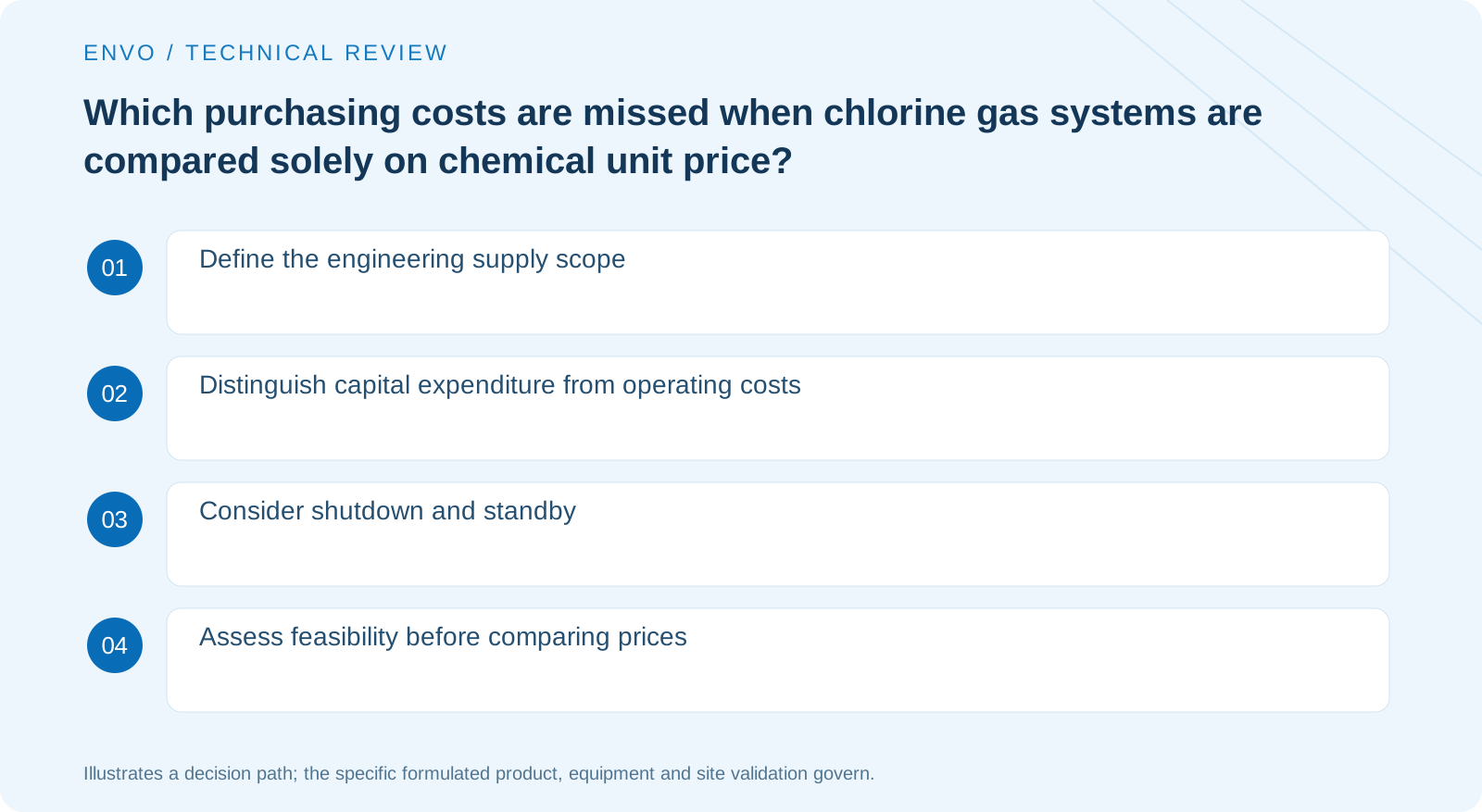
First define the complete engineering scope
Describe existing facilities, new facilities and the modification scope, identifying responsibility for chemical receipt, storage, feeding, monitoring and emergency management. Public disinfection guidance describes system approaches; it does not establish that ENVO holds engineering qualifications or complete supply capability for a particular project.
Separate one-time expenditure from recurring costs
Initial investment includes design, installation and necessary facilities. Ongoing costs include actual items such as raw materials, maintenance, testing, personnel and compliance management. Amounts should come from real quotations, not online averages used in place of site-specific costs. Compare options with the same treatment objectives and water-supply conditions.
Account for shutdown and standby capacity
Evaluate more than unit cost during normal operation: discuss continuous treatment during maintenance, equipment failure and supply interruptions. Backup capacity needs explicit engineering design; a webpage should not prescribe operating arrangements. Without operations and maintenance support, a candidate's price advantage may not translate into an executable project.
Screen for feasibility before ranking by price
Confirm that the site, personnel and local requirements are satisfied before comparing commercial terms. Projects lacking the necessary engineering conditions should consider a more suitable approach rather than ignore facilities in pursuit of a low price. Separately listing chemical supply and engineering services helps prevent gaps in responsibility.
Include long-term responsibilities in comparable engineering quotations
Break quotations into main equipment, auxiliaries, monitoring, training, maintenance spares and handover services, assigning responsibility. Gas-source price versus another program's chemical price cannot establish total engineering cost. Mark unquoted items as undefined scope rather than zero cost or insert market estimates as if they were the project budget.
Compare operating costs for equivalent treatment tasks and conditions, separating initial construction, continuing consumption and periodic maintenance. If one offer includes standby capacity and another does not, align service scope first. EPA documents provide route background, but historical cost figures are not current local or ENVO project quotations.
Decision tables should establish whether personnel, management and emergency responsibilities can meet proposal requirements. These engineering-suitability factors cannot be ignored because raw materials are cheap. Final selection should define verifiable supply scope, missing site conditions and acceptance evidence before omitted auxiliary elements become apparent after purchase.
Explore further
Does cheaper chlorine gas necessarily mean a lower total cost?
No. Chemical price alone omits engineering, operating and maintenance costs.
Can the existing chemical dosing room be reused directly?
Professional design and compliance checks must confirm this; the existence of a site alone is insufficient.
References
This article draws on publicly available technical information. Third-party sources do not establish ENVO product approvals, field testing or project experience. Confirm each use against actual supply documents and site conditions.