First establish whether the endpoint is discharge or further reuse
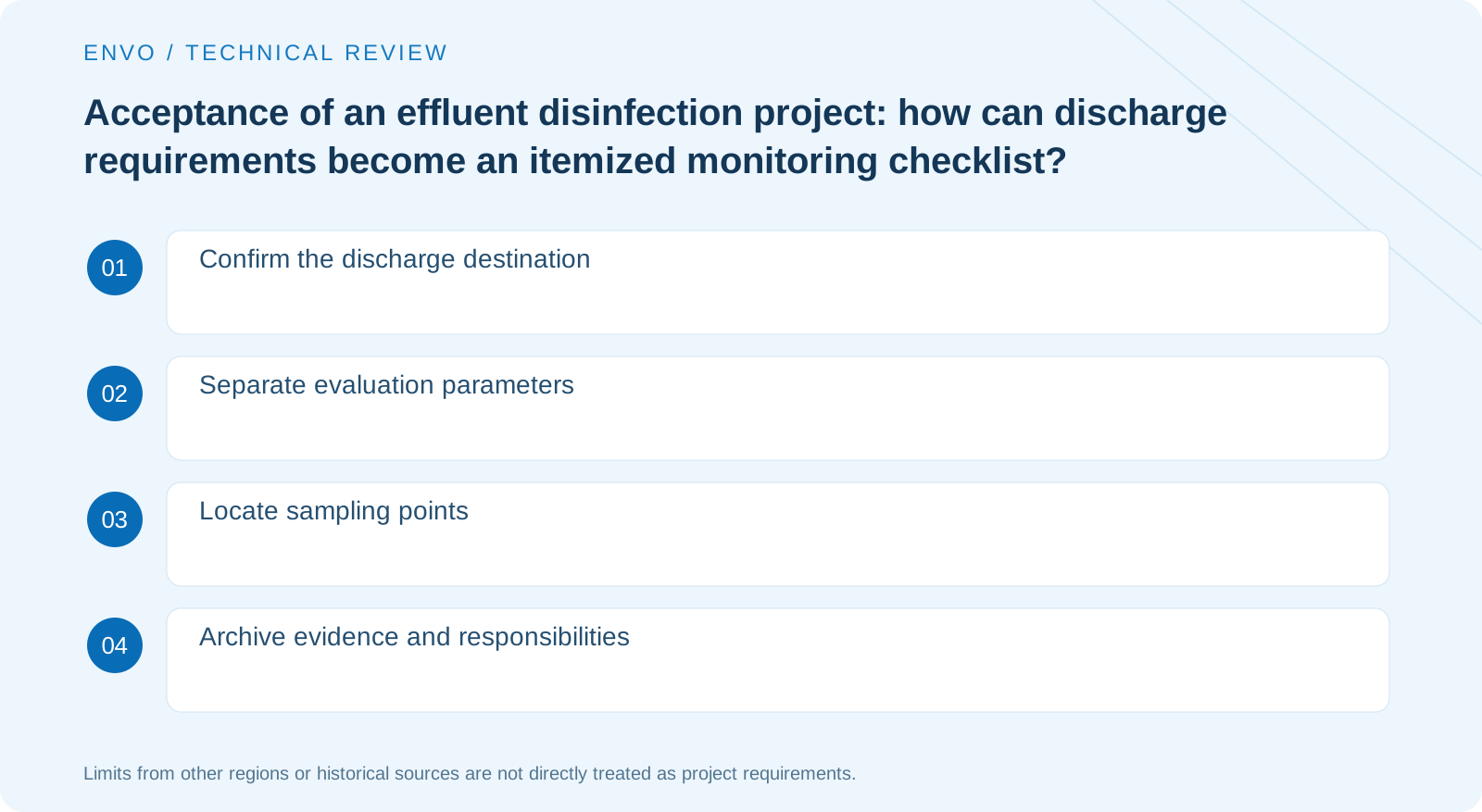
One effluent stream may divide into several uses with distinct requirements. Identify actual outlets, subsequent storage and recipients, confirming document versions and jurisdiction. This article provides no universal cross-region discharge limits. Engineering or management personnel should verify current requirements and turn them into procurement inputs rather than cite online summaries alone.
For each permit or contractual parameter, add required sampling location, sample type, reporting frequency and applicable conditions, attaching the source version. Name online controls and laboratory reports separately when purposes differ. This prevents stable dosing-equipment operation being mistaken for discharge compliance assessment and clarifies scope when testing providers change.
Distinguish target microorganisms from operational surrogate indicators
An online residual used for control does not automatically establish every microbial target; microbial results likewise do not confirm chemical residuals or other discharge conditions. EPA technical information supports route-specific assessment of water quality and process conditions. Monitoring sheets should distinguish control from acceptance parameters and state methods so one value does not carry every conclusion.
Give sampling points a clearly defined scope
Sampling before disinfection, after contact, after removal or at the final outfall answers different questions. Link locations to process identifiers and identify other flows joining upstream. Follow applicable testing and storage procedures rather than substitute results between treatment stages. Update acceptance forms whenever design changes sampling locations.
Agree in advance on handling missing measurements and anomalies
When equipment stops, instruments fail or samples are invalid, record why data are missing and the management measures taken. Estimates cannot replace measurements. Acceptance plans should explain how insufficient evidence will be supplemented, preventing 'testing completed' from becoming 'all passed.' Define necessary third-party testing and project responsibilities early so delivery does not reveal unavailable methods or sampling conditions.
Create a traceable delivery package
Delivery packages may include process diagrams, monitoring tables, methods, calibration, product documents, trial scope and operating-training records. Identify evidence supporting every commitment, distinguishing generic supplier information from actual project testing. Later product, equipment or use changes then have a clear review starting point rather than reliance on one original promise of compliance.
Explore further
Can one online parameter form the entire acceptance basis?
Do not assume this; determine assessment methods and locations for each actual requirement.
Does a limit appearing in technical information automatically apply to this station?
Check the jurisdiction, use, document version and specific project requirements.
References
This article draws on publicly available technical information. Third-party sources do not establish ENVO product approvals, field testing or project experience. Confirm each use against actual supply documents and site conditions.