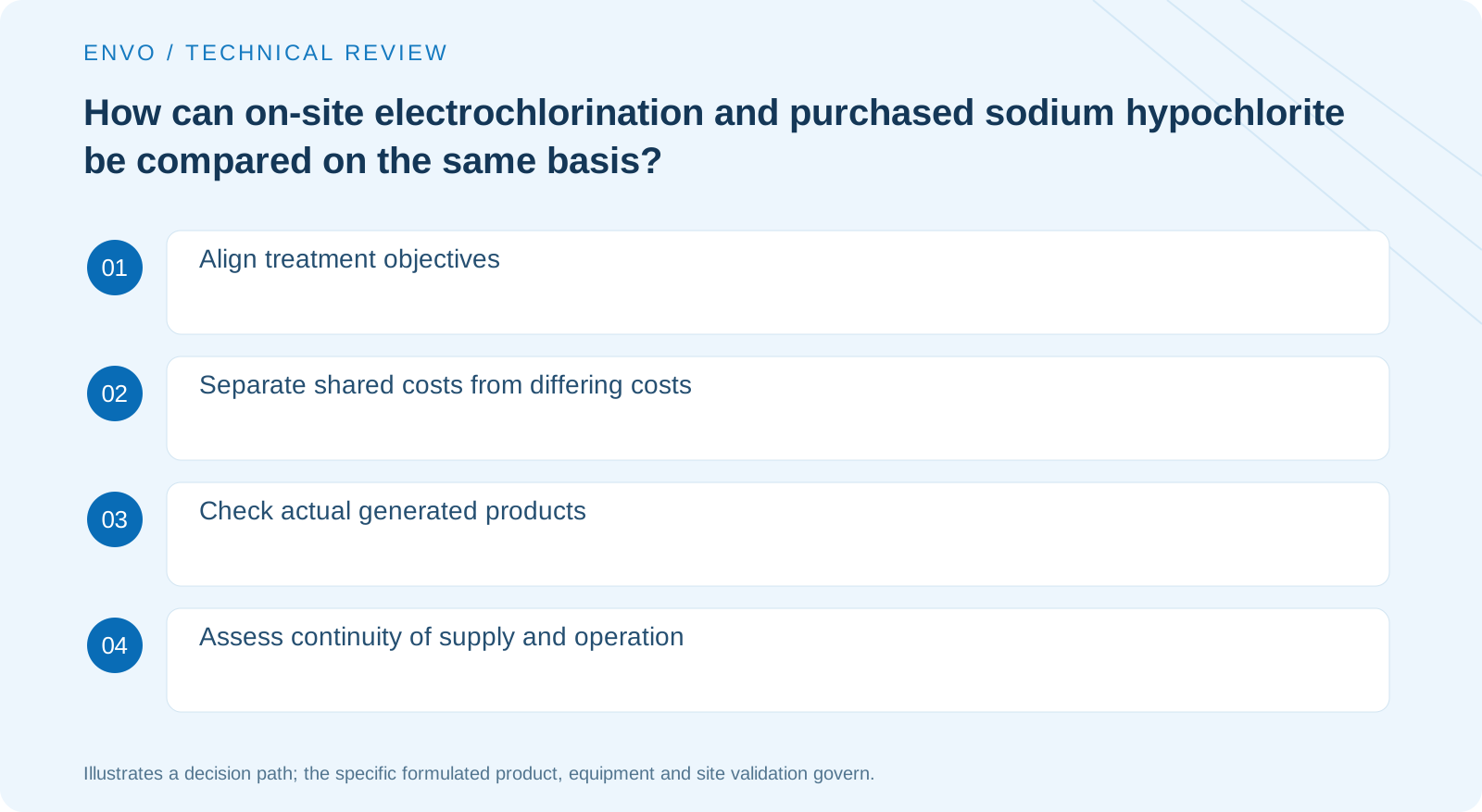
Establish shared service objectives
Specify actual throughput, final use, demand variation and continuous-supply requirements. Otherwise one party may calculate for low load while another supplies for peak demand, making costs incomparable. Required water quality and available operating-maintenance resources should also be shared conditions.
List the duties performed by each of the two approaches
Purchasing liquid chemicals involves supply, receiving, storage and metering; on-site generation involves salt or seawater, energy, equipment, testing and maintenance. Separate shared and differing cost items without omitting either option's supporting requirements or treating equipment maintenance for one option as zero.
Compare actual output products and supplied condition
Check purchased formulated products by batch and storage conditions, and on-site generated solutions against actual equipment conditions and monitoring. Do not use one equipment supplier's example of low impurity levels to represent every system or treat a concentration found online as a guarantee for the current purchased product.
Consider resilience of supply and operation
Investigate supply interruptions, equipment maintenance, raw-material availability and staff capability to establish project-specific backup arrangements. Design should be undertaken by a professional team. Purchasing conclusions may vary with site and scale; without evidence, no approach should be declared always cheaper or safer.
Compare the two supply methods within the same service scope
Define equivalent water tasks, demand fluctuations, storage and continuous-supply requirements before comparing purchased products with on-site generation. Itemize raw materials/products, equipment, auxiliary facilities, monitoring, maintenance and staffing. Missing items mean unclear scope, not free provision. Unverified industry-average costs cannot replace the customer's budget.
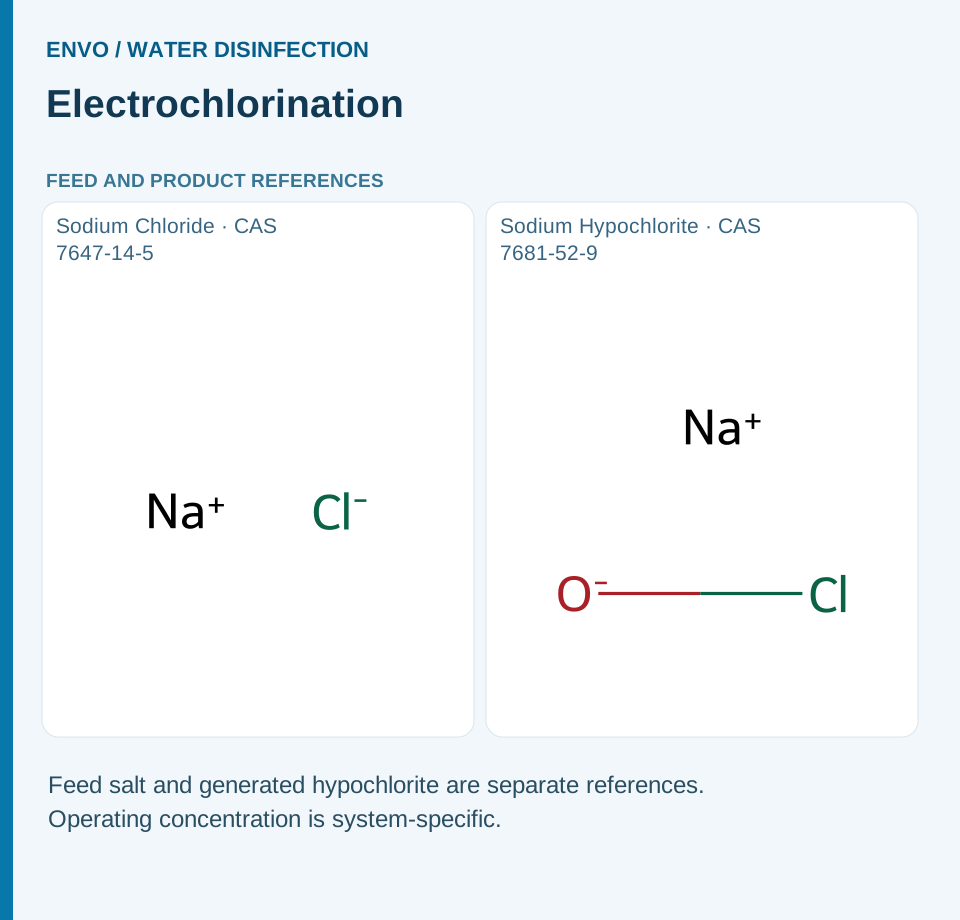
A formulated-product option requires clear arrangements for product quality, delivery and storage. An on-site generation option requires verification of raw materials, equipment and the generated product. Each has its own chain of responsibility; neither should simply be promoted as always cheaper or more reliable. If the customer lacks operating resources, feasibility must consider maintenance capability as well as equipment investment.
The final output can be a conditional comparison table identifying conclusions supported by current information, missing actual quotations and water-quality data, and who will supply them. Recompare those variables if load or supply conditions change. This supports procurement rather than turning a technology description into an unsupported project-cost savings promise. Keep historical budgets separate from current quotations to avoid carrying old cost assumptions into new project conditions.
Explore further
Does a low electricity cost mean on-site generation is more economical?
Equipment, raw materials, maintenance and operating conditions also need to be included in the assessment.
Is comparison of available-chlorine cost alone sufficient?
It is one parameter; generated-product quality, reliability and complete supporting provisions are also needed.
References
This article draws on publicly available technical information. Third-party sources do not establish ENVO product approvals, field testing or project experience. Confirm each use against actual supply documents and site conditions.