Identify water by its catchment source
Map roofs, roads, landscaped areas and places where other waters may enter, recording collection facilities and flows. Do not merge different sources merely by total stored volume. Professionals should determine whether areas with potential special contamination can enter reuse. Disinfection cannot replace identification and treatment of chemical or other contaminants.
Catchment inventories can include roof materials, nearby contaminating activities, recent repairs and possible mixing of rainwater with surface runoff. Reassess water-data representativeness after reroofing or nearby construction. First-flush diversion is one source-management measure, not proof that subsequent rainwater meets every requirement for any use.
Check the interface between pretreatment and disinfection equipment
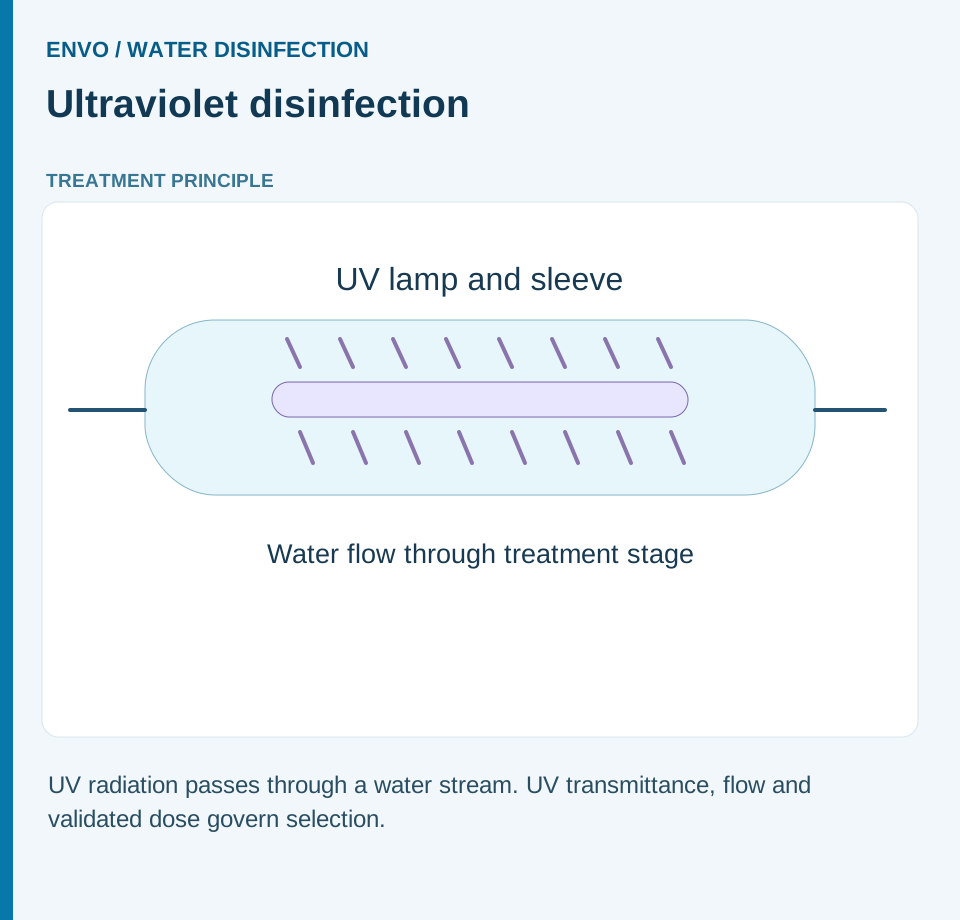
Record screens, settling, filtration, storage and bypasses, defining when water enters disinfection. A clear-water rated flow alone does not establish rainwater suitability. EPA's source-and-use-based reuse framework helps organize this interface, but project validation must establish process and control ranges.
Record rainfall events instead of taking only one sample
Incoming water may change over the course of rainfall and with dry intervals, so the testing plan should represent the conditions relevant to the project. Qualified personnel should determine sampling and assessment methods, recording rainfall, maintenance of collection facilities and tank condition. A stored-water sample taken on a dry day may not represent equipment influent during the next rain, and results from one storm cannot characterize the whole year.
Confirm actual use and contact after storage
Rainwater irrigation, toilet flushing and cleaning need different requirements. Add final outlets, usage periods and possible personnel contact to diagrams rather than stop review before the tank. Explicitly restrict unsupported uses; natural rainwater or installed disinfection equipment cannot substitute for evidence.
Provide inquiry information with clearly defined scope
Submit catchment type, pretreatment, event-related water-quality ranges, storage and uses rather than daily capacity alone. Proposals should define acceptable influent, monitoring and abnormal-condition management. This reveals whether source control or filtration needs improvement first and avoids discovering after purchase that equipment conditions do not match the site. Actual performance still needs site validation.
Explore further
Can rooftop and ground-level rainwater be treated as equivalent?
No. Source conditions and possible contamination differ and require separate checks.
Can all collected water be reused if disinfection equipment is installed?
No. Confirm the source, pretreatment, equipment scope and final use.
References
This article draws on publicly available technical information. Third-party sources do not establish ENVO product approvals, field testing or project experience. Confirm each use against actual supply documents and site conditions.