Assess flow during the busiest and quietest periods
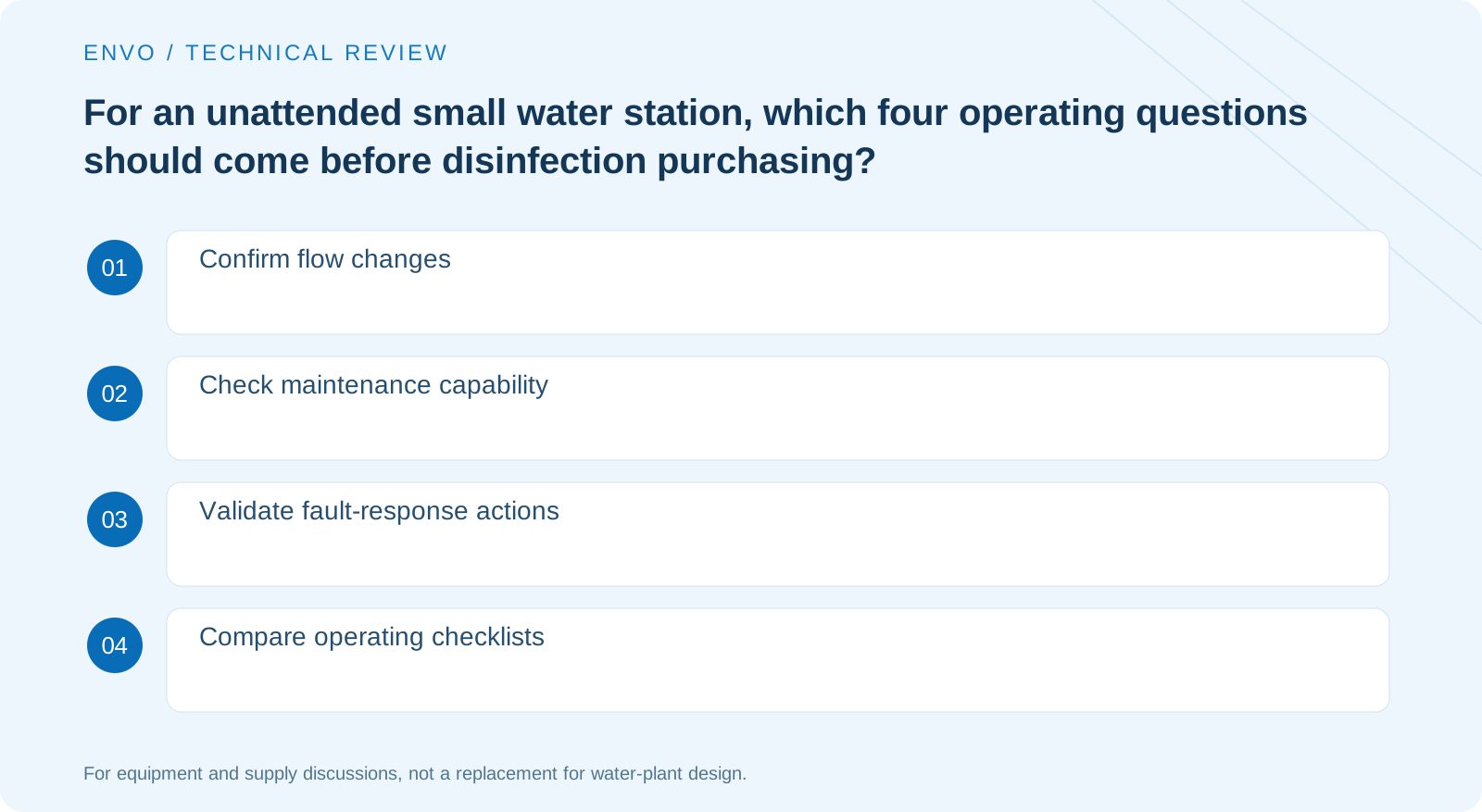
Compile normal supply, peak demand, nighttime low flow and restart conditions after shutdown. Daily capacity alone may not reveal instantaneous treatment and shutdown-protection needs. Use an existing week's records to identify obvious variation before deciding whether more measurement is needed. Fixed pump frequency or rated equipment capacity is not automatically a year-round operating program.
Confirm who can perform testing and replenish consumables
List available site tests, instruments, reagents, personnel training and attendance frequency. WHO discusses treatment technologies and conditions separately; small equipment size does not remove validation requirements. Where replenishment, cleaning or consumable replacement is needed, state stock locations and actual delivery times. If only external personnel can perform maintenance, include water-supply arrangements during the wait in comparisons.
Test automation claims against fault scenarios
Ask suppliers how the system behaves during power loss, chemical depletion, sensor faults and flow outside design limits. Request testable alarm and interlock logic rather than a fully automatic claim. Professionals can simulate permitted fault conditions during acceptance to verify actions, notifications and recovery. Specify who receives alerts and who may stop supply when nobody is on site.
Turn a one-time cost estimate into an operating-cost checklist
Compare equipment, consumables, reagents, spare parts, travel and maintenance separately using available facts rather than inventing lifetime costs. If a route's operating requirements cannot be maintained, low purchase price alone should not determine selection. Staffing plans and water-quality information help suppliers exclude impractical configurations and reduce repeated redesign.
Test the plan through an actual shift handover
Before handover, actual shift personnel can work through the documentation checklist: where alarms appear, how to find maintenance documents, who replenishes reagents and whether technical contacts remain valid. This check does not require deliberate interruption of supply and must not bypass equipment protections. If critical information exists only on a commissioning technician's phone, convert it into a formal handover record. Automated equipment must fit actual staffing arrangements; a customer's promise that someone will take responsibility later does not establish sustained operating capability.
Explore further
Can testing be omitted during unattended operation?
No. Automation requires corresponding monitoring, alarms and manual review arrangements.
Does low daily water consumption mean low risk?
That conclusion is not justified; stagnation, intermittent use and maintenance capability also affect the proposal.
References
This article draws on publicly available technical information. Third-party sources do not establish ENVO product approvals, field testing or project experience. Confirm each use against actual supply documents and site conditions.