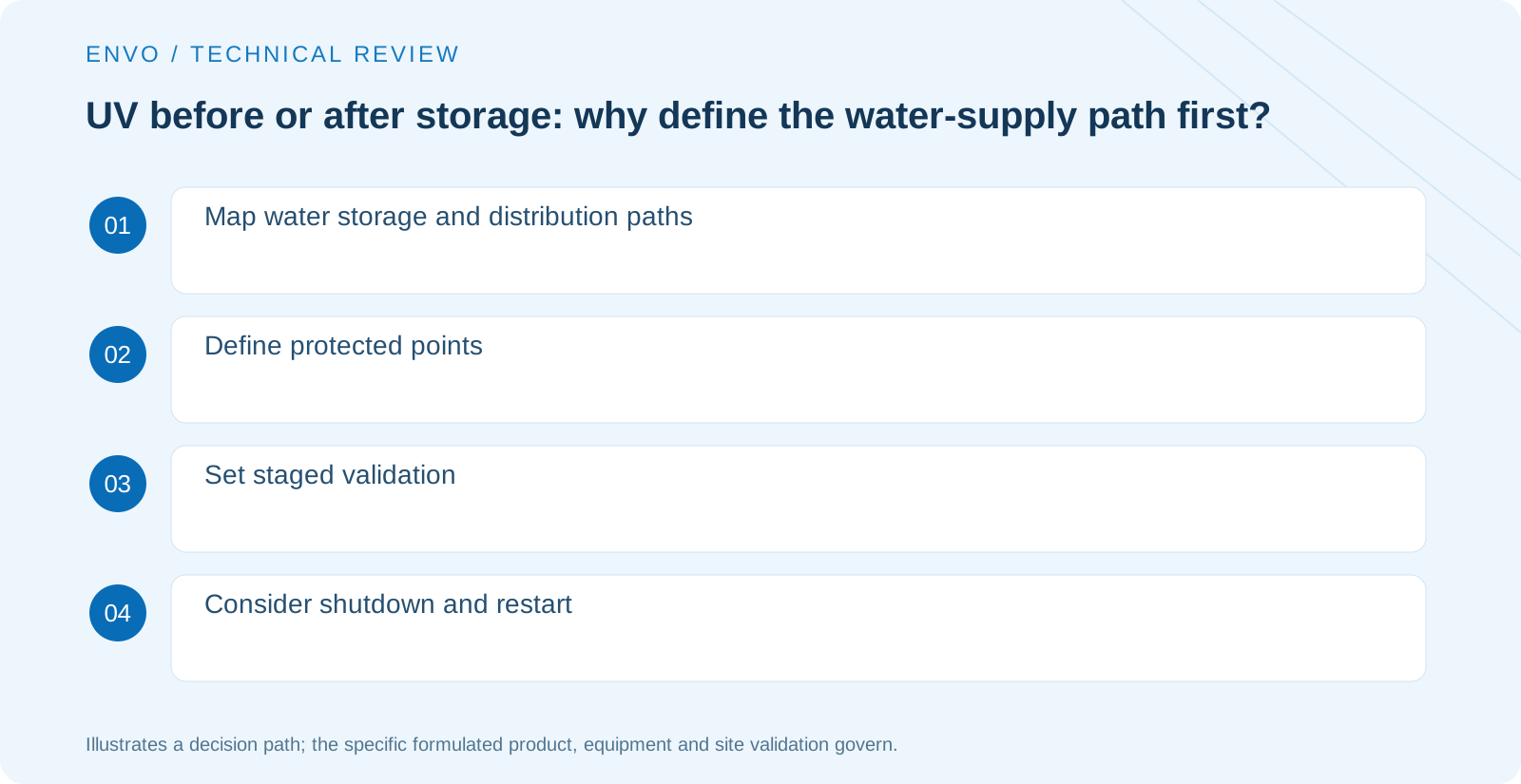
Map the complete path after water treatment
Trace the route from the UV outlet through tanks, returns, pumps and distribution branches to points of use, marking open connections and low-use areas. Supplying only reactor-inlet parameters during procurement overlooks potential downstream hygiene risks.
Identify the points requiring protection
Controlling the load entering a tank and controlling water leaving it for points of use may require different configurations. No universally optimal location is prescribed here because actual flow, circulation and maintenance conditions differ. The design should explain why each location is covered or which other barrier addresses it.
Compare upstream and downstream monitoring results
When evaluating the program, distinguish sampling at equipment inlets, outlets and critical endpoints, recording flow and time. Abnormalities after a tank should not all be attributed to UV equipment; abnormalities at the outlet cannot be resolved on paper by substituting good tank management for equipment validation.
Include maintenance and shutdown states in drawings
Clearly manage water-supply arrangements during equipment shutdown, bypass, cleaning and return to use. DWI and EPA guidance emphasizes appropriate equipment and validation scope; operating records cannot be omitted simply because no chemicals are used. Procurement scope should cover the reactor and its actual connections within the system.
First identify which part of the water supply users actually drink or use
Draw a continuous route from the UV outlet through the tank inlet and outlet to the final point of use, marking recirculation and stagnant branches. Conditions as water enters UV treatment may differ from those at final use, and tank hygiene and turnover also have independent roles. Procurement requirements should therefore specify the final use location rather than simply requesting installation of a UV unit.
Sampling plans should distinguish validation of the UV outlet from assessment of final-use water. If outlet and remote results differ, investigate tanks, connections and operating history. Remote anomalies do not alone prove UV failure, while normal outlet results do not negate post-storage problems. Mark stages without data on the diagram to guide the next review.
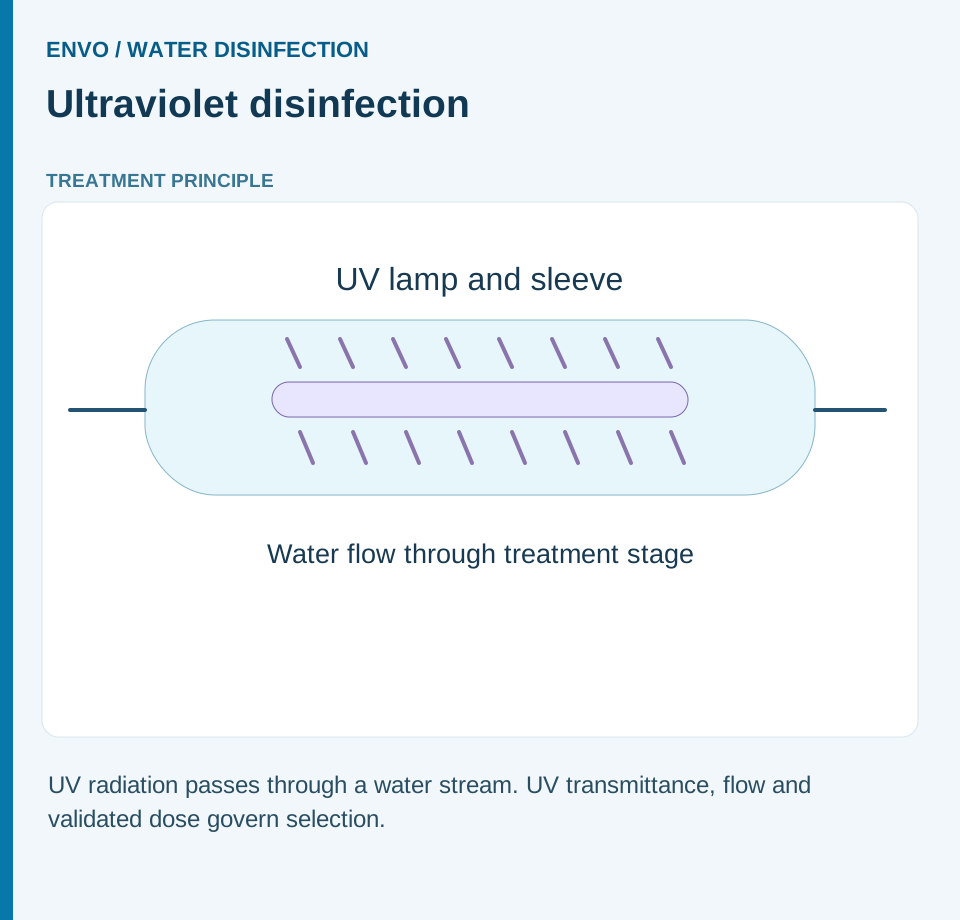
DWI information states that UV does not provide a persistent disinfectant residual. Include this in whole-circuit design, but it does not authorize casually adding another disinfectant. Water use, the system and professional assessment determine whether other barriers are needed. Handover should specify UV's treatment stage and storage/distribution responsibilities to avoid implying automatic protection of the entire line.
Explore further
Can UV-treated water be stored long term without management?
No. Downstream storage and distribution still require hygiene management.
Should it always be installed at the final endpoint?
No general rule applies. Design should reflect the complete water circuit and actual operating conditions.
References
This article draws on publicly available technical information. Third-party sources do not establish ENVO product approvals, field testing or project experience. Confirm each use against actual supply documents and site conditions.