
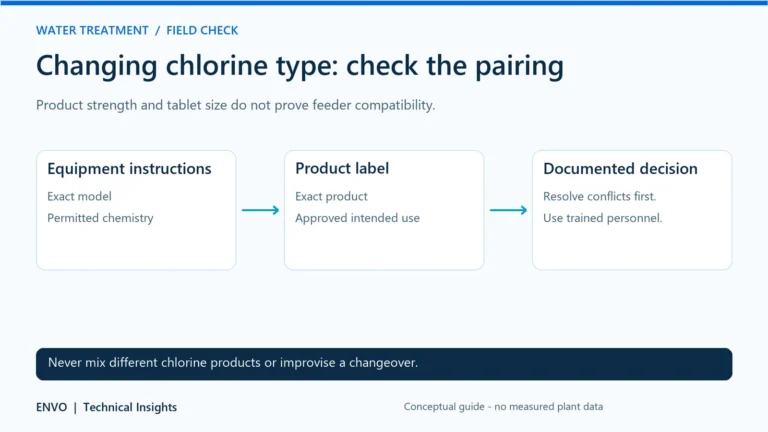
Do not treat trichlor and calcium hypochlorite as interchangeable feeder charges. A change of chlorine product begins with equipment approval, product labeling and safe handling arrangements. Available-chlorine content or a tablet diameter cannot establish compatibility with a feeder that previously contained a different chemical.
Identify the equipment before comparing products
Record the exact feeder model, its current instructions and the chemical history of the unit. Photograph the nameplate and permitted-chemical statement without opening or disturbing equipment. If the history is uncertain, obtain advice from the equipment manufacturer and a trained pool professional before any proposed change.
Pentair's Model 320 guide is a concrete example: it specifies permitted slow-dissolving tablet chemistry and prohibits calcium hypochlorite in that feeder. This is a model-specific restriction, not a claim about every feeder. Use the instructions for the actual installed unit.
Compare four separate approvals
| Approval question | Evidence to obtain | What is insufficient |
|---|---|---|
| Can the feeder use this chemistry? | Manufacturer instructions for the exact model | A similar-looking feeder or tablet |
| Is the product authorized for this use? | Current product label and destination-specific requirements | A generic TCCA brochure |
| Is the physical form suitable? | Permitted tablet form and the supplied product specification | Available-chlorine percentage alone |
| Can the proposed change be carried out safely? | Manufacturer-approved changeover or replacement arrangement | An improvised cleaning or mixing procedure |
Keep incompatible products apart
CDC's pool chemical safety guidance warns against mixing different pool chemicals, including different chlorine types, and emphasizes trained handling and product instructions. Do not top up one chemistry with another, combine residues or invent a cleaning mixture. Keep storage, handling equipment and product identification within the required safety arrangements.
An empty-looking feeder is not proof that it is ready for a different chemistry. This guide intentionally does not provide a conversion recipe. If a change is required, the manufacturer and a trained professional should determine whether the unit can be used, requires an approved procedure or must be replaced.
Compare the water-treatment implications separately
A hardware-compatible choice still needs a water-management review. Product chemistry affects which water-quality records and operating requirements are relevant. Keep that discussion distinct from the feeder compatibility decision. Do not choose an incompatible chemical because it appears to solve another water-balance concern.
Prepare a purchasing specification only after those decisions are documented. Include product identity, intended application, physical form, packaging, label requirements and the agreed equipment basis. Ask for documents for the supplied grade and destination rather than accepting a certificate copied from an unrelated product.
Document the decision, not just the replacement order
A clear record states the old and proposed product, equipment model, manufacturer response and the responsible professional’s approved plan. It should also identify who maintains the water-testing and operating records during the transition. Purchasing, operations and maintenance need the same product identity.
If paperwork conflicts, resolve the conflict before changing the chemical. A sales description, an old manual and a current product label may serve different purposes. An unverified assumption should remain an open question, not become a statement that the combination is safe.
Questions about changing chlorine types
Can tablets with the same size be substituted?
No compatibility conclusion follows from size alone. Chemistry, formulation, equipment approval and intended use all need confirmation. Similar appearance is not evidence of an approved substitution.
Does this mean calcium hypochlorite cannot be used in pools?
No. The issue is the suitability of the specific product, application and equipment combination. A restriction on one feeder must not be generalized into a claim about all pool-treatment systems.
Prepare a documented TCCA enquiry
Send the feeder model, permitted-chemical statement, current product label and intended destination. Review trichloroisocyanuric acid and pool-water treatment applications, or discuss the required product and documentation with ENVO. Product supply does not replace equipment approval.
Related technical guides
- Trichlor Tablets and Rising Cyanuric Acid: What to Track
- Trichlor Feeder Uses Fewer Tablets: Check Delivery First
Sources and scope
- Pentair, Model 320 feeder installation and operating guide, R24290 Rev D
- CDC, Pool Chemical Safety (June 2025)
Sources checked on 30 October 2026. The comparison framework and illustration are original ENVO editorial material. They are not a plant case study, a product performance guarantee or a substitute for the applicable product label, operating procedure and local requirements.
