
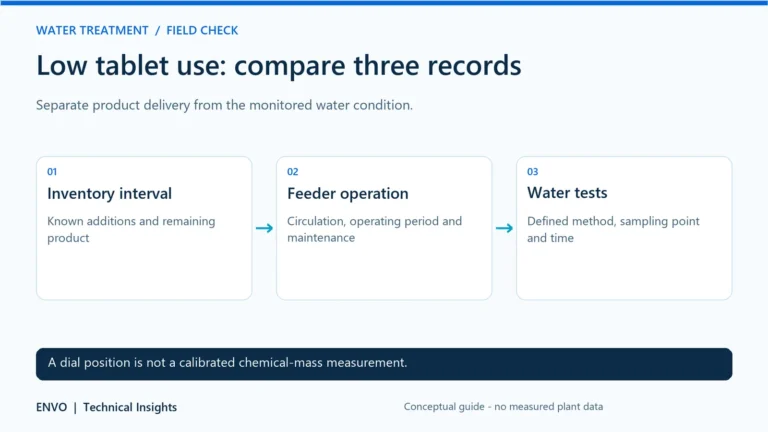
When a feeder uses fewer trichlor tablets, investigate delivery and operating history before declaring that the chemical is weak. Tablet consumption, feeder setting and a pool-water chlorine reading describe different parts of the system. Connect them with a time-based record rather than using one as a direct substitute for another.
Confirm the product and the equipment boundary
Record the feeder model, approved chemical, tablet form, product lot and the period being compared. Use the manufacturer’s current instructions for that equipment. Do not introduce a different chlorine type, break tablets to force a fit or improvise a chemical mixture while troubleshooting.
Pentair's Model 320 instructions illustrate why the equipment context matters: the manual specifies permitted chemistry and discusses feeder installation and flow arrangements. These details are specific to the model. A control position on that device is not a universal mass-delivery measurement for every installation.
Separate three records
| Record | What it can show | What it does not prove |
|---|---|---|
| Product inventory over a defined period | An estimate of chemical use when additions and remaining material are known | The chlorine residual at a particular pool location |
| Feeder and circulation operating history | When the delivery arrangement was available | Actual delivery inferred solely from a dial setting |
| Water-test results | The monitored condition at defined times and locations | Whether low delivery, changing demand or testing caused the difference |
Reconstruct a representative operating interval
Choose an interval with a clear beginning and end. Note product additions, the way remaining material was assessed, circulation schedules and relevant maintenance. Avoid comparing an uninterrupted period with one containing a shutdown without identifying the difference.
Use appropriate operating records rather than unsafe manual inspection of equipment. Any opening, isolation, servicing or restart must follow the actual manufacturer instructions and be performed by trained personnel. This guide is a diagnostic record, not a feeder-service procedure.
Review delivery and water demand independently
If the usage record changes, ask the equipment professional to examine the approved delivery arrangement and its operating conditions. If measured water quality changes while usage appears similar, investigate the water-testing and operating context as well. Neither observation alone identifies a failed tablet batch.
CDC's pool-water testing guidance explains that chlorine concentration is affected by conditions in the water and that routine measurement matters. Keep the relevant pH and stabilizer context in the record. Use the limits and response requirements that apply to the venue rather than a historical equipment brochure’s example.
Make a batch-quality comparison traceable
If a product-quality concern remains after the delivery review, preserve the lot identity and the applicable product documents. Compare approved products under a controlled, equipment-appropriate plan. Record differences in supplied form and handling history. Do not create a home-made dissolution or reactivity test involving concentrated pool chemicals.
A receiving sample, a supplier COA and a plant operating log answer different questions. Ask which evidence would establish the specific concern. Keep retained-sample handling within the product instructions and the agreed quality procedure; an undocumented visual judgment is not a substitute for the relevant analysis.
Questions about low tablet consumption
Does an unchanged feeder setting mean the same chemical delivery?
Not necessarily. Treat the setting as an operating record, not a calibrated chemical-mass result. Verify the relationship for the actual equipment and conditions through the approved operating and maintenance process.
Should more tablets be loaded whenever chlorine is low?
Follow the venue’s approved corrective-action procedure. First identify whether the issue involves delivery, water demand, test interpretation or another condition. Loading more material does not establish which problem has been addressed.
Prepare a focused troubleshooting enquiry
Include the feeder model, product label and lot, inventory interval, circulation history and time-matched water results. See trichlor product information and pool applications, or send ENVO the product and documentation requirements. Equipment servicing and operational approval remain with the responsible professional.
Related technical guides
- Switching Trichlor and Cal-Hypo: Check the Feeder First
- Trichlor Tablets and Rising Cyanuric Acid: What to Track
Sources and scope
- Pentair, Model 320 feeder installation and operating guide, R24290 Rev D
- CDC, Home Pool and Hot Tub Water Treatment and Testing
Sources checked on 30 October 2026. The comparison framework and illustration are original ENVO editorial material. They are not a plant case study, a product performance guarantee or a substitute for the applicable product label, operating procedure and local requirements.
