Establish exactly what will be delivered
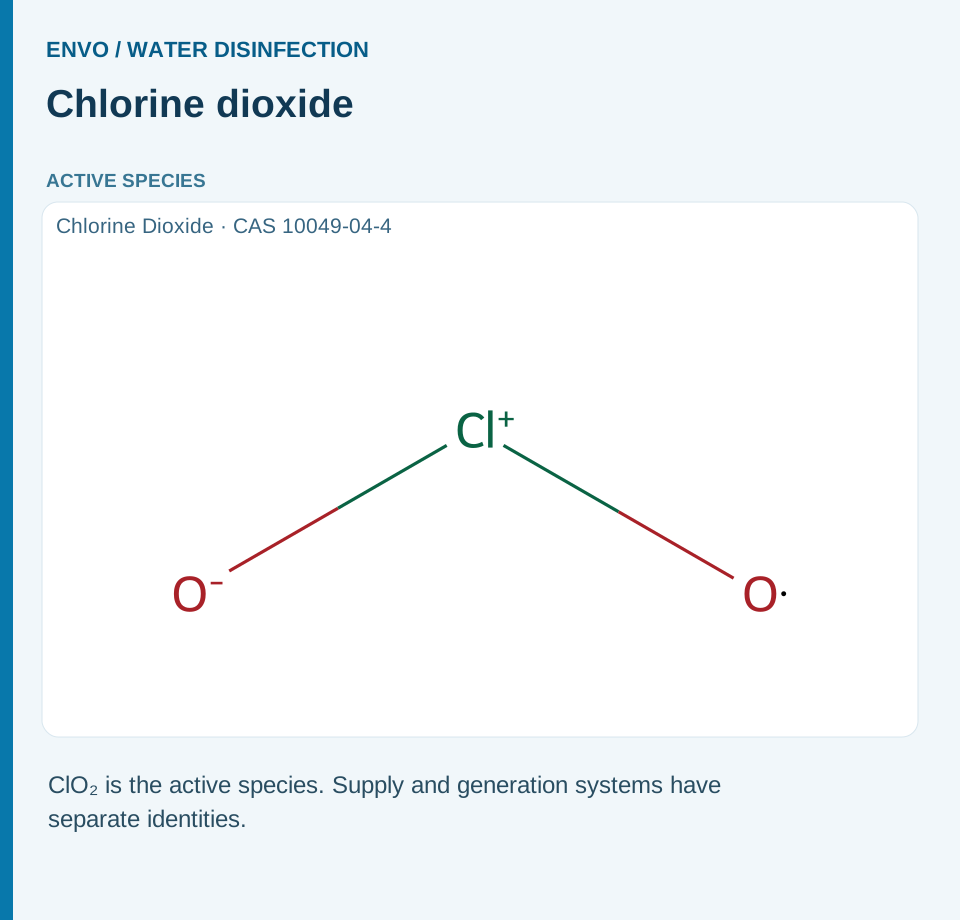
Ask the supplier for the complete name, physical form, component identification, intended-use label and instructions. Establish whether delivery is a formulated product used according to its label or a precursor requiring compatible equipment. Marketing terms such as stabilized cannot replace composition and operating conditions, and chlorine dioxide on the package does not alone identify the active species.
An inquiry form can distinguish formulated product, precursor, and generation-and-dosing system, with explicit confirmation of the included equipment, consumables, testing and service. This establishes whether quotations cover the same supply scope.
Match precursor quality to the specific equipment
EPA technical information on chlorate explains that chlorine dioxide for drinking-water treatment is typically generated on site, and both the generation process and raw-material impurities can affect by-products. Precursor purchases should therefore be checked against generator requirements, composition and impurity specifications, packaging and batch documents. A raw-material name alone does not justify replacing an existing supply.
A precursor is not itself a formulated product that has already performed disinfection. The manufacturer's documents and project design must establish the validated system used by the equipment. Raw materials for different systems must not be interchanged without that basis.
Evaluate equipment parameters within the treatment system
Equipment inquiries should state the application, flow and variability, dosing points, contact facilities, site utilities and operating arrangements. Nameplate generation capacity alone does not establish project treatment capacity; define the actual operating range, control method and testing approach.
Acceptance should cover installation documents, metering and monitoring, alarms and interlocks, operator training, maintenance spares and handover records. Identify during quotation which items belong to the equipment supplier and which require site engineering.
Test the active species and by-products separately
Chlorine dioxide, chlorite and chlorate are different analytes. EPA information links chlorate to generation, storage or subsequent water-use conditions, so the analytical plan must follow the actual treatment process. A single total oxidizing measurement cannot establish all aspects of quality.
The buyer should confirm what each method measures, potential interference from other components, and the measurements required at generation, contact and final-use locations. Commissioning records should retain water quality, flow and sampling locations so results can be interpreted.
Compare the complete delivery scope and costs
A formulated-product option emphasizes delivered quality, shelf life, storage, transport and application equipment. A precursor option emphasizes specified quality, replenishment and batch control. A generation system also involves maintenance, testing, spares and staffing. Compare their total costs, but do not directly equate the price of a drum of precursor with the price of complete system support.
The final document package should explain who supplies what, the acceptance specifications, the water quality used for validation and whom to contact when problems occur. Clear supply responsibilities are fundamental to an actionable chlorine dioxide purchase.
Explore further
Can sodium chlorite directly replace a formulated chlorine dioxide product?
No. It functions as a precursor in relevant systems and must match the specific equipment or product instructions and intended-use requirements.
Does a generator's nameplate capacity prove final disinfection performance?
Not by itself. Validation must also address water quality, contact facilities, actual operation and effluent testing.
References
This article draws on publicly available technical information. Third-party sources do not establish ENVO product approvals, field testing or project experience. Confirm each use against actual supply documents and site conditions.