First list the two acceptance questions
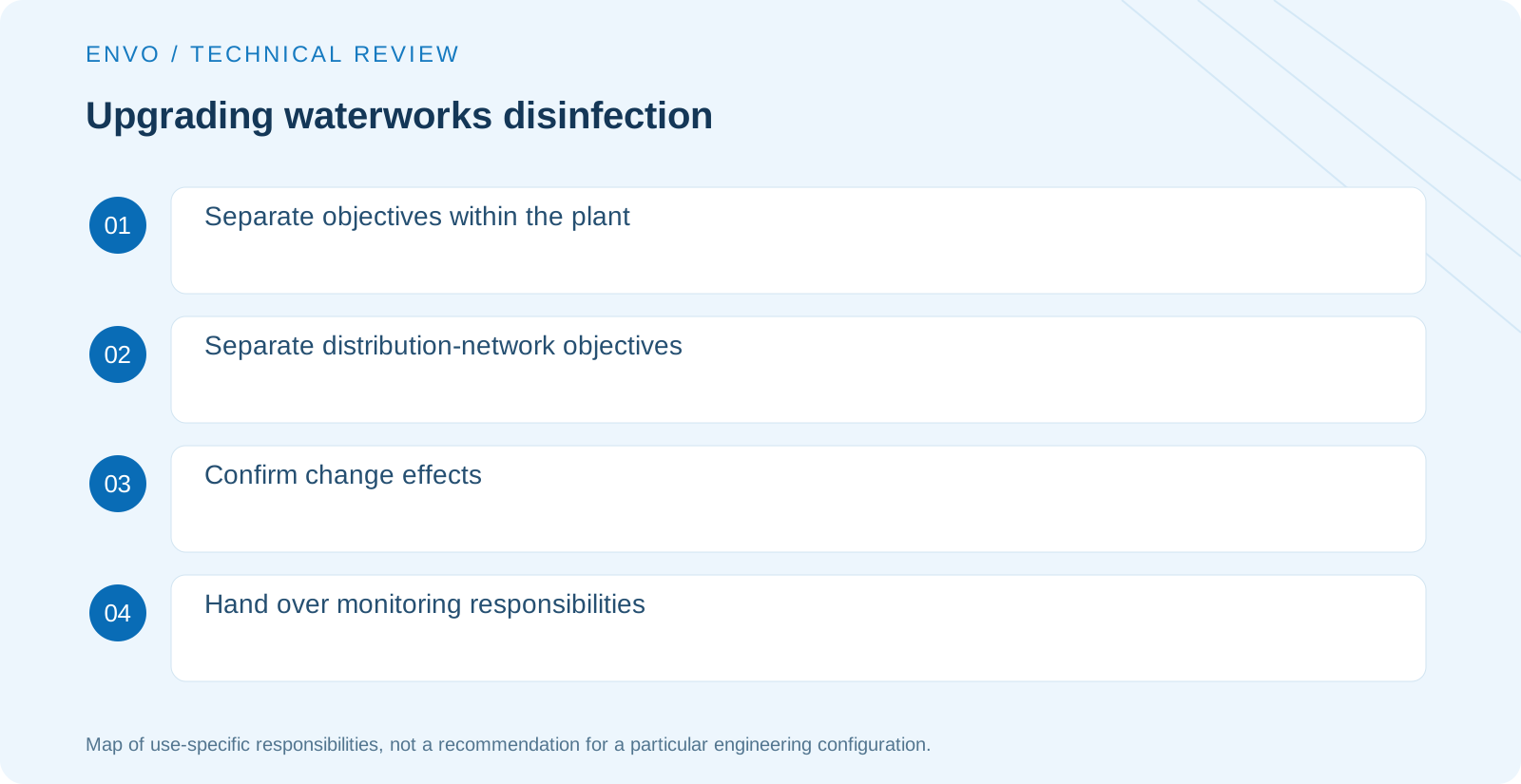
First determine how treatment targets are verified before water enters supply; second, how quality is monitored and maintained after storage and distribution. EPA's explanation of primary and secondary disinfection reflects this division. Proposal tables should separately identify assessment locations, monitoring parameters and responsible people for each objective rather than use one disinfection passed field for all delivery requirements.
Compare downstream effects as well as reaction speed
Disinfection approaches differ in residual persistence and monitoring needs, and selection must consider distribution conditions. Ask each candidate to explain control after water leaves the plant, points needing continuous records, and water-quality or material issues requiring review during conversion. Comparing these answers in one table better supports operational decisions than comparing advertised kill speeds alone.
Specify who confirms switching
Treatment plants, distribution operators, testing organizations and customers with specialized water uses need change notifications. Start with an impact list: equipment depending on the current disinfection method, users requiring additional treatment and anomaly-feedback routes. This article does not recommend direct changes to chemical combinations or provide on-site generation formulations. System conversion requires professional design and applicable management requirements and should be documented as a process change, not merely a substitute purchase.
Link supply documentation to operational handover
Alongside purchasing specifications, agree technical-document versions, applicable uses, metering and monitoring support, and commissioning records. Reviewing plant and remote data together helps distinguish chemical issues, distribution problems and changing demand. Establish a handover sheet identifying monitoring, response and restart-approval responsibilities so water-quality management continues after supply is complete.
Maintain a shared response record for interface problems
Plant and distribution-network teams can share an incident number while separately recording the discovery location, notification time, available test results and outstanding checks. This preserves both perspectives and avoids treating one normal upstream test as proof that a downstream anomaly has been ruled out. If a supplier participates, clarify whether its advice explains the product, supplies monitoring information or recommends further engineering review. The responsible team should consolidate the information into traceable tasks, reducing repeated referrals at the boundary between supply and operations.
Explore further
Must primary and secondary disinfection use two different chemicals?
Not necessarily. This refers to treatment responsibilities; the specific process depends on the water source, system and applicable requirements.
Is a longer-lasting residual always better?
This cannot be judged alone; also check the primary treatment objective, monitoring capability, downstream uses and material effects.
References
This article draws on publicly available technical information. Third-party sources do not establish ENVO product approvals, field testing or project experience. Confirm each use against actual supply documents and site conditions.