
Total chlorine is detected but distal management remains uncontrolled
Check species, water age, ammonia nitrogen and nitrification.
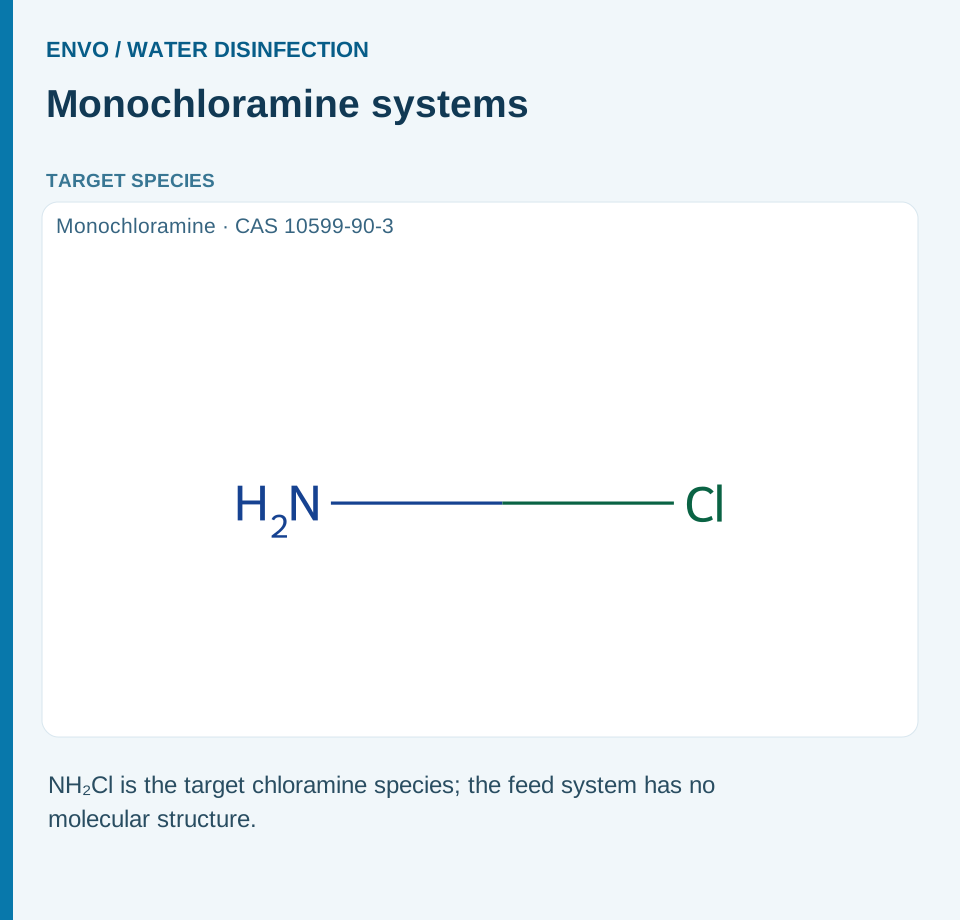
Equipment and engineered systems / Engineered system
Engineered monochloramine systems · NH₂Cl systems
For engineered or approved secondary disinfection of water supplies and specific process applications. Chemical species control, nitrification management and distal-point monitoring are central; this does not mean arbitrary on-site mixing of chlorine and ammonia.
An engineered candidate for residual maintenance in water storage/distribution and specific industrial processes.
Bring an existing model or purchasing specification directly into the discussion.
Identity and physical form identify the product; specific concentration, grade, packaging and uses are governed by mutually confirmed formulated-product documents.
01 / Engineering compatibility
An engineered approach to controlled monochloramine formation and management; total chloramines are not simply monochloramine.
An engineered system combining metering, species and water-quality monitoring, contact and operational management.
02 / Specification selection
| Items to confirm | Relevance to purchasing and use |
|---|---|
| Monochloramine speciation and free ammonia | Prevent total chlorine readings from obscuring actual species. |
| Nitrification, water age and distal points | Establish ongoing operating and monitoring requirements. |
| Sensitive downstream uses | Dialysis and other processes require corresponding removal barriers. |
Include parameters, test methods and acceptance checkpoints in purchasing requirements to compare specifications.
03 / Applications and limits
These are starting points for conditional verification. Specific product suitability still requires joint confirmation through product documents, operating conditions and destination requirements.
04 / Common challenges
Check species, water age, ammonia nitrogen and nitrification.
Review the water supplier and system design together.
Specify dedicated removal and monitoring requirements.
05 / Documents and evidence
These documents support technical categories and use limits, not ENVO certifications or customer cases. Verification date: 2026-10-26.
06 / Frequently asked questions
No. Use monitoring capable of supporting species assessment.
First complete engineering, authorization and water-supply coordination assessments.
Assess against target microorganisms and the complete treatment process.
Related selection options
Related products are not necessarily direct substitutes; verify each intended use.
 Sample photograph
NaClO
A chlorination chemical used with liquid metering systems and residual monitoring. Purchasing priorities are available chlorine at delivery, storage turnover and impurity requirements for the intended use.
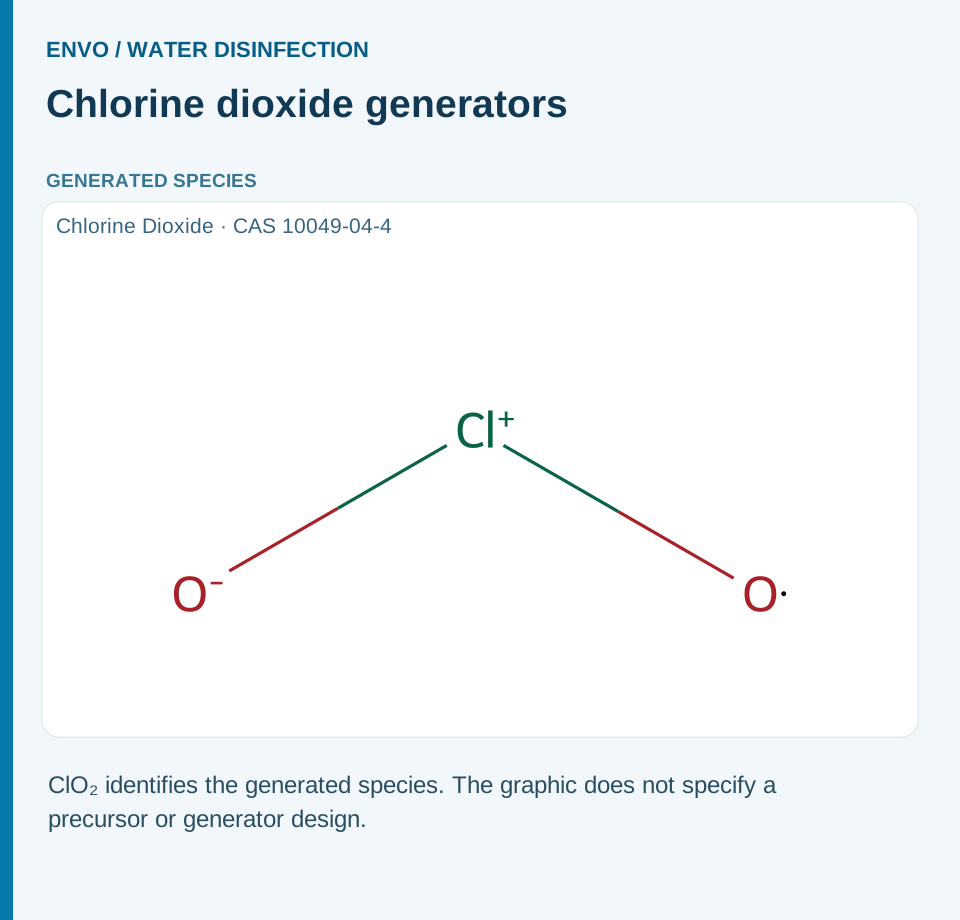 Generated species
ClO₂ generation
An engineered system that produces chlorine dioxide using equipment-approved precursors and processes. Purchasing verification should cover precursor purity, product identity, by-products, dosing points, operation and maintenance together.
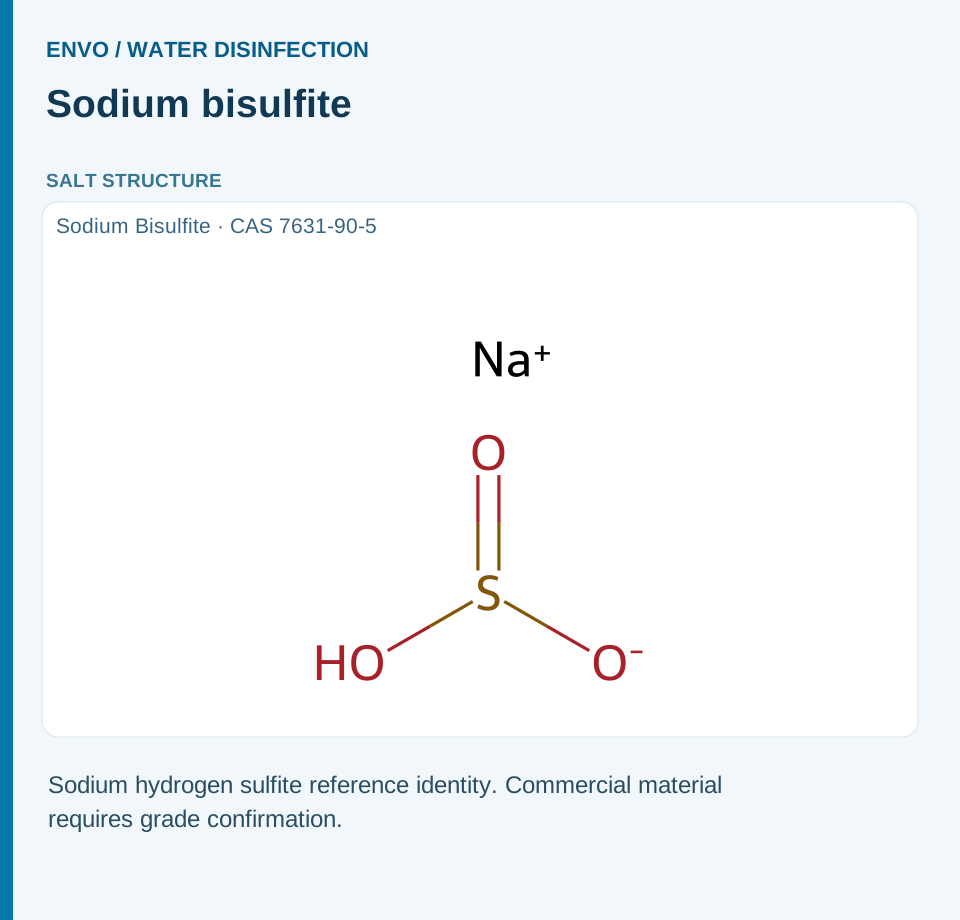 Salt structure
NaHSO₃
A reducing auxiliary for engineered dechlorination or specific membrane maintenance procedures. Define the substance to be removed and the endpoint, while considering the effects of excess reducing agent on dissolved oxygen, pH and other chemicals.

Total chlorine alone does not establish individual chloramine species or whole-distribution-system hygiene. Assess with appropriate methods, water age and relevant water-quality parameters.
Read and verify →
A distal residual decline should not be attributed solely to underdosing. Investigate high water age, free ammonia, temperature and deposits alongside nitrification-related parameters.
Read and verify →
Public-water disinfection and specialized equipment feedwater requirements differ. Identify sensitive downstream uses and verify dedicated protective barriers before changing supply treatment.
Read and verify →ENVO · Purchasing and application support
Start with a product name, current model, water-quality report or destination documentation requirements.