
Similar bromine tablets give different readings and delivery rates
Compare active ingredients, available-halogen bases and equipment parameters.
Bromine products / Chemical
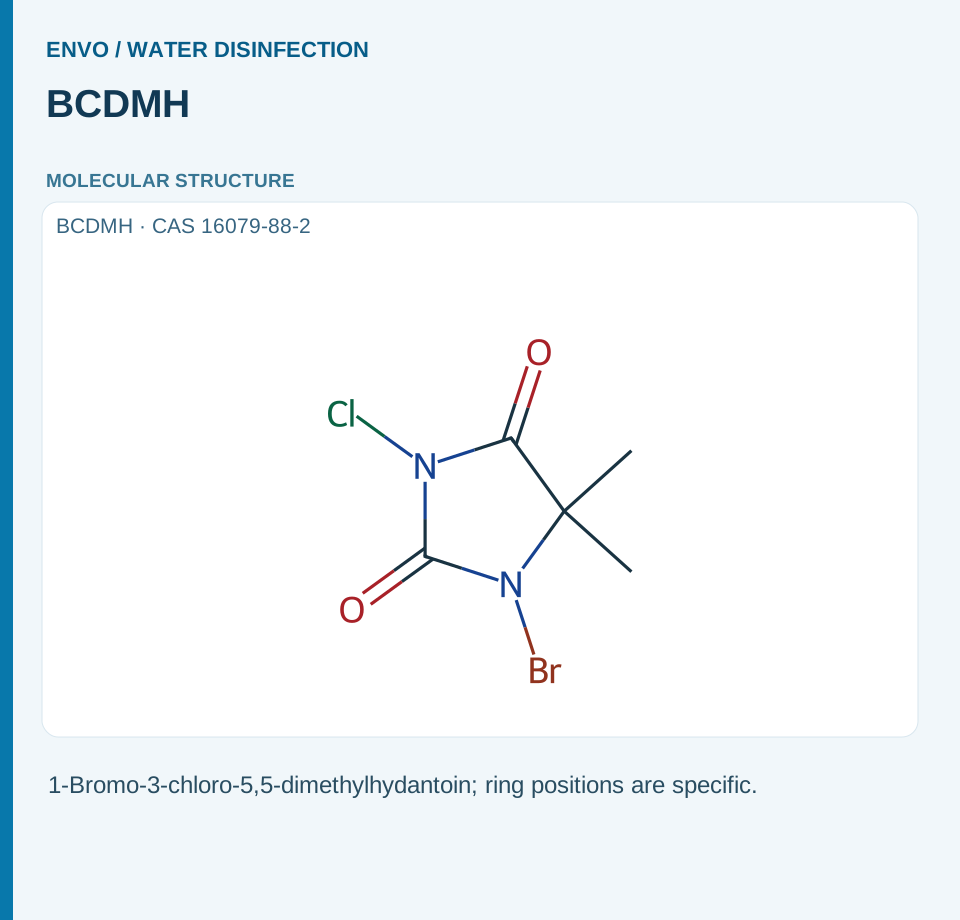
Bromochlorodimethylhydantoin · BCDMH
For selecting formulated products with defined uses in spas, pools and industrial recirculating water. Compare available halogen, finished-product composition and feeder compatibility to identify a specification matching the existing system.
A bromine-based disinfection ingredient for pool and industrial-water products with defined uses.
Bring an existing model or purchasing specification directly into the discussion.
Identity and physical form identify the product; specific concentration, grade, packaging and uses are governed by mutually confirmed formulated-product documents.
01 / Product and applications
1-Bromo-3-chloro-5,5-dimethylhydantoin; commercial products may contain a single active or a halogenated hydantoin blend.
Solid products are available; granules or tablets, dimensions and auxiliaries must match actual supply and feeder requirements.
This page refers to 1-bromo-3-chloro-5,5-dimethylhydantoin. PubChem lists 16079-88-2 in its current record and 32718-18-6 as a deprecated CAS; historical EPA documents include both. Both are retained for searching, not presented without explanation as interchangeable identifiers for all supplied products. Verify the original manufacturer's SDS and registration label.
02 / Specification selection
| Items to confirm | Relevance to purchasing and use |
|---|---|
| Available halogen and reporting basis | Distinguish expression as chlorine, as bromine and ingredient content. |
| Product composition and hydantoin type | Prevent incorrect substitution of different blended formulations. |
| Feeder and actual water temperature and flow | Validate stable chemical delivery. |
| Residual monitoring and use label | Ensure the analytical basis matches the product and system. |
Include parameters, test methods and acceptance checkpoints in purchasing requirements to compare specifications.
03 / Applications and limits
These are starting points for conditional verification. Specific product suitability still requires joint confirmation through product documents, operating conditions and destination requirements.
04 / Common challenges
Compare active ingredients, available-halogen bases and equipment parameters.
Check water temperature, circulation, load and actual product use.
Reverify industrial uses, corrosion and blowdown requirements.
05 / Documents and evidence
These documents support technical categories and use limits, not ENVO certifications or customer cases. Verification date: 2026-10-26.
Material photographs are appearance references only and do not correspond to ENVO batches or packaging specifications; image-license status is retained in the local usage register.
06 / Frequently asked questions
Compare composition, delivery capacity, test methods and uses; they are not directly interchangeable.
Also consider pH, circulation, microbiology and maintenance records.
Sodium bromide is usually a precursor requiring a matching system, not a direct substitute for this product type.
Related selection options
Related products are not necessarily direct substitutes; verify each intended use.
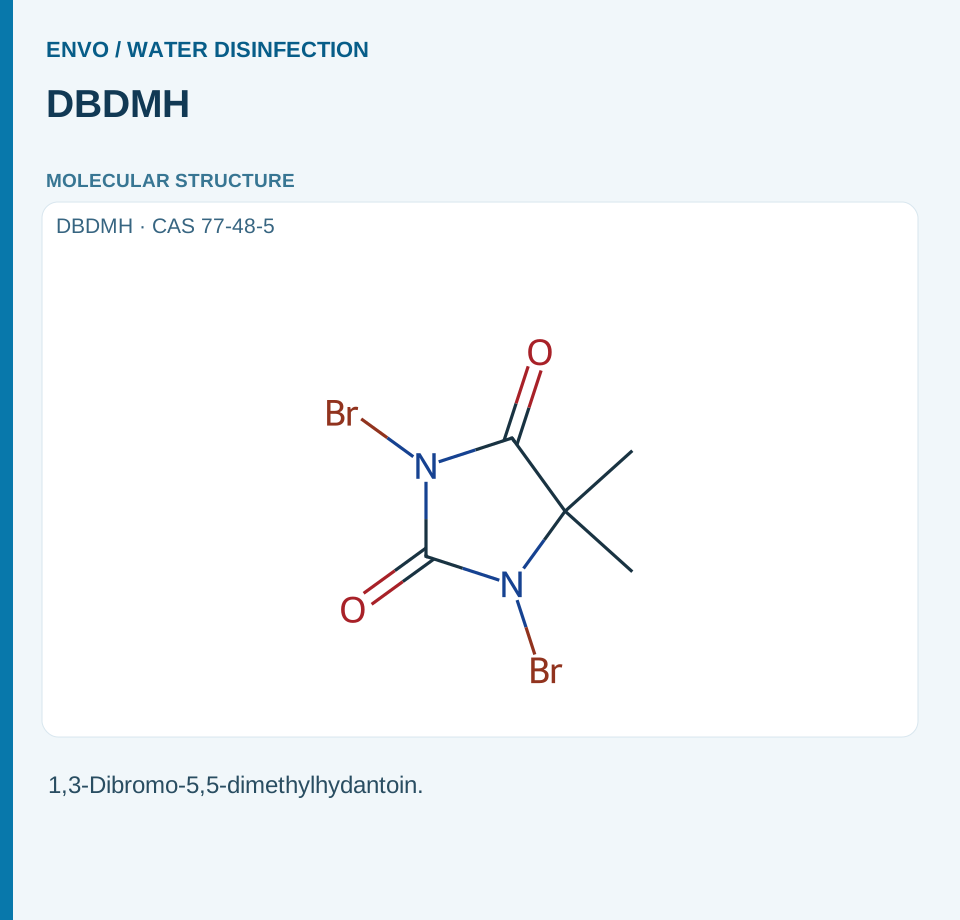 Molecular structure
DBDMH
A solid bromine approach using dibromodimethylhydantoin as the active ingredient. Public manufacturer documentation supports technical uses in pool and industrial water; the specific formulated product must still be checked against its current label and equipment.
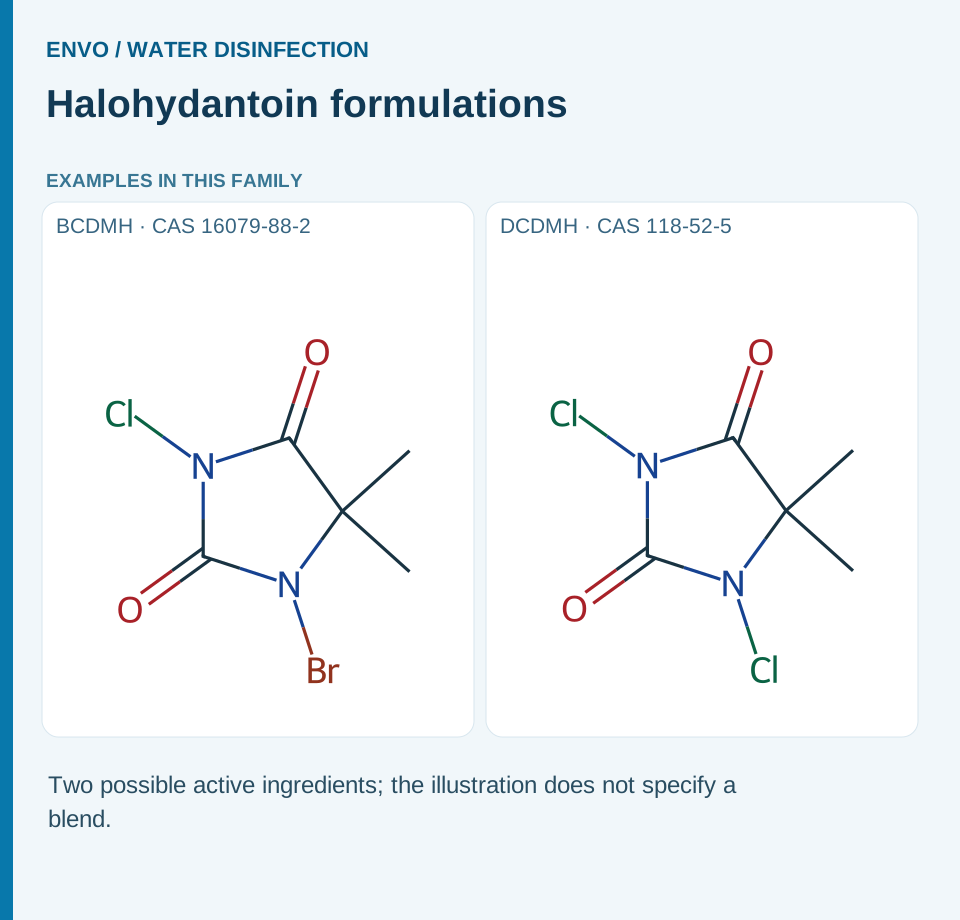 Examples in this family
Hydantoin blends
A formulated product category containing specific halogenated hydantoins such as BCDMH and DCDMH. Verify purchasing requirements against the complete product label; a blend's uses cannot be assigned to each individual raw material.
 Sample photograph
NaBr
A bromine source for specific active bromine systems. Sodium bromide content is not equivalent to available bromine disinfection capacity; verify the complete system, raw-material specification and final use together.
BCDMH product content, available halogen and water residuals are different parameters. Before comparing quotations and reports, align chemical identity, parameter names and reporting bases, then discuss numerical differences.
Read and verify →
Averages can hide peaks and troughs. Once BCDMH is part of a spa or hot-tub program, focus on monitoring and response during load changes rather than retaining only one daily average result.
Read and verify →
BCDMH and TCCA have different chemical structures, so cyanuric acid management rules cannot simply be applied to hydantoin systems. Absence of the same component does not remove the need to manage long-term water quality, makeup and discharge, or product restrictions.
Read and verify →ENVO · Purchasing and application support
Start with a product name, current model, water-quality report or destination documentation requirements.